

Question
Gramps,
In Daniel 10, it says that a “Prince of Persia” delayed the message that Daniel should have received by 21 days, and that Michael had to come to help. I know the main message of these verses is that our prayers are heard and will be answered, but who is the Prince of Persia, and how could they stop a message from heaven? Was it Satan? Other faiths interpret this part of Daniel as a glimpse into an ever-raging spiritual battle; does our doctrine support this too? Help please!
Caitie
Answer
Caitie,
One of the fascinating things about the Old Testament is that every now and then we get a glimpse of what is happening behind the scenes in the spiritual world. Daniel 10 is one of those passages. It raises some interesting questions: Who was the Prince of Persia? Was he Satan or one of his followers? Could an evil spirit actually prevent a heavenly messenger from delivering a message? And does Latter-day Saint doctrine support the idea of an ongoing spiritual battle between the forces of good and evil?
The answer is yes! In fact, when we look at Daniel 10 through the teachings of The Church of Jesus Christ of Latter-day Saints, we find some interesting connections to other scriptures and to our understanding of the premortal conflict between Christ and Satan.
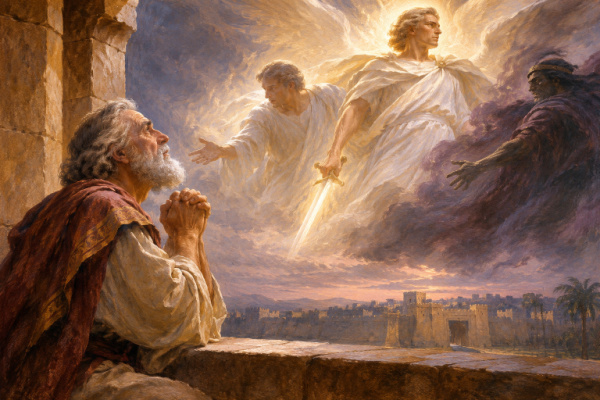
In Daniel 10, Daniel had been praying, fasting, and seeking understanding from the Lord for three weeks. He was concerned about what he had seen in a vision and wanted to understand its meaning. When a heavenly messenger finally appeared, he explained something Daniel probably wasn’t expecting. In Daniel 10:12–13, the messenger told him,
“Fear not, Daniel: for from the first day that thou didst set thine heart to understand, and to chasten thyself before thy God, thy words were heard, and I am come for thy words.”
He then explained that “the prince of the kingdom of Persia withstood me one and twenty days,” but Michael, one of the chief princes, came to help him.
Think about what the messenger was telling Daniel. His prayers had been heard from the very first day! God had not ignored him or forgotten him. A messenger had been sent, but that messenger encountered opposition that delayed his arrival. The source of that opposition was identified as the Prince of Persia.
This is where the passage becomes especially interesting. The messenger wasn’t simply describing a disagreement with an ordinary Persian king. The language suggests that something was happening in the spiritual realm. So, who was this Prince of Persia? Was it Satan?
According to the Church’s Old Testament Student Manual, the Prince of Persia was not a mortal ruler but rather the leader of evil spiritual forces that support the unrighteous dominion of the world’s kingdoms. The manual explains that “the prince was not a mortal leader in Persia but was the leader of the evil forces that supported the unrighteous dominion of the kingdoms of the world.”
The manual goes even further, suggesting that if this interpretation is correct, “then Satan or one of his host is the prince spoken of.” This is an important distinction. The scripture itself never gives us the individual’s exact identity, so we shouldn’t claim that it specifically names Satan. However, the Church’s instructional material does recognize that the Prince of Persia could have been Satan or one of the fallen spirits who followed him. In other words, Daniel was being shown that earthly events could involve spiritual opposition that isn’t always visible to us.
Another interesting aspect of this account is Michael’s involvement. Latter-day Saint doctrine identifies Michael as the premortal name of Adam, who is also known as the archangel. The Church’s Guide to the Scriptures identifies Michael as Adam and cites Daniel 10:13, in which Michael comes to help the heavenly messenger. This is significant because Michael appears in other scriptures connected with the conflict between good and evil. Revelation 12:7–9 describes a war in heaven in which Michael and his angels fight against Satan and his followers. Jude 1:9 also describes Michael contending with the devil.
We find another reference to this conflict in Doctrine and Covenants 88:112–115, which describes a future time when Michael will gather his armies and fight against Satan and his followers. When we put these passages together, we begin to see that Michael has an important role in God’s work and in opposing the forces of evil. His appearance in Daniel 10 isn’t an isolated detail; it fits into a much larger scriptural picture of the spiritual conflict that has existed since before the creation of this earth.
This brings us to another question: Does Latter-day Saint doctrine teach that there is an ongoing spiritual war? Absolutely! The conflict between good and evil is central to our understanding of the plan of salvation. We believe that it began in the premortal existence when Satan rebelled against Heavenly Father’s plan and sought to take away the agency of God’s children. He was cast out of heaven, along with those who followed him (Moses 4:1–4; Revelation 12:7–9). However, being cast out did not mean that Satan and his followers stopped trying to oppose God’s work. They continue to tempt, deceive, discourage, and influence individuals toward wickedness.
Paul describes this spiritual struggle in Ephesians 6:12, writing,
“For we wrestle not against flesh and blood, but against principalities, against powers, against the rulers of the darkness of this world, against spiritual wickedness in high places.”
This scripture fits remarkably well with what we read in Daniel 10. Paul is reminding us that not every struggle is simply physical or earthly. There are spiritual forces working against righteousness. The Book of Mormon teaches the same principle. In 2 Nephi 2:27, Lehi explains that we are free to choose liberty and eternal life through Christ or captivity and death through the power of the devil. Satan wants to lead God’s children away from Him, while Heavenly Father continually works to bring us back into His presence.
Of course, we should remember that Satan is not equal to God in power. Latter-day Saints believe that he is a spirit who rebelled against God, not a being who can challenge God’s ultimate authority. He can tempt and influence, but he cannot force us to surrender our agency or prevent God from accomplishing His purposes.
So, can Satan or his followers actually interfere with heavenly messages? Daniel 10 certainly gives us reason to believe that evil spiritual beings can oppose the work of God’s messengers. However, the chapter doesn’t explain exactly how the Prince of Persia opposed the messenger. We aren’t told whether this involved a direct spiritual confrontation, an attempt to influence earthly rulers, or something else. We simply know that there was opposition in the spiritual realm and that Michael came to assist. It is also important not to assume that every unanswered prayer, delayed blessing, or difficult circumstance is caused by Satan. We don’t always understand why answers come when they do, and Daniel’s experience doesn’t give us a reason to attribute every delay to spiritual interference.
Perhaps the most comforting lesson in the entire chapter is actually found in Daniel 10:12. Before explaining the opposition he encountered, the messenger made sure Daniel understood that his prayers had been heard from the very first day. Daniel had been praying for 21 days, and from his perspective, he hadn’t received the answer he was seeking. He could easily have wondered whether God was listening. But heaven had heard him immediately, and a messenger had already been sent.
That is a wonderful reminder for all of us. Sometimes we mistake the absence of an immediate answer for the absence of God’s attention, but those are two very different things. We may not see everything happening in the spiritual world, understand what the Lord is arranging, or know why certain answers take time. Nevertheless, we can trust that Heavenly Father hears our sincere prayers. Doctrine and Covenants 6:36 gives us a simple but powerful reminder: “Look unto me in every thought; doubt not, fear not.”
I think Daniel 10 offers one of the most interesting glimpses into the unseen spiritual world in the Old Testament. According to the Church’s Old Testament Student Manual, the Prince of Persia was likely Satan or one of his followers, and Michael (Adam) came to assist the heavenly messenger who was being opposed. While we cannot know every detail of what happened, the account certainly supports the broader Latter-day Saint understanding that spiritual opposition is real and that the battle between good and evil continues.
But perhaps the greatest lesson isn’t identifying every spiritual being involved in Daniel’s experience. It is recognizing that Daniel’s prayers were heard even when he couldn’t see what was happening. Sometimes we are waiting for an answer and have no idea what the Lord is doing behind the scenes. Daniel’s experience reminds us that a delay does not necessarily mean that God hasn’t heard us. Sometimes heaven is working on our behalf long before we recognize an answer is coming.
Gramps