
Question
Gramps,
Were the jailers in Hyrum and Joseph Smith’s murder ever charged, as well as any mob or persons involved in anti-Mormon behavior?
Ronda
Answer
Ronda,
Joseph Smith was not only the religious leader and prophet of The Church of Jesus Christ of Latter-day Saints; he was also a charismatic and controversial political figure. Hailed by his followers as a visionary and by his critics as dangerously unconventional, Joseph’s life was repeatedly marked by conflict and exile, as the Latter-day Saints moved from New York to Ohio, Missouri, and finally to Nauvoo, Illinois. Yet, nowhere did the social and religious tensions that surrounded the Church reach a more deadly pitch than in Illinois during the early 1840s.
The immediate cause of the mob’s wrath was the destruction of the Nauvoo Expositor, a newspaper started by dissenters from the Church who exposed internal disagreements and accused Church leaders of misconduct. As mayor of Nauvoo, Joseph Smith and the city council ordered the press destroyed, fearing it would inflame violence against the Saints. This action, seen by outsiders as a tyrannical affront to freedom of the press, quickly escalated animosity against Joseph and his closest associates and set the stage for his arrest and eventual death at Carthage Jail.
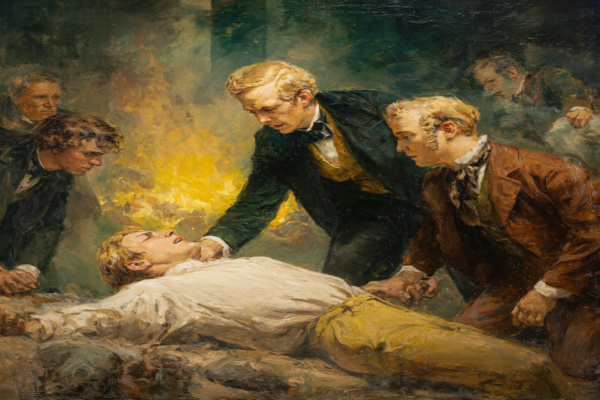
The account, published by the Church in Doctrine and Covenants 135, describes how Joseph and Hyrum were shot by a mob masked with black paint, numbering between 150 and 200 men, who stormed the jail at around 5:00 p.m. on June 27, 1844. Hyrum was killed instantly, while Joseph, after firing back in self-defense, leapt for the window and was shot multiple times, crying, “O Lord, my God!” Both brothers were shot again after death, in what the Church remembers as an act of brutal martyrdom.
After the smoke had cleared and the bodies of Joseph and Hyrum were brought home to their grieving families and followers, a crucial question loomed: Would those responsible ever face consequences for their actions?
Despite the size of the mob (estimated at 150–200 men), only nine individuals were ever indicted for the murders. Four of the indicted men—John Wills, William Voras, and two men known only as Gallaher and Allen—fled the county to avoid trial. Of these, Wills, Voras, and Gallaher reportedly received wounds when Joseph Smith, armed within the jail, fired back through the cell door in self-defense.
The remaining five men—Levi Williams, Mark Aldrich, Jacob C. Davis, Thomas C. Sharp, and William N. Grover—stood trial in May 1845 in what became known as the People v. Levi Williams et al., or the Carthage Conspiracy Trial. The courtroom itself was a charged environment. According to contemporary accounts, the courthouse was packed with armed supporters of the defendants, creating an atmosphere of intimidation not only for witnesses but also for the judge, who allegedly felt his own life was in danger throughout the proceedings. As B.H. Roberts later summarized, the “armed mob stamped with their feet and yelled their approbation at every sarcastic and smart thing that was said, and the judge was not only forced to hear it but to lend it a kind of approval.”
Witnesses, likely influenced by this oppressive atmosphere or divided loyalties, denied knowledge of the critical facts. As one observer put it, “faction may find men honest, but it scarcely ever leaves them so. This was verified to the letter in the history of the Mormon quarrel. The accused were all acquitted.”
On May 30, 1845, the jury returned a verdict of not guilty for all five defendants. The outcome surprised few, especially among the remaining Latter-day Saints in Nauvoo. Brigham Young, who would soon lead the Church westward, wrote in his journal that the verdict was just as he had anticipated; the local newspaper, Nauvoo Neighbor, observed that “convictions never are to be expected in ‘martyr cases.’”
Why was no one punished for such a high-profile double murder? The answer involves a complex web of local politics, societal hostilities, and the limits of the law in a divided frontier society.
The killing of Joseph Smith was not an isolated incident but the climax of years of simmering tensions between the rapidly growing Latter-day Saint community in Nauvoo and their non-Latter-day Saint neighbors in Illinois. Joseph Smith wielded substantial influence both as a religious and civic leader, commanding the Nauvoo Legion (the city militia), serving as mayor, and wielding remarkable political clout. For many opponents, the destruction of the Nauvoo Expositor was a red line, confirming their suspicions of Smith as an authoritarian threat.
Yet, as one anthropologist observed, the very practices that made the Latter-day Saints suspect—tight-knit communalism, secretive rituals, the creation of a city militia—were not unique to the Church. Similar practices could be found in other utopian communities and fraternal societies of the era. What made life so perilous for the Saints, then, was not only what they did, but the intensity and visibility with which they did it, and the degree to which they challenged prevailing social norms. When the tide turned fully against the Latter-day Saints, few outside the faith were willing to defend them—neither in the press nor in court.
Even in a “free state” like Illinois, the rule of law was often fragile when underlying social consensus broke down. The demographic and political weight of anti-Latter-day Saint sentiment was such that the trial in Carthage could scarcely be impartial. The defense, rather than mounting a case for innocence, attacked Governor Ford and the entire legitimacy of Latter-day Saint grievances. Armed observers influenced the proceedings, and witnesses shied away from testifying openly. It was an environment where “the crowd had everything their own way,” and justice, in the formal sense, could not be expected.
The Church treats June 27, 1844, as a day of solemn remembrance and reflection, commemorating the prophetic martyrdom of Joseph and Hyrum Smith. The events in Carthage Jail and the failure of Illinois courts to convict anyone for the crimes show narratives of suffering for faith’s sake and standing firm in the face of overwhelming hostility.
The knowledge that no one was ever held accountable for their murders only amplifies the sense of injustice and sacrifice felt by members of the Church. As recounted in reports and histories, this outcome was anticipated and later understood as both a sign of the perils the Saints faced and a testament to the faith’s resilience. It is precisely within this complexity—where martyrdom and agency, faith and violence, justice and its failure are all present—that many Latter-day Saints find the deepest sources of meaning and conviction.
Gramps