
Question
Gramps,
How are Jesus and John related?
Kathy
Answer
Kathy,
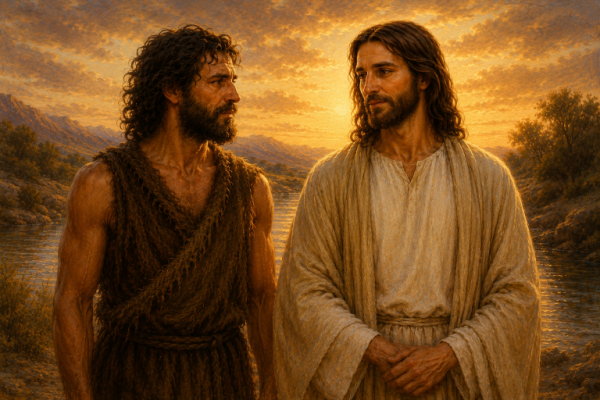
According to the Bible and Latter-day Saint understanding, Jesus and John the Baptist were relatives through their mothers, Mary and Elisabeth (Elizabeth). The scriptures do not spell out the exact family connection in modern genealogical terms, but they clearly describe the two women as kin.
In the Gospel of Luke, the angel Gabriel told Mary:
“And, behold, thy cousin Elisabeth, she hath also conceived a son in her old age.”
That verse has traditionally led Christians, including Latter-day Saints, to describe Jesus and John the Baptist as cousins. The word translated as “cousin” in English can also mean “relative” or “kinswoman,” so the precise relationship may not be fully known. But LDS theology firmly teaches that they were family.
What makes the relationship especially meaningful is not merely the family connection, but the divine missions both men were foreordained to fulfill.
John the Baptist was sent to prepare the way for Jesus Christ. Latter-day Saints believe John was one of the greatest prophets ever born. Jesus Himself declared:
“Among those that are born of women there is not a greater prophet than John the Baptist.” (Luke 7:28)
John’s role had been prophesied centuries earlier. Isaiah wrote of “the voice of him that crieth in the wilderness,” preparing the way of the Lord. John fulfilled that prophecy by preaching repentance and baptizing in preparation for the coming Messiah.
LDS scripture adds even more insight into John’s mission. In Doctrine and Covenants 84:28, we learn that John:
“was ordained by the angel of God at the time he was eight days old unto this power.”
Latter-day Saints believe John held the Aaronic Priesthood and was specifically chosen before birth to prepare Israel for the Savior.
The connection between Jesus and John begins even before their births. Luke records one of the most beautiful scenes in scripture: Mary visits Elisabeth while both are pregnant. Elisabeth is carrying John the Baptist, and Mary is carrying Jesus Christ.
The account says:
“And it came to pass, that, when Elisabeth heard the salutation of Mary, the babe leaped in her womb.”
Elisabeth, filled with the Holy Ghost, then testified of Mary and the unborn Savior:
“Blessed art thou among women, and blessed is the fruit of thy womb.”
“And whence is this to me, that the mother of my Lord should come to me?”
Latter-day Saints often see this as a powerful witness that John recognized the Savior even before birth. President Harold B. Lee once taught:
“John the Baptist was a special witness of the mission of Jesus Christ from before his birth.”
That idea fits beautifully with LDS teachings about foreordination—the belief that certain individuals were prepared in the premortal life for sacred earthly missions.
Although Jesus and John were relatives, their missions were very different. John was the forerunner. Jesus was the Messiah. John preached repentance; Jesus offered salvation. John baptized with water; Jesus would baptize “with the Holy Ghost, and with fire” (Matthew 3:11).
Yet despite their different roles, there was deep love and humility between them. John understood exactly who Jesus was. When Jesus came to John to be baptized, John initially resisted, saying:
“I have need to be baptized of thee, and comest thou to me?” (Matthew 3:14)
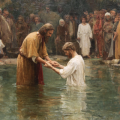
But Jesus insisted “to fulfil all righteousness.” John then baptized the Savior in the Jordan River, becoming one of the first public witnesses of Christ’s ministry.
That moment is incredibly important in LDS theology because it demonstrates several key doctrines at once:
- The necessity of baptism by proper authority
- The humility of Jesus Christ
- The manifestation of all three members of the Godhead
As Jesus came up out of the water, the Holy Ghost descended like a dove, and the Father’s voice declared:
“This is my beloved Son, in whom I am well pleased.” (Matthew 3:17)
Latter-day Saints also believe John later restored priesthood authority in modern times. In 1829, John the Baptist appeared to Joseph Smith and Oliver Cowdery as a resurrected being and conferred the Aaronic Priesthood upon them.
Joseph Smith recorded that John declared:
“Upon you my fellow servants, in the name of Messiah, I confer the Priesthood of Aaron.”
That restoration gives John the Baptist a unique place in LDS belief. He was not only the cousin and forerunner of Christ in mortality, but also a resurrected messenger who helped restore Christ’s Church in the latter days.
Another beautiful aspect of their relationship is John’s humility. Even though many wondered whether John himself was the Messiah, he consistently pointed others to Jesus rather than seeking attention for himself.
John famously declared:
“He must increase, but I must decrease.” (John 3:30)
That single verse captures John’s entire character. In LDS teachings, John is admired not only for his courage and prophetic calling, but for his willingness to step aside so people would follow Christ.
Elder Bruce R. McConkie once wrote that John the Baptist was:
“One of the noblest and greatest souls ever born into mortality.”
Latter-day Saints generally see the relationship between Jesus and John as both familial and symbolic. They were blood relatives, but they were also united in mission. John prepared hearts for the Savior, and Jesus fulfilled the plan of redemption.
In many ways, their relationship teaches an important gospel principle: true disciples point people to Christ rather than to themselves.
John never tried to compete with Jesus. He rejoiced in Jesus’s success. He recognized divine truth when he saw it and faithfully fulfilled the role God had given him.
So, according to LDS theology, Jesus and John the Baptist were relatives—commonly understood as cousins through Mary and Elisabeth. But more importantly, they were connected through sacred missions established by God long before either was born. John prepared the way. Jesus became “the way, the truth, and the life” (John 14:6).
Gramps