

Question
Gramps,
As I was starting to read the New Testament again, a new question popped into my head. Why did Jesus wait so long to be baptized? In Doctrine & Covenants 84:28, it states that John was baptized in his youth, ordained to the priesthood, and called to make way for the Lord’s ministry. I understand that the lord had to learn grace by grace until he received a fullness, but wouldn’t baptism and the gift of the Holy Ghost be beneficial in that process? Why would he wait until the latter years of his life to be baptized by John?
Austin
Answer
Austin,
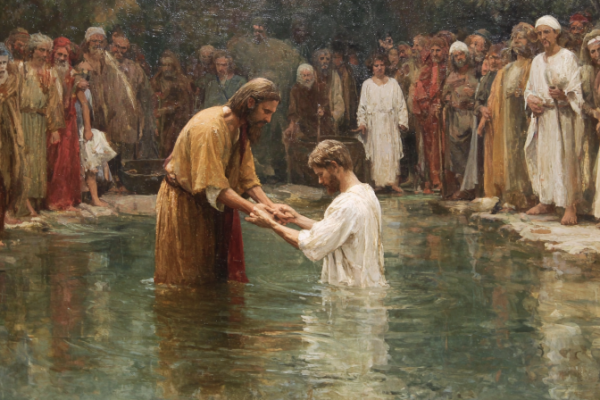
To understand why Jesus was baptized at age 30, it is crucial to reflect on the reasons for His baptism and the theological context in which it occurred. According to the Book of Mormon, Nephi provides four key reasons why Jesus was baptized:
1. To fulfill all righteousness.
2. To humble Himself and witness to the Father His obedience in keeping all commandments.
3. To illustrate the straitness of the path, and narrowness of the gate.
4. To set the ultimate example for us to follow.
Notably, Jesus did not need baptism for the remission of sins, since He was without sin. Instead, His baptism fulfilled the law of the gospel, made a covenant, and provided a pattern for all. This shows that, in this context, baptism was less about personal need and more about fulfilling divine law and serving as a necessary example.
Baptism in The Church of Jesus Christ of Latter-day Saints is a sign of repentance and a covenant to take upon oneself the name of Christ, obey the Father’s commandments, and remain true and faithful throughout life. The act represents more than just a ritual washing; it’s an invocation of authority, a formal commitment, and a public declaration of faith in God.
Yet, Jesus’ situation was unique—He was the only sinless being to have walked the earth, yet He submitted to baptism. This was not to receive forgiveness, but to obey all of God’s laws exactly and show humility before the Father. As Nephi taught, “according to the flesh He humbleth Himself before the Father, and witnesseth unto the Father that he would be obedient unto him in keeping His commandments” (2 Nephi 31:7).
One of the central questions is: Why did Jesus wait until age 30, rather than being baptized as a child or at the commonly cited “age of accountability” of eight, as practiced today in the Church? The answer touches on Jewish law, priesthood authority, and the mission of John the Baptist.
We read in Doctrine & Covenants 84:27-28 concerning John:
Which gospel is the gospel of repentance and of baptism, and the remission of sins, and the law of carnal commandments, which the Lord in his wrath caused to continue with the house of Aaron among the children of Israel until John, whom God raised up, being filled with the Holy Ghost from his mother’s womb.
For he was baptized while he was yet in his childhood, and was ordained by the angel of God at the time he was eight days old unto this power, to overthrow the kingdom of the Jews, and to make straight the way of the Lord before the face of his people, to prepare them for the coming of the Lord, in whose hand is given all power.
In ancient Israel, age 30 was considered the time when one could publicly enter upon priestly or rabbinical service. For example, only Levites aged 30 and older could serve in the Tabernacle (Numbers 4:3). This age was associated with maturity and readiness to assume public religious responsibility. Both John the Baptist and Jesus waited until this age to begin their ministries, reflecting obedience to Jewish custom and law.
John the Baptist was foretold by Isaiah (Isaiah 40:3) as the one sent to “prepare the way of the Lord.” But his authority to baptize the Savior was of paramount importance. John possessed priesthood keys and authority not held even by his father, Zacharias. An angelic ordination conferred upon John powers specific to his mission: “This great authority required a special ordination beyond the delegated power that had been given to Zacharias or any other priest who went before him, so the angel of the Lord was sent to John in his childhood to confer it.
Joseph Fielding Smith said:
The reason Zacharias could not ordain John is because of the fact that John received certain keys of authority which his father Zacharias did not possess. Therefore this special authority had to be conferred by this heavenly messenger, who was duly authorized and sent to confer it. John’s ordination was not…the bestowal of the Aaronic Priesthood, which his father held, but…the conferring of certain essential powers peculiar to the time among which was the authority to overthrow the kingdom of the Jews and “to make straight the way of the Lord.” Moreover, it was to prepare the Jews and other Israelites for the coming of the Son of God. This great authority required a special ordination beyond the delegated power that had been given to Zacharias or any other priest who went before him, so the angel of the Lord was sent to John in his childhood to confer it. (Answers to Gospel Questions, 5 vols. [Salt Lake City: Deseret Book Co., 1957-1966], 5: 2.)
John’s purpose was twofold: to prepare Israel for the Messiah and to baptize the Savior Himself. He was instructed that he would recognize the Messiah “upon whom thou shalt see the Spirit descending, and remaining on him, the same is he which baptizeth with the Holy Ghost” (John 1:33). When Jesus came to be baptized, John resisted at first, recognizing Jesus’ divinity, but ultimately complied to fulfill all righteousness.
One important doctrine clarified by the Church is that candidates for baptism cannot baptize themselves, nor can anyone without proper priesthood authority perform the ordinance. Even Jesus, with all authority, submitted to John’s baptism—demonstrating that proper authority is fundamental to the sacred nature of ordinances. This principle continues to this day, making clear that true baptism must be performed by one who holds authorized priesthood keys.
Given all this, how should Latter-day Saints reconcile Jesus’ baptism at age 30 with the Church’s practice of baptizing children at age eight? And why is baptism not required for certain groups, like young children or those unable to be accountable?
The Church teaches that the age of eight is the minimum age at which we should be baptized. This highlights that while children become capable of accountability at eight, baptism is not compulsory at that age for all—it marks the earliest opportunity, not a mandatory timeline. Focusing too strictly on the timing of Jesus’ baptism can distract from its deeper significance; the core example Christ set was not about the age itself, but about living obediently, making sacred covenants, and following God’s will.
For those who die before the age of accountability or are unable to be responsible for their actions, baptism is not required. The baptism of repentance is only for those capable of making a conscious decision to follow Christ and repent. According to the teachings of the Church, the Savior’s Atonement covers the sins of those incapable of accountability—they need no baptism, as they cannot repent and are already innocent before the law.
Some may wonder why self-baptism isn’t permitted, especially in light of scriptural accounts of Adam and Alma performing baptisms with minimal or singular authority. The distinction lies in divine authorization: Adam was baptized by the Holy Spirit directly, and Alma received direct revelation for his circumstances. In the organized Church, baptism must be performed by one holding proper priesthood authority, even the Savior, whose authority we invoke when performing baptisms…submitted himself to John to be baptized, which John held the Aaronic Priesthood. Modern converts must also receive baptism from authorized priesthood holders to ensure the ordinance is valid and recognized by God.
Gramps
Related Posts
 Did Jesus possess human desires and earthly pleasures just like any other mortal man?
 What did Jesus do from the time He was 12 until He began His ministry at 30?
 Why is speaking against the Holy Ghost worse than speaking against Jesus Christ?
 Why do Mormons believe that Jesus is a brother to Satan?