
Question
Dear Gramps,
We know that Christ’s Atonement was infinite, and eternal, and that He died for the sins of all Of Heavenly Fathers planets and creations. I have also heard that our world was the only one wicked enough to crucify Our Lord. So my question is, was Satan cast down to our planet only? Could this explain why our world is so wicked?
Heather
Answer
Heather,
Members of The Church of Jesus Christ of Latter-day Saints believe something remarkable about Jesus Christ: His Atonement is infinite and eternal. It wasn’t performed merely for one generation or even one world. The scriptures teach that His redeeming power reaches throughout all of Heavenly Father’s creations.
That naturally leads to some fascinating questions. If God has created “worlds without number” (Moses 1:33), and if Jesus Christ is the Savior for all of God’s children, what role does Satan play in the rest of God’s creations? Was Lucifer cast down only to this earth? If so, could that explain why our world seems to experience so much wickedness?
The honest answer is that we simply don’t know all the details. The restored gospel gives us important pieces of the puzzle, but it doesn’t answer every question we might have about Satan’s influence throughout the universe.
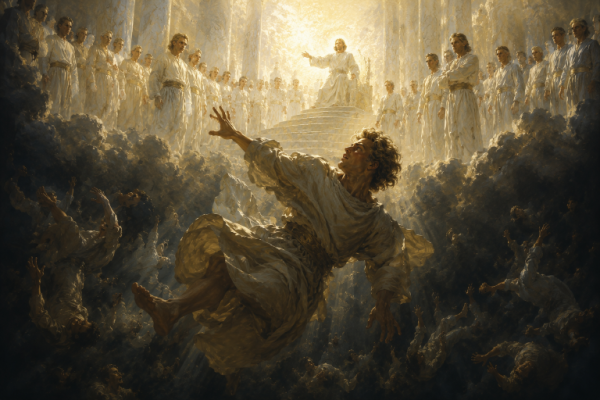
What we do know begins in the premortal life. Before the earth was created, Lucifer rebelled against Heavenly Father’s plan. Rather than accepting God’s plan of agency, he sought to destroy it by compelling everyone to obey. Because of that rebellion, he and the spirits who followed him were cast out of God’s presence.
The Lord revealed:
“And he became Satan, yea, even the devil, the father of all lies, to deceive and to blind men” (Moses 4:4).
John the Revelator likewise described the conflict in heaven:
“And there was war in heaven: Michael and his angels fought against the dragon” (Revelation 12:7).
Once cast out, Satan immediately turned his attention to Adam and Eve, beginning the work of temptation that has continued throughout human history.
One detail that often catches people’s attention is that the scriptures repeatedly describe Satan as being cast down to the earth. Revelation declares:
“Woe to the inhabiters of the earth and of the sea! for the devil is come down unto you” (Revelation 12:12).
Because these passages focus specifically on our earth, some Latter-day Saints have wondered whether Satan’s influence is actually limited to this world. It’s an understandable question, but one that the scriptures never directly answer.
No official doctrine teaches that Satan was assigned exclusively to Earth. The Lord has simply not revealed how Satan’s influence relates to God’s other creations. Some members have suggested that his efforts may be concentrated here because this is the world where Adam and Eve fell and where Jesus Christ performed His mortal ministry and infinite Atonement. That certainly seems possible, but it remains thoughtful speculation rather than revealed doctrine.
A related idea often surfaces in discussions like this. Many Church members have heard it said that our world was the only one wicked enough to crucify the Son of God. While that statement has become familiar in Latter-day Saint culture, it is important to distinguish between what has been revealed and what has been inferred.
Some early Church leaders, including Elder Orson Pratt, held that among God’s many inhabited worlds, ours may have been unique in rejecting and crucifying the Savior. Those comments are certainly worth considering, but they were never presented as binding doctrine for the Church.
The scriptures clearly establish that Jesus came to this earth and that many rejected Him. As the Apostle Paul wrote:
“For had they known it, they would not have crucified the Lord of glory” (1 Corinthians 2:8).
The Book of Mormon likewise describes the widespread wickedness in Jerusalem and among many people during the Savior’s mortal ministry. Whether another world would have acted differently is something the Lord has chosen not to reveal. Even if the idea were true, however, it would not necessarily follow that Earth is uniquely wicked because Satan resides here.
One of the central doctrines of the restored gospel is agency. Satan can tempt, deceive, and encourage evil, but he cannot force anyone to sin. President James E. Faust offered this reassuring counsel:
“However, we need not become paralyzed with fear of Satan’s power. He can have no power over us unless we permit it. He is really a coward, and if we stand firm, he will retreat.” (“The Great Imitator,” General Conference, October 1987)
That perspective is important because it reminds us that the wickedness we see around us cannot simply be blamed on the devil. Every person is accountable for the choices they make. Satan may provide temptation, but agency belongs to each of us.
It’s also worth remembering that if this earth has been the stage for Satan’s opposition, it has also been the stage for the greatest manifestation of God’s love. This is the world where Jesus Christ was born, taught, healed, suffered in Gethsemane, died on the cross, and rose from the tomb. It is the world where the fulness of the gospel has been restored in preparation for His Second Coming.
Rather than viewing Earth as merely the most wicked place in creation, it may be more accurate to see it as a central stage in the Father’s plan of salvation. This is the world where the Fall occurred, where Jesus Christ performed His infinite Atonement, and where the fulness of the gospel has been restored in preparation for His Second Coming. Those events alone give this earth a unique place in God’s work, regardless of what may be true of His other creations.
There’s another perspective worth considering as well.
Sometimes we look at the wickedness surrounding us and assume our world must be exceptionally evil. Yet the scriptures also tell the story of countless faithful men and women who have lived here. Adam and Eve, Enoch, Noah, Abraham and Sarah, Moses, Ruth, Peter, Mary, Mormon, Moroni, Joseph Smith, and millions of unnamed disciples all chose righteousness despite living in a fallen world.
The Lord has repeatedly established covenants with people on this earth. He has called prophets here, revealed scripture here, built temples here, and restored priesthood authority here. In other words, Earth has at times produced extraordinary wickedness, but also extraordinary faithfulness. Both realities coexist because agency allows individuals to choose whom to follow.
In the end, the restored gospel teaches us enough to understand the broad picture while leaving some fascinating questions unanswered. We know that Jesus Christ’s Atonement is infinite and eternal. We know that God has created worlds without number. We know that Satan rebelled, was cast out, and now seeks to deceive God’s children. We also know that agency remains intact and that every person is responsible for their choices.
What we do not know is whether Satan’s activities are confined entirely to this earth or how his influence relates to God’s other creations. Until the Lord reveals more, the wisest approach is to distinguish carefully between revealed doctrine and thoughtful speculation.
There’s nothing wrong with wondering about these questions. In fact, they can deepen our appreciation for both the vastness of God’s creations and the scope of Christ’s redeeming mission.
What we can say with complete confidence is that wherever Satan’s influence may extend, Jesus Christ’s power reaches farther still. The Savior has already won the decisive victory. Through His infinite Atonement, every child of God has access to forgiveness, redemption, resurrection, and the opportunity for eternal life.
And in the end, that truth matters far more than knowing exactly where Satan’s jurisdiction begins or ends.
Gramps