
Question
Gramps,
What is the difference between being raised from the dead by priesthood authority and being resurrected? Why does the body remain mortal after being brought back to life, while the resurrection is immortal?
Scott
Answer
Scott,
It’s a great question because the scriptures describe two very different miracles that can sound almost identical at first. Several people in the Bible and the Book of Mormon were brought back from the dead through the power of God and priesthood authority, yet they eventually died again. Jesus Christ, however, was resurrected, and because of His Resurrection, every person who has ever lived will one day receive an immortal body that can never die again.
Understanding the difference helps us appreciate why the Resurrection of Jesus Christ is one of the greatest miracles in Heavenly Father’s plan.
Throughout the scriptures, we read about faithful servants of God raising people from the dead. Elijah restored the widow’s son to life (1 Kings 17). Elisha raised the Shunammite woman’s son (2 Kings 4). Jesus raised Jairus’s daughter, the widow’s son at Nain, and Lazarus. Peter raised Tabitha, and Paul restored Eutychus to life after he fell from a window.
At first glance, these events might seem like resurrections, but according to Latter-day Saint doctrine, they were not. Instead, these individuals were restored to mortal life.
Their spirits returned to their mortal bodies, and those bodies resumed living just as they had before death. They could still become sick, grow old, suffer injury, and eventually die again.
A resurrection is something entirely different.
When a person is resurrected, the spirit and body are reunited forever. The body is no longer mortal but immortal. It will never again die or be separated from the spirit.
The Book of Mormon explains:
“Now, this restoration shall come to all, both old and young, both bond and free, both male and female, both the wicked and the righteous; and even there shall not so much as a hair of their heads be lost; but every thing shall be restored to its perfect frame, as it is now, or in the body.” (Alma 11:44)
Jesus Christ was the first person ever to be resurrected. The Apostle Paul taught:
“But now is Christ risen from the dead, and become the firstfruits of them that slept.
For since by man came death, by man came also the resurrection of the dead.
For as in Adam all die, even so in Christ shall all be made alive.” (1 Corinthians 15:20–22)
Because Christ overcame death, every one of God’s children will eventually be resurrected. One question naturally follows: if resurrection had not yet happened, how could prophets raise people from the dead? The answer is that these miracles were temporary restorations to mortal life through God’s power. Priesthood authority did not transform those individuals into immortal beings. God simply allowed their spirits to return to their mortal bodies so they could continue their mortal lives for a time.
Eventually, every one of them died again.
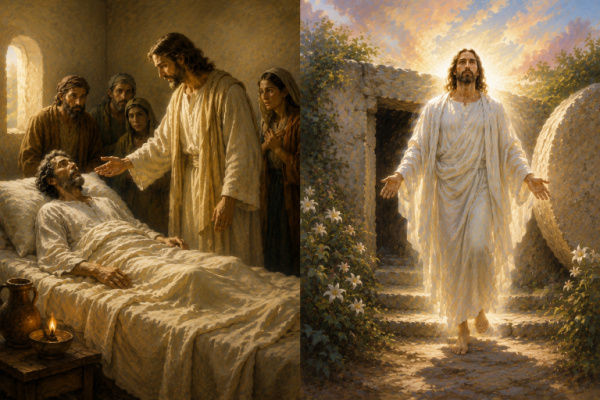
Lazarus is perhaps the best-known example. Jesus called him from the tomb after he had been dead for four days, but Lazarus was not resurrected. He returned to his mortal life and eventually experienced physical death once again.
The Church teaches this plainly:
“No one was resurrected before Jesus Christ was resurrected.” (Doctrines of the Gospel Student Manual, Chapter 32)
Everything changed on the morning of Christ’s Resurrection. Jesus was not simply brought back to mortal life. He rose with a glorified, perfected, immortal body. He could eat, walk, speak, and invite His disciples to touch Him, but His body had become immortal and would never die again.
The Book of Mormon explains what resurrection means:
“The spirit and the body shall be reunited again in its perfect form; both limb and joint shall be restored to its proper frame, even as we now are at this time… and we shall be brought to stand before God.” (Alma 11:43–44)
Then Alma adds one of the clearest descriptions of resurrection found anywhere in scripture:
“They can die no more; their spirits uniting with their bodies, never to be divided; thus the whole becoming spiritual and immortal.” (Alma 11:45)
That simple phrase—”never to be divided”—captures the essential difference between being raised from the dead and being resurrected.
Someone might wonder, “If priesthood authority can restore life, why can’t it also make someone immortal?” The answer is that priesthood authority always operates according to God’s laws and timing. Resurrection is not simply another priesthood miracle. It is one of the direct results of the infinite Atonement and Resurrection of Jesus Christ.
Before Christ broke the bands of death, immortality was not yet available. Even after His Resurrection, individuals do not choose when they are resurrected. Resurrection comes according to God’s appointed order because it is made possible only through the Savior’s victory over death.
The Doctrine and Covenants gives another beautiful definition of resurrection:
“The spirit and the body are the soul of man.
And the resurrection from the dead is the redemption of the soul.” (Doctrine and Covenants 88:15–16)
Latter-day Saints believe every person who has ever lived will eventually receive this gift. Every spirit will be reunited with its body forever. The resurrected body will never again age, become sick, or experience death. While people will inherit varying degrees of glory based on their faithfulness and acceptance of the gospel, every resurrected person will receive an immortal body through Jesus Christ.
The miracles of restoring someone to mortal life served several important purposes. They demonstrated God’s power over death, strengthened faith in His prophets, and pointed forward to the greater miracle yet to come. Every time someone was restored to mortal life, it served as a preview of the day when Christ would conquer death forever.
Elder Dallin H. Oaks beautifully summarized the importance of this doctrine:
“The assurance of immortality is fundamental to our faith.” (Resurrection)
The distinction between being raised from the dead and being resurrected teaches us something profound about Jesus Christ. A prophet may, through God’s power, restore someone to mortal life for a season. But only the Savior could break the bands of death forever. Because Jesus Christ was resurrected, every cemetery is only temporary. Every faithful reunion is possible. Every goodbye has an ending.
As the Savior promised:
“Because I live, ye shall live also.” (John 14:19)
Those who were raised from the dead eventually faced death again. Those who are resurrected never will. Their spirits and bodies are reunited forever, never to be separated again. Because of Jesus Christ, death is not the end of our story—it is simply the doorway to a glorious resurrection and eternal life.
Gramps