

Question
Gramps,
From your understanding, what is the history of the temple of the Community of Christ (formerly the Reorganized Church of Jesus Christ of Latter Day Saints in Independence, Missouri, and what happens inside?
Samuel
Answer
Samuel,
Many members of The Church of Jesus Christ of Latter-day Saints who visit Independence, Missouri, are surprised to discover a large temple there that does not belong to the Church. Instead, it belongs to the Community of Christ, formerly known as the Reorganized Church of Jesus Christ of Latter Day Saints (RLDS).
Because both churches trace their roots to Joseph Smith and the early Restoration, many people wonder why the temple was built, what its purpose is, and what actually happens inside.
The story begins in 1831.
According to revelations received by Joseph Smith, Independence was designated as the “center place” of Zion, and a temple was to be built there in the future. Joseph Smith and other Church leaders traveled to Missouri and dedicated land for that purpose. Community of Christ notes that Joseph Smith and other leaders dedicated the area in 1831 and that the dream of building a temple there has been part of their heritage ever since.
Latter-day Saints recognize the importance of this location as well. The Church teaches that Joseph Smith dedicated a temple site in Independence and that the Saints hoped to build a temple there before persecution forced them from Jackson County.
After Joseph Smith’s death in 1844, the Latter Day Saint movement divided into several groups. The largest group followed Brigham Young to the West and eventually became The Church of Jesus Christ of Latter-day Saints. Another group later reorganized under Joseph Smith III, the Prophet’s son, and became known as the RLDS Church.
Throughout the nineteenth and twentieth centuries, the RLDS Church maintained a strong presence in Independence. Although it did not gain ownership of the small parcel known today as the Temple Lot itself, it acquired much of the surrounding original temple property and eventually established its world headquarters there.
In 1984, RLDS President Wallace B. Smith announced that the church would build a temple in Independence. Unlike LDS temples, however, this temple would not be used primarily for sacred ordinances. Instead, it would be dedicated to peace, reconciliation, worship, and spiritual ministry. Construction began in 1990, and the temple was formally dedicated on April 17, 1994.
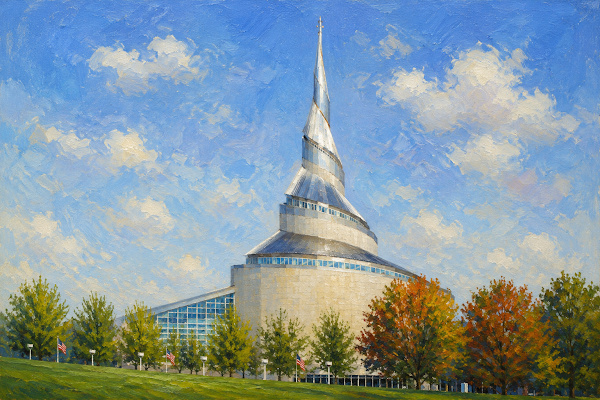
The temple’s design is one of its most recognizable features. The stainless-steel spiral tower rises roughly 300 feet above Independence and is inspired by the shape of a nautilus shell. It has become one of the city’s most recognizable landmarks.
One of the biggest differences between the Independence Temple and an LDS temple is accessibility. The Community of Christ temple is open to the public. Visitors may tour the building, attend worship services, participate in educational programs, and visit areas devoted to prayer and meditation. Community of Christ describes the temple as a place of worship, education, community building, discipleship preparation, and church administration.
Inside the building is a large sanctuary used for worship services, conferences, devotionals, musical performances, and church gatherings. The temple also contains offices, classrooms, meeting rooms, and administrative facilities that support the church’s worldwide ministry.
Perhaps the most distinctive activity that occurs in the temple is the Daily Prayer for Peace. Every day, a worship service is held to pray for peace in a specific nation or region of the world. This ministry has become one of the defining characteristics of the temple and reflects the Community of Christ’s emphasis on peace and reconciliation.
Community of Christ states that the temple is “dedicated to the pursuit of peace” and serves as a witness of Christ’s call for peace, justice, and healing.
From an LDS perspective, there are both similarities and significant differences.
The similarities arise from a shared Restoration heritage. Both faiths look back to Joseph Smith, both recognize the importance of Independence in early Church history, and both consider temples to be sacred places dedicated to God.
The differences, however, are substantial. Community of Christ does not perform the ordinances that Latter-day Saints associate with temples. There are no endowment sessions, baptisms for the dead, sealings, initiatories, or temple recommends. The temple functions more as a center of worship, prayer, peace ministry, education, and church administration than as a place where saving ordinances are performed.
Latter-day Saints would therefore not regard the Independence Temple as a temple operating under the priesthood authority recognized by The Church of Jesus Christ of Latter-day Saints. Likewise, ordinances performed in LDS temples are unique to LDS beliefs and practices.
Nevertheless, many Latter-day Saints who visit Independence choose to tour the Community of Christ Temple because it stands on land closely connected with the earliest Restoration history. Along with the nearby Temple Lot, owned by the Church of Christ (Temple Lot), and the Independence Visitors’ Center, operated by The Church of Jesus Christ of Latter-day Saints, the temple helps visitors better understand the complex history of the Restoration movement.
In the end, the Community of Christ Temple represents a different understanding of what a temple should be. For Community of Christ members, it symbolizes peace, worship, and reconciliation. For Latter-day Saints, it is an interesting reminder of a shared historical beginning and of the different paths taken by Restoration churches after the death of Joseph Smith.
Gramps