
Question
Gramps,
Why wasn’t the Lord interested in saving the Egyptians? I know some of their leaders did terrible things, such as killing babies and enslaving others, but there were probably many innocent Egyptians. It appears the Lord never invited the Egyptians to repent.
Shasta
Answer
Shasta,
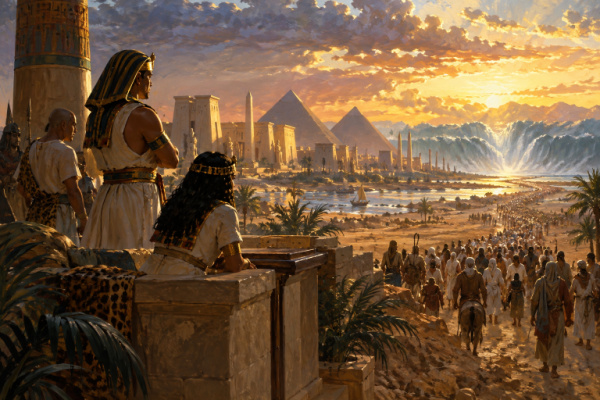
When we read the story of the Exodus, there is something that can be difficult to understand. The Lord sent Moses to deliver the Israelites from slavery in Egypt, and He eventually brought devastating plagues upon the Egyptians. The final plague resulted in the death of the firstborn throughout Egypt. That naturally raises a difficult question: What about the Egyptians who weren’t responsible for enslaving Israel? Pharaoh certainly behaved terribly. He enslaved the Israelites and ordered that their baby boys be killed. But Egypt was a large nation, and there must have been ordinary people who had nothing to do with Pharaoh’s decisions. Some may even have disagreed with what Pharaoh was doing. So why does the Exodus story seem to focus almost entirely on saving Israel rather than saving the Egyptians? And why doesn’t it appear that the Lord gave the Egyptians the same invitation to repent that He gave Israel?
The first thing we need to remember is that the Exodus account is primarily the story of God’s covenant relationship with Israel. It isn’t intended to give us a complete account of every Egyptian’s relationship with God. The Lord had made specific covenants with Abraham, Isaac, and Jacob concerning their descendants, and the Exodus was an important part of fulfilling those promises. The Israelites had been enslaved for generations, and the Lord remembered the covenant He had made with their fathers. He called Moses to lead them out of bondage and eventually establish them as a covenant people. But that doesn’t mean God loved Israel while simply ignoring everyone else.
One of the clearest teachings in the restored gospel is that God loves all of His children. The Book of Mormon says that God “inviteth them all to come unto him and partake of his goodness; and he denieth none that come unto him.” It then makes the point especially clear: “all are alike unto God” (2 Nephi 26:33). Israel was chosen for a particular covenant responsibility, but being chosen didn’t mean that everyone outside Israel was rejected by God. In fact, the Lord told Abraham that through his descendants “all the families of the earth” would be blessed (Abraham 2:9–11). Israel’s role was ultimately to help bring God’s blessings to other nations, not to keep those blessings exclusively for themselves.
There is also something we sometimes overlook in the Exodus story. The Lord actually did give Pharaoh opportunities to respond to Him. Moses and Aaron repeatedly went before Pharaoh and told him to let the Israelites go, and Pharaoh repeatedly refused. The plagues were not simply one sudden punishment. They occurred over a period of time, and the Lord repeatedly demonstrated His power while Pharaoh continued to resist. In Exodus 10:3, Moses asked Pharaoh, “How long wilt thou refuse to humble thyself before me?” Pharaoh wasn’t simply unaware of what was happening. He had been confronted again and again with evidence that the God of Israel was acting.
The scriptures even tell us that one purpose of the plagues was so that the Egyptians would know that the Lord was God. In Exodus 7:5, the Lord said, “And the Egyptians shall know that I am the Lord.” This is an important detail because it shows that the purpose of the plagues wasn’t simply to punish Egypt. The Lord was making Himself known. The Egyptians were witnessing events that were intended to demonstrate His power and distinguish Him from the gods of Egypt. At the same time, however, we shouldn’t stretch the account further than the scriptures allow. The Bible doesn’t tell us that every individual Egyptian was personally given a formal invitation to repent. Most of the story focuses on Pharaoh, the Egyptian government, the oppression of Israel, and the Lord’s deliverance of His covenant people.
That brings us to the part of the question that can be especially troubling. What about the ordinary Egyptians who may not have been responsible for Pharaoh’s actions? There certainly must have been people in Egypt who weren’t personally responsible for enslaving Israel. Some Egyptians may have participated in the oppression, while others may simply have been ordinary people living under Pharaoh’s government. We don’t know the circumstances of each individual. The Bible doesn’t give us enough information to determine exactly how God dealt with every Egyptian individually, and this is where LDS doctrine about the plan of salvation becomes especially important.
In the restored gospel, physical death isn’t the end of a person’s opportunity to accept the gospel. Doctrine and Covenants 138 teaches that the gospel is preached to people in the spirit world and that those who didn’t have an opportunity to receive it during mortality can still hear it there. This means that LDS doctrine doesn’t require us to believe that someone was spiritually condemned simply because he or she happened to live in the wrong place, at the wrong time, or under the rule of a wicked government. God judges people according to their individual circumstances, knowledge, choices, and opportunities.
Imagine an Egyptian who lived during the time of Moses but had never been taught about the God of Israel and had never personally participated in Pharaoh’s oppression. Suppose that person died during the plagues. We don’t know what happened to that individual in the spirit world, and the scriptures don’t give us enough information to say. But LDS doctrine gives us good reason not to assume that the person was simply lost because he or she was Egyptian. The Lord knows every person individually. He knows what people understand, what opportunities they have, what choices they make, and what they would have done if they had been given opportunities they never received. His judgment is therefore far more complete and just than anything we could determine from simply reading the historical account.
There is another interesting detail in the Exodus account that is easy to overlook. Exodus 12:38 says that a “mixed multitude” went up with the children of Israel when they left Egypt. The scripture doesn’t tell us exactly who made up this group, so we shouldn’t speculate too much about their identity, but it does remind us that the people leaving Egypt weren’t necessarily a completely uniform group of Israelites. The story is more complicated than simply dividing everyone into two groups, with Israelites on one side and Egyptians on the other.
The scriptures also give us an important reason not to think that Egypt was permanently rejected by God. In Isaiah 19, the prophet describes a future time when the Lord will bless Egypt. The chapter contains descriptions of judgment, but it eventually looks forward to a time when Egypt will turn to the Lord and receive His blessings. In one particularly remarkable passage, Isaiah describes Egypt, Assyria, and Israel together in God’s blessing: “Blessed be Egypt my people, and Assyria the work of my hands, and Israel mine inheritance” (Isaiah 19:25). That’s a remarkable statement. The same God who judged Egypt in the days of Moses could later describe Egypt as “my people.” This helps us see that God’s judgment on a nation at one point in history doesn’t mean that He has permanently rejected the people of that nation.
This is also why it can be misleading to think of the Exodus as simply a story of “good Israelites versus bad Egyptians.” The Israelites themselves weren’t perfect. After leaving Egypt, they repeatedly struggled with faith and obedience, and eventually some participated in worshipping the golden calf. Being part of Israel didn’t automatically make someone righteous, just as being Egyptian didn’t automatically make someone wicked. The Lord was dealing with people individually while also working through a covenant nation to accomplish His larger purposes.
So why did the Lord focus so much attention on saving Israel? The simplest LDS answer is that the Exodus was part of the fulfillment of God’s covenant with Abraham, Isaac, and Jacob. Israel had been enslaved, Pharaoh had attempted to destroy their children, and the Lord intervened to deliver them. He was establishing Israel as a covenant people through whom the gospel and knowledge of God would eventually be taken to the nations of the earth. The fact that Israel had a special role in God’s plan does not mean that Egyptians had no value to Him.
In fact, the larger story of scripture points in the opposite direction. God repeatedly reaches beyond Israel to bless people from other nations. The Book of Mormon teaches that He invites everyone to come unto Him, and the Abrahamic covenant itself was intended to bless “all the families of the earth.” The gospel was never ultimately intended to belong to one nationality.
We also need to be careful about equating physical death with spiritual condemnation. An Egyptian who died during the plagues was not necessarily an Egyptian who had knowingly rejected God. LDS doctrine makes a clear distinction between physical death and a person’s eternal standing before God. A person can die without ever having received the gospel and still receive an opportunity to accept it in the spirit world. Ultimately, God’s judgment will take into account circumstances that we cannot see from the biblical account.
So, was the Lord interested in saving the Egyptians? According to LDS doctrine, there is no good reason to conclude that He wasn’t. The Exodus story simply isn’t primarily about the salvation history of Egypt. It is about God’s covenant with Israel, the deliverance of an enslaved people, and the beginning of Israel’s journey as a covenant nation. Because the story is focused on Israel, we don’t get a detailed account of what happened spiritually to every Egyptian.
That leaves us with an important distinction. We can say with confidence that the Lord judged Pharaoh and Egypt for their actions and that He delivered Israel from bondage. We can also say that Pharaoh was repeatedly confronted with the Lord’s power and given opportunities to respond. But we should be much more cautious about making judgments concerning individual Egyptians whose circumstances aren’t described in scripture.
The Lord knew every one of them individually. He knew who was responsible for the oppression, who wasn’t, who understood what was happening, and who didn’t. And LDS doctrine teaches that God is perfectly just and merciful and that every person will ultimately have a fair opportunity to accept or reject His plan. The Exodus tells us how God delivered Israel. It doesn’t tell us that He stopped caring about the Egyptians.
Gramps