
Question
Gramps,
It is usual to say ‘the Sacrament will now be blessed by the priesthood, but the prayers specifically say ‘O God the ETERNAL FATHER we ask THEE in the name of thy Jesus Christ to bless [the emblems].
Colin
Answer
Colin,
If you’ve attended a sacrament meeting in The Church of Jesus Christ of Latter-day Saints for very long, you’ve probably heard someone say something like, “The sacrament will now be blessed by the priesthood.”
That statement is common and easy to understand, but it can also raise an interesting question. The actual sacrament prayers don’t say, “We bless this bread” or “We bless this water.” Instead, both prayers begin by addressing Heavenly Father:
“O God, the Eternal Father, we ask thee in the name of thy Son, Jesus Christ, to bless and sanctify this bread to the souls of all those who partake of it…” (Doctrine and Covenants 20:77)
The prayer for the water follows the same pattern:
“O God, the Eternal Father, we ask thee in the name of thy Son, Jesus Christ, to bless and sanctify this wine to the souls of all those who drink of it…” (Doctrine and Covenants 20:79)
Today, the Church uses water as directed by the Lord (see Doctrine and Covenants 27:2).
So who is actually blessing the sacrament? Is it the priesthood holders, or is it Heavenly Father?
The answer is that both ideas fit together, but in different ways.
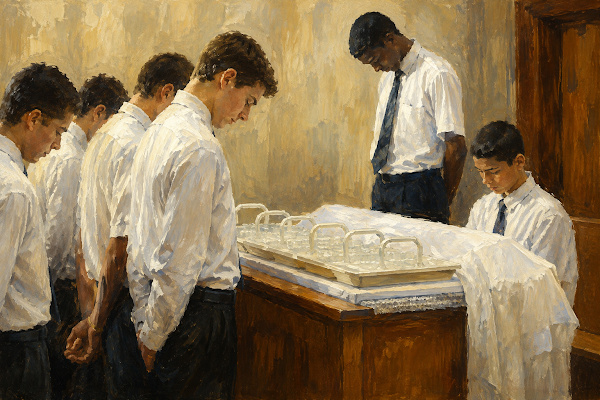
The priesthood holders are the ones authorized to perform the ordinance, but the prayer itself is a petition asking Heavenly Father to bless and sanctify the emblems. The young man kneeling at the sacrament table isn’t declaring the bread or water blessed by his own authority. Instead, he is acting under the authority of the priesthood to offer the prayer that the Lord Himself revealed.
The General Handbook explains:
“Priesthood authority is the authorization to represent God and act in His name. In the Church, all priesthood authority is exercised under the direction of those who hold priesthood keys.”
That distinction is important.
In the Church, priesthood authority allows ordinances to be performed properly, but the power behind every ordinance ultimately comes from God. The sacramental prayer reminds us of that by directing our attention immediately to the Father.
Notice the wording carefully:
“O God, the Eternal Father, we ask thee … to bless and sanctify this bread…”
The priest doesn’t say, “I bless this bread.”
He says, “We ask thee to bless.”
That simple phrase teaches a profound principle. Priesthood holders are servants carrying out the Lord’s work. They are not acting independently of Him. They are asking Heavenly Father to do what only He can do.
The sacramental prayer perfectly reflects that truth. The priest is not using personal power to bless the emblems. He is exercising delegated authority to ask Heavenly Father to bless them.
This pattern is found throughout the scriptures. Jesus Himself taught His disciples to pray to the Father in His name:
“Therefore ye must always pray unto the Father in my name.” (3 Nephi 18:19)
The sacrament prayers follow exactly that pattern. They are offered to the Eternal Father, in the name of Jesus Christ, just as the Savior instructed.
The wording of the prayers also helps us remember whose sacrament this really is.
Sometimes we casually think of it as “the priest’s blessing of the sacrament.” While that isn’t incorrect in everyday conversation, it isn’t the complete picture. The priests are performing a sacred ordinance by priesthood authority, but the blessing itself is requested from Heavenly Father.
Think of it this way. If someone asks you to pray for them, you are the one offering the prayer, but you are not the one granting the blessing. God is. Likewise, the priest offers the revealed prayer, asking Heavenly Father to bless and sanctify the bread and water.
This also explains why the sacrament prayers are recited word for word. Unlike most prayers, these are not spontaneous. The Lord revealed the exact wording in both Moroni 4–5 and Doctrine and Covenants 20. Because they are revealed prayers connected to a sacred ordinance, they are offered exactly as written. If an error is made, the prayer is repeated to match the revealed wording.
Again, this reminds us that the ordinance belongs to the Lord.
Priesthood authority is certainly essential. According to Church doctrine, the sacrament must be administered by those who have been properly ordained and authorized. The bread and water are prepared, blessed, and passed under the direction of the priesthood. Without that authority, the ordinance would not be performed according to the Lord’s established order.
President Russell M. Nelson taught:
“Priesthood is the authority of God delegated to man to minister for the salvation of men.”
The sacrament beautifully illustrates this principle.
The priest kneels in humility rather than standing in authority over the congregation. His posture itself reflects dependence upon God. He isn’t commanding heaven; he is petitioning heaven.
Another interesting detail is the phrase “bless and sanctify.”
To sanctify means to make holy or set apart for a sacred purpose. Again, this isn’t something a young priest accomplishes through personal ability. He asks Heavenly Father to sanctify the bread and water so they become sacred emblems that help worshippers remember the Savior and renew their covenants.
Of course, the bread and water do not become physically different. Latter-day Saints do not believe the emblems literally transform into the body and blood of Christ. Instead, they remain bread and water while becoming sacred symbols used in a holy ordinance.
Ultimately, the greatest blessing of the sacrament is not found in the bread or water themselves. It is found in the covenant relationship we renew with God.
The prayer asks that those who partake may “eat in remembrance of the body of thy Son,” witness their willingness to take upon them His name, always remember Him, and keep His commandments. In return comes the beautiful promise “that they may always have his Spirit to be with them” (Doctrine and Covenants 20:77).
That promise comes from God—not from the young man offering the prayer.
So is it wrong to say, “The sacrament will now be blessed by the priesthood?” Not at all. It’s a convenient way of saying that the ordinance will now be performed by authorized priesthood holders. Most members understand exactly what is meant.
However, the actual wording of the revealed prayers reminds us of something even more meaningful. The priesthood performs the ordinance, but Heavenly Father is the One being asked to bless and sanctify the emblems. The ordinance is carried out through priesthood authority, yet its power and effectiveness come from God.
Perhaps that’s one of the quiet lessons the sacrament teaches every Sunday. Even when priesthood authority is involved, faithful servants point people to Heavenly Father and Jesus Christ—not to themselves.
The next time you hear the sacrament prayer, listen closely to its opening words: “O God, the Eternal Father…”
Those words gently remind us that every ordinance, every covenant, every blessing, and every promise ultimately comes from our Eternal Father through the redeeming power of His Son, Jesus Christ.
Gramps