

Question
Gramps,
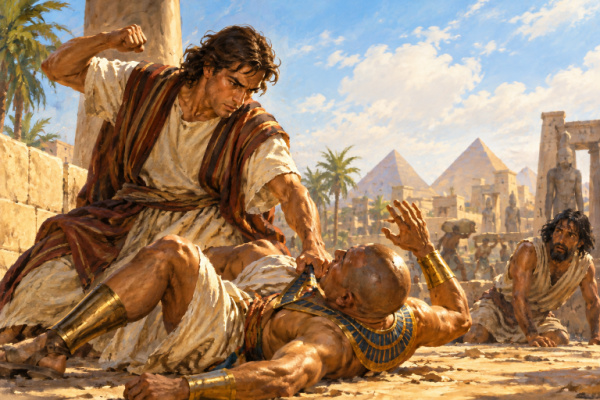
Moses murdered an Egyptian who was oppressing a Hebrew. The Book of Mormon explains that sometimes it is better for one man to perish than that a nation should dwindle and perish in unbelief, but Moses’ act seems spontaneous. How are we to understand Moses’ act in light of his later becoming a prophet of God?
Jeff
Answer
Jeff,
To understand this story from a Latter-day Saint perspective, we need to look at what the scriptures actually say, what they do not say, and what Moses’ life teaches us about the Lord’s ability to work through imperfect people.
In Exodus 2:11–15, we read that Moses went out to observe the burdens of his Hebrew brethren. He saw an Egyptian beating a Hebrew, and after looking around and seeing no one, he killed the Egyptian and hid his body in the sand. The following day, Moses discovered that people knew what he had done. When Pharaoh learned about it, he sought to kill Moses, so Moses fled to the land of Midian.
Notice something important about this account. The Scriptures do not tell us that the Lord commanded Moses to kill the Egyptian. They do not say that Moses received a revelation telling him to take this man’s life. Instead, the account describes Moses seeing an act of oppression and responding by killing the Egyptian.
That distinction matters.
One interesting passage that helps us understand Moses’ motivation is found in the New Testament. In Acts 7:23–29, Stephen recounts the story of Moses before the Jewish council. He explains that when Moses was about forty years old, he went to visit his fellow Israelites.
Stephen says Moses saw one of them being mistreated and defended him by striking down the Egyptian. Then Stephen adds something particularly interesting in Acts 7:25: Moses thought his brethren would understand that God would deliver them by his hand, but they did not.
This suggests that Moses already had some awareness of his future role in delivering Israel. According to Stephen’s account, Moses believed that God would use him to help his people. However, the Israelites did not recognize this at the time.
Does that mean the Lord directed Moses to kill the Egyptian? Not necessarily. The passage tells us what Moses believed about his future role, but it does not establish that God commanded him to take the Egyptian’s life.
It is possible that Moses felt a strong desire to defend his people and may have believed he was acting in their interest. But feeling that we are doing something for a good reason is not the same as receiving a commandment from God.
That is an important lesson for us today. A good intention does not automatically make every action right.
The comparison with the Book of Mormon is interesting. In 1 Nephi 4:13, Nephi explains why the Lord commanded him to kill Laban. He says it is better for one man to perish than for an entire nation to dwindle and perish in unbelief.
At first glance, someone might connect this principle with Moses’ actions. After all, both situations involve the death of one person and the welfare of God’s people.
However, there is a major difference between the two accounts.
In Nephi’s case, the Book of Mormon explicitly describes a divine command. Nephi initially hesitated, but he received direction through the Spirit and was told that the Lord had delivered Laban into his hands. Nephi understood that the Lord was commanding him to do something he would not ordinarily have done.
In Moses’ case, we have no comparable account of a divine command to kill the Egyptian.
Therefore, we should be careful not to use 1 Nephi 4:13 to automatically justify Moses’ actions. The principle Nephi describes is not a general permission for people to take matters into their own hands whenever they believe that doing so might benefit others.
From an LDS perspective, there is a difference between an individual deciding that a person’s death would serve a greater purpose and the Lord specifically commanding something for His own purposes. We cannot simply assume that the two are the same.
The scriptures do not give us enough information to say with certainty everything Moses was thinking or whether he felt any spiritual prompting at the time.
Does Moses’ action mean he was unworthy to become a prophet? Not at all. One of the wonderful things about scripture is that the Lord’s servants are not presented as people who never make mistakes.
Consider the lives of other individuals in the scriptures. Peter denied knowing Jesus Christ three times. Paul persecuted followers of Christ before becoming one of the great missionaries of the early Church. Alma the Younger opposed the Church before experiencing a powerful change of heart.
Their earlier actions did not prevent the Lord from working through them later.
That does not mean their mistakes were unimportant or that God approved of everything they had done. Rather, their stories demonstrate that people can change, grow, repent, and become instruments in the Lord’s hands.
Moses’ life also involved a long period of preparation. After fleeing Egypt, he lived in Midian, married Zipporah, and spent years away from the royal household in which he had been raised. Later, the Lord appeared to him in the burning bush and called him to return to Egypt to deliver Israel (Exodus 3:1–10).
By then, Moses had experienced a very different life. He was no longer living in Pharaoh’s household. He had spent years in the wilderness and would eventually lead an entire people through their own journey through it.
His life reminds us that the Lord’s preparation of a servant can take many years. We should not assume that everything a person does before receiving a calling has been approved by God simply because that person eventually becomes a prophet.
Perhaps the most important lesson is that we should avoid claiming more certainty than the Scriptures provide.
We know that Moses killed an Egyptian who was beating a Hebrew. We know that he fled when Pharaoh sought his life. We also know that the Lord later called Moses to lead Israel out of bondage and that Moses became one of the most significant prophets in biblical history.
What we do not know is whether Moses received any divine prompting before killing the Egyptian. The biblical account does not tell us that he did.
It is possible to recognize the injustice Moses witnessed without concluding that killing the Egyptian was a divinely commanded act. We can also recognize Moses’ later prophetic calling without assuming that the Lord approved of every decision he made earlier in life.
For Latter-day Saints, this fits with the broader understanding that God works with people who are still learning and developing. Being called by God does not mean a person has always acted perfectly. Nor does a person’s future service to God automatically make every earlier action righteous.
We should also remember that the Lord is the ultimate judge of each person’s heart, intentions, understanding, and circumstances. We have only a limited account of Moses’ experience, so it would be unwise to pronounce a final judgment on his spiritual condition based on these few verses.
Ultimately, the story of Moses teaches us to distinguish between what God has explicitly commanded and what a person chooses to do. Nephi’s experience with Laban involved a specific command from the Lord. Moses’ experience with the Egyptian is not described that way.
We can leave room for questions about Moses’ motives without claiming to know exactly what happened in his heart. And we can appreciate the remarkable prophet he became while acknowledging that the Scriptures do not provide a clear divine justification for his earlier act.
The larger message is that God can prepare, teach, and work through people over time. Moses’ story is not a declaration that every action of a future prophet is approved by God. It is a reminder that the Lord can call people to accomplish His work, even when their lives and experiences are more complicated than we might expect.
Gramps