
Question
Gramps,
Was there a Priesthood lineage during Joseph of Egypt and the calling of Moses?
Robert
Answer
Robert,
According to the doctrine of The Church of Jesus Christ of Latter-day Saints, priesthood authority existed long before Moses led the children of Israel out of Egypt. The Doctrine and Covenants teaches that priesthood authority can be traced back to Adam and continued through generations of righteous servants of God.
Latter-day Saints believe that priesthood authority is the power and authority God gives His servants to act in His name. It did not begin with Moses or with the organization of ancient Israel. According to latter-day revelation, priesthood authority existed from the beginning.
Doctrine and Covenants 84:6-17 provides an important explanation of the priesthood’s ancient history. It teaches that the priesthood was given to Adam and continued through generations of God’s servants. The Lord explains that Abel received the priesthood through his father, Adam. The revelation also identifies Enoch, Noah, Abraham, and other individuals in the history of priesthood authority.
Doctrine and Covenants 107:40-57 also discusses the patriarchal order and the transmission of priesthood authority through the generations, including the relationship between Adam and his righteous descendants.
These passages establish an important principle in Latter-day Saint teaching: God did not wait until Moses’s time to establish priesthood authority. It was already part of His work among His children.
Joseph of Egypt was the son of Jacob, also known as Israel, and the great-grandson of Abraham. His story is found primarily in Genesis 37–50. Joseph was clearly a man whom God called to accomplish an important purpose. Through revelation, he interpreted dreams, warned Egypt of an approaching famine, and helped preserve many lives, including those of his own family.
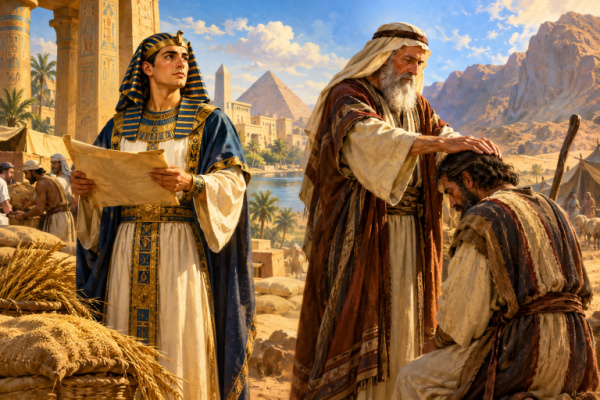
But does the Bible specifically tell us that Joseph of Egypt received the priesthood through a formal ordination? The Bible does not provide a detailed account of Joseph’s priesthood ordination or identify the person who might have ordained him. Therefore, we should be careful not to claim that the Bible explicitly describes an ordination that it does not record.
Latter-day Saint scripture does, however, teach that priesthood authority continued through ancient generations. Abraham received the priesthood from Melchizedek, and Isaac and Jacob were part of the patriarchal line through which God’s covenant promises continued.
Joseph was one of Jacob’s sons and received important promises connected with the covenant God made with Abraham and his descendants. In the Joseph Smith Translation of Genesis 48, additional details are given concerning Joseph’s blessings and posterity.
It is important to distinguish between receiving a patriarchal blessing or covenant promise and receiving a documented priesthood ordination. They are related to God’s dealings with His people, but they are not automatically the same thing.
The safest conclusion is that Joseph lived during a period when God was working through the covenant family of Abraham, but the scriptures do not give us a complete, individual ordination record for Joseph of Egypt.
Moses’s priesthood lineage is discussed in greater detail in Doctrine and Covenants 84:6-16. One particularly interesting detail is that Moses received the priesthood under the hand of his father-in-law, Jethro.
This may surprise some readers. We often think of Moses primarily as the great prophet who led Israel out of Egypt, received the Ten Commandments, and spoke with the Lord. Yet latter-day revelation provides additional information about how he received priesthood authority.
Doctrine and Covenants 84:6–7 states that Moses received the priesthood from Jethro. The revelation then traces Jethro’s priesthood lineage back to earlier figures, eventually connecting it to Abraham and, ultimately, to Adam. This is significant because Jethro was not an Israelite in the same sense as Moses and his Hebrew family. Jethro was a priest of Midian, and the Bible portrays him as a man who worshipped and honored the Lord.
In Exodus 18, Jethro meets Moses in the wilderness, offers sacrifices to God, and gives Moses wise counsel on governing the people.
The Doctrine and Covenants adds an important piece of information that is not stated in the biblical account: Jethro held priesthood authority and conferred it upon Moses. This shows that, according to Latter-day Saint scripture, priesthood authority was not limited to one immediate family or nation. God could work through faithful servants outside the direct line of Jacob’s descendants.
Sometimes priesthood authority was passed from father to son. Doctrine and Covenants 107:40-41 teaches that a particular patriarchal order of priesthood was handed down from father to son, beginning in the days of Adam.
However, we should not assume that every priesthood ordination in every period followed an exclusively father-to-son pattern. Moses’s experience illustrates this point. According to Doctrine and Covenants 84, he received the priesthood from his father-in-law, Jethro, rather than through a recorded ordination from his own father, Amram.
The scriptures therefore describe both the continuation of priesthood authority through generations and the conferral of authority through other authorized servants of God. The central principle is that priesthood authority comes from God. It is not simply inherited because someone belongs to a particular family, nor is it something a person can claim merely because he feels called to serve.
Latter-day Saint doctrine also teaches that the children of Israel eventually lost the privilege of enjoying the fulness of the higher priesthood because they hardened their hearts and rejected the Lord’s greater law.
Doctrine and Covenants 84:19–27 explains that the Lord took Moses and the higher priesthood from among Israel, while the lesser priesthood continued. This lesser priesthood is associated with the Aaronic Priesthood and the preparatory law given to ancient Israel.
The Aaronic Priesthood was conferred upon Aaron and his descendants, as explained in Doctrine and Covenants 107:13–14. This hereditary arrangement differs from the broader historical lineage of the Melchizedek Priesthood.
According to Latter-day Saint doctrine, priesthood authority existed long before Joseph of Egypt and Moses. It began with Adam and continued through generations of God’s servants.
Joseph of Egypt lived within the covenant family of Abraham, but the scriptures do not give us a detailed account of his personal priesthood ordination. Moses’s priesthood lineage, on the other hand, is described more explicitly in Doctrine and Covenants 84, which teaches that he received the priesthood from his father-in-law, Jethro.
The story reminds us that God’s work has continued throughout history, often in ways that are not fully explained in the Bible alone. Through latter-day revelation, Latter-day Saints believe they have additional insight into how priesthood authority was preserved, conferred, and exercised in ancient times.
Gramps