

Question
Gramps,
In 1 Peter 3:20 it reads: 20 Which sometime were disobedient, when once the long suffering of God waited in the days of Noah, while the ark was a preparing, wherein few, that is, eight souls were saved by water.
Do the 8 souls saved by water have any connection to the age of accountability? I’m just curious, I suppose I do not want to read further into something than there actually is.
Thanks!
Aaron
Answer
Dear Aaron,
One of the more interesting verses in the New Testament appears in 1 Peter 3:20:
“Which sometime were disobedient, when once the longsuffering of God waited in the days of Noah, while the ark was a preparing, wherein few, that is, eight souls were saved by water.”
At first glance, this verse seems fairly simple. Peter is referring to Noah and his family surviving the Flood while the rest of the world rejected God’s warnings. Yet many readers have paused over one detail in particular: why did Peter specifically mention “eight souls”? Since Latter-day Saints place special significance on the age of eight as the age of accountability and baptism, this naturally raises the question of whether there is a connection.
Officially, there is no doctrine from The Church of Jesus Christ of Latter-day Saints that directly ties the eight people saved on the ark to the age of accountability. The scriptures never make that claim. Still, there are some beautiful symbolic parallels that are worth considering. Scripture often uses patterns, symbols, and recurring themes to teach deeper spiritual truths, even when those patterns are not meant to establish doctrine in and of themselves.
Peter’s primary purpose in this passage is not to explain the age of accountability. Instead, he is teaching about salvation through Jesus Christ and comparing Noah’s deliverance through water to the ordinance of baptism. In other words, Peter sees the Flood account as more than just a historical event. He sees it as a symbolic foreshadowing of spiritual salvation through Christ.
Just a verse later, Peter writes:
“The like figure whereunto even baptism doth also now save us” (1 Peter 3:21).
Peter clearly sees Noah’s experience as symbolic of salvation. The Flood represented destruction for the wicked but deliverance for the faithful. Noah and his family passed safely through the water because they trusted God.
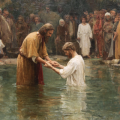
Latter-day Saints often recognize this same symbolism in baptism. Going into the water represents death to sin, and coming out of the water represents new life in Christ.
The Pearl of Great Price uses similar imagery. In Moses 6:59, we read:
“That by reason of transgression cometh the fall, which fall bringeth death, and inasmuch as ye were born into the world by water, and blood, and the spirit… even so ye must be born again into the kingdom of heaven, of water, and of the Spirit.”
Water is repeatedly associated in scripture with cleansing, rebirth, covenant making, and salvation.
Peter could have simply said that Noah and his family were saved, but instead, he specifically mentioned the number eight. Throughout scripture, numbers sometimes carry symbolic meaning.
In biblical tradition, the number seven is often associated with completion or fullness. The number eight can symbolize a new beginning—a fresh start after completion.
That symbolism fits the Flood narrative remarkably well.
The Flood ended a corrupt world and marked the beginning of a renewed one through Noah and his family. In many ways, the ark carried humanity into a fresh start. That idea of beginning again fits naturally with the symbolism of baptism in LDS theology.
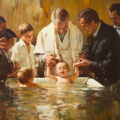
When a child reaches the age of accountability and is baptized at eight years old, baptism represents a spiritual rebirth and the beginning of covenant discipleship. The old life is left behind, and a new life in Christ begins. Because of that, many Latter-day Saints have noticed that the symbolism surrounding Noah’s family and the symbolism surrounding baptism at age eight overlap in meaningful ways, even if the scriptures never directly connect the two.
According to LDS doctrine, little children are innocent before God and are not accountable for sin until they reach the age of eight.
Doctrine and Covenants 68:27 states:
“And their children shall be baptized for the remission of their sins when eight years old, and receive the laying on of the hands.”
This doctrine is deeply connected to the belief that children are born innocent because of the Atonement of Jesus Christ.
Moroni strongly condemned infant baptism in the Book of Mormon. Moroni 8:8 says:
“Listen to the words of Christ, your Redeemer, your Lord and your God. Behold, I came into the world not to call the righteous but sinners to repentance; the whole need no physician, but they that are sick; wherefore, little children are whole.”
Latter-day Saints believe children do not need baptism before they are accountable because Christ’s grace already covers them.
President Joseph F. Smith taught:
“With little children who are taken away in infancy and innocence before they have reached the years of accountability, and are not capable of committing sin, the gospel reveals to us the fact that they are redeemed, and Satan has no power over them.” (The Salvation of Little Children)
This doctrine makes the age of eight highly significant in LDS theology. It marks the beginning of personal accountability and covenant responsibility.
Even though there is no official teaching tying Noah’s eight souls directly to the age of accountability, several symbolic parallels are meaningful to many Latter-day Saints when reading these passages together.
Both stories involve salvation through water. Noah’s family was physically saved through the floodwaters, while baptism symbolizes spiritual salvation through Jesus Christ. Peter himself directly connects the Flood to baptism, making the comparison impossible to ignore.
After the Flood, humanity began again through Noah’s family. Likewise, after baptism at age eight, a child symbolically begins a new spiritual life as a covenant disciple of Christ. In both cases, water is connected to cleansing, renewal, and a fresh beginning.
Noah entered into a covenant with God. After the Flood, God established a covenant with Noah and gave the rainbow as a sign.
Likewise, baptism is a covenant ordinance.
Both experiences involve entering into a special relationship with God through faith and obedience.
In scripture, eight can symbolize transition, renewal, or a new order.
For example, male children under the law of Moses were circumcised on the eighth day. Circumcision represented covenant entry into the house of Israel.
Similarly, baptism at age eight represents covenant entry into Christ’s Church.
Because of these patterns, some LDS teachers and members have informally drawn symbolic connections between the number eight in Noah’s story and the age of accountability.
Still, it is important to distinguish between symbolism and doctrine.
It is probably unwise to claim that Peter intentionally meant the eight souls on the ark to prophesy or establish the age of accountability.
The scriptures themselves never make that connection directly.
LDS doctrine on the age of accountability comes primarily through modern revelation, especially Doctrine and Covenants 68 and Moroni 8.
This is often how scripture works. There are meaningful patterns and symbols throughout the scriptures that teach spiritual truths without necessarily being formal doctrine.
Elder David A. Bednar has taught the importance of distinguishing between eternal doctrine and personal interpretation. He explained:
“Doctrine refers to the eternal, unchanging, and simple truths of the gospel of Jesus Christ. Principles are doctrinally based guidelines for what we ought to do.” (Doctrines, Principles, and Applications: A Framework for Gospel Learning)
That perspective is helpful here. Symbolic parallels can strengthen faith, but they should not be treated as revealed doctrine unless the Lord has clearly declared them.
In this case, the safest conclusion is that the connection is symbolic rather than doctrinal.
Even if the connection is symbolic, it is still beautiful.
The Flood story reminds us that God preserves and saves those who enter into a covenant with Him.
Baptism at age eight represents a child willingly entering the covenant path.
Both experiences involve water, faith, covenant, and beginning again. Most importantly, both point toward salvation through Jesus Christ.
In many ways, Noah’s ark itself can even be viewed as a symbol of Christ—a place of safety amid destruction.
Just as Noah’s family entered the ark to survive the Flood, disciples enter into a covenant with Christ through baptism to receive spiritual safety and eternal life.
So, do the eight souls saved by water in 1 Peter 3:20 have a connection to the age of accountability?
Officially, LDS doctrine does not teach a direct connection.
However, there are strong symbolic similarities that many Latter-day Saints appreciate:
- Both involve salvation through water,
- Both represent new beginnings,
- Both involve covenant relationships with God,
- and both are associated with the number eight.
Peter’s primary message was about salvation through Jesus Christ and the symbolism of baptism. Yet the recurring scriptural themes surrounding the number eight beautifully harmonize with the restored doctrine that children become accountable and enter the covenant path through baptism at age eight.
Whether intentional symbolism or simply a meaningful pattern, the connection ultimately points us back to Christ, whose grace makes all covenant relationships possible.
Gramps