


Question
Gramps,
What exactly was the curse mentioned in Ether 14:1? Does it mean that things just disappeared?
Luis
Answer
Dear Luis,
Ether 14 describes one of the darkest periods in Jaredite history. Their civilization is collapsing, wars are everywhere, and the people have become deeply wicked. Right at the beginning of the chapter, Moroni describes something especially strange.
Ether 14:1 says:
“And now there began to be a great curse upon all the land because of the iniquity of the people, in which, if a man should lay his tool or his sword upon his shelf, or upon the place whither he would keep it, behold, upon the morrow, he could not find it, so great was the curse upon the land.”
So what exactly was happening? Were tools and swords literally vanishing overnight?
The simple answer is that the Book of Mormon doesn’t tell us exactly how the objects disappeared. It tells us that people would put possessions somewhere and later be unable to find them. It also specifically connects this problem to a curse upon the land caused by the people’s wickedness.
What makes the passage particularly interesting is the very next verse. Ether 14:2 says:
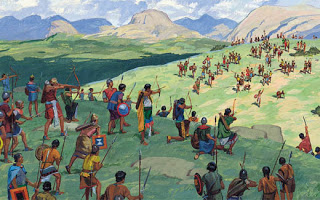
“Wherefore every man did cleave unto that which was his own, with his hands, and would not borrow neither would he lend; and every man kept the hilt of his sword in his right hand, in the defence of his property and his own life and of his wives and children.”
That gives us an important clue. The curse wasn’t merely an odd supernatural inconvenience. Jaredite society had reached the point where people could no longer trust one another or feel secure in their possessions. Violence and fear had taken over.
Interestingly, this curse had been foretold much earlier in Jaredite history. Ether 11:6 says that prophets had warned the people that “a great curse should come upon the land, and also upon the people” unless they repented. Verse 7 describes wars, contentions, famines, pestilences, and widespread destruction.
Later, the prophet Ether gave another warning. Ether 13:20–21 says that Ether told Coriantumr that if he and his household would repent, the Lord would spare him and allow him to keep his kingdom. But if he refused, the people would be destroyed, and another people would inherit the land.
By Ether 14, those warnings were being fulfilled.
The language in Ether is also very similar to a prophecy given by Samuel the Lamanite centuries later. Samuel warned the Nephites that because of their wickedness, the Lord would curse the land and their riches.
Helaman 13:18 says:
“And it shall come to pass, saith the Lord of Hosts, yea, our great and true God, that whoso shall hide up treasures in the earth shall find them again no more, because of the great curse of the land.”
In Helaman 13:34, Samuel then describes what the people would eventually say:
“Behold, we lay a tool here and on the morrow it is gone.” He
That sounds remarkably similar to Ether 14:1.
Samuel continues in Helaman 13:35:
“Yea, we have hid up our treasures and they have slipped away from us, because of the curse of the land.”
So the idea of riches becoming “slippery” appears more than once in the Book of Mormon. It describes people becoming unable to retain the possessions they valued so highly.
Mormon later describes the fulfillment of Samuel’s prophecy. Mormon 1:17–19 explains that because of the people’s hardness of heart, “the land was cursed for their sake.” Gadianton robbers infested the land, causing people to hide their treasures in the earth. Mormon then says:
“and they became slippery, because the Lord had cursed the land, that they could not hold them, nor retain them again.”
So were the objects in Ether 14 miraculously disappearing? Possibly—but the scripture doesn’t explain the mechanism.
Ether 14:1 says that a person could leave a tool or sword somewhere and be unable to find it the next day. We should be careful not to go beyond scripture and say that God was literally making objects vanish into thin air.
The objects could have been stolen. They could have been moved or hidden by other people. The chaos and violence of Jaredite society may have made it nearly impossible to secure property. There could also have been a miraculous element to the curse that Moroni simply does not explain.
The text doesn’t provide enough information to confidently choose among those explanations.
But the important part of the story isn’t really how the sword disappeared. It is why the people could no longer hold onto anything.
Long before Ether 14, prophets had warned the Jaredites about exactly where their wickedness was taking them. Ether 11:1 says prophets foretold “the destruction of that great people except they should repent, and turn unto the Lord, and forsake their murders and wickedness.”
The people repeatedly rejected those warnings. Eventually, their society became filled with secret combinations, warfare, murder, fear, and destruction.
By Ether 14, people were desperately clinging to whatever they owned. They wouldn’t lend or borrow. They kept their swords in their hands because they feared for their property, their lives, and their families.
Their possessions hadn’t made them secure. Quite the opposite. The things they valued had become sources of fear.
From an LDS perspective, there is no need to dismiss Ether 14:1 as merely symbolic. Moroni presents the curse as something that really happened. People were really losing their possessions and could not reliably recover them.
At the same time, the Church does not provide an official explanation, saying that these objects literally vanished into thin air.
The safest reading is to accept what the scripture says without adding details it doesn’t provide: the Lord cursed the land because of the people’s wickedness, and one result was that they could no longer reliably retain their possessions.
Whether those possessions were stolen, mysteriously lost, supernaturally removed, or lost through some combination of circumstances isn’t explained.
The deeper message is that the Jaredites had spent years fighting for power, wealth, land, and control. By Ether 14, they had reached the tragic point where they couldn’t even put down a sword without fearing that it would be gone the next morning.
So when Ether 14:1 talks about a “great curse,” it isn’t necessarily describing objects magically blinking out of existence. It describes a people who, because of persistent wickedness, had lost the security and blessings they once enjoyed. Their possessions had become “slippery,” much like what the Book of Mormon later describes among the Nephites.
The curse wasn’t simply that things disappeared.
The greater tragedy was that the people had rejected God so thoroughly that nothing they possessed could give them the security they were desperately trying to find.
Gramps
Related Posts
 Why are the biblical passages cited in the Book of Mormon essentially identical with those in the Bible?
 What evidence is there that steel was used on the American continent during Book of Mormon times?
 How do I best prepare myself for the return of my missionary boyfriend?
 According to the Book of Mormon, when did the Lamanites skin turn a dark color?