
Question
Gramps,
Why are we making the Salt Lake Temple earthquake-proof? Should we not have faith that Heavenly Father can protect his temple using divine means? If God isn’t concerned about protecting his temples from natural disasters. Why are we worried?
Josh
Answer
Josh,
It’s an honest question, and one that touches on an important principle in the gospel: the relationship between faith and personal responsibility.
The short answer is that Latter-day Saints believe in both divine protection and wise preparation. The Church’s efforts to strengthen the Salt Lake Temple are not a sign of weak faith. Rather, they reflect a longstanding gospel principle that God often expects His children to do what they can while trusting Him for what they cannot do.
One of the most famous examples comes from the story of Noah. God could have miraculously protected Noah and his family from the Flood without requiring them to build an ark. Instead, He commanded Noah to spend years constructing one. The miracle came, but preparation came first.
The same pattern appears throughout scripture. Nephi was commanded to build a ship before crossing the ocean. Joseph in Egypt stored grain before the famine arrived. The people of Alma fortified their cities before attacks came. In each case, faith did not replace preparation. Faith-motivated preparation.
Latter-day Saints often summarize this principle with the phrase, “Pray as if everything depends on God and work as if everything depends on you.” While that exact wording is not scripture, it captures an important gospel truth.
The Church teaches self-reliance, food storage, emergency preparedness, financial responsibility, and wise planning. Few members would argue that having food storage demonstrates a lack of faith in God’s ability to provide. Likewise, purchasing insurance does not mean a person lacks faith that God can protect their home. We take reasonable precautions while trusting in the Lord.
The Salt Lake Temple renovation follows the same principle.
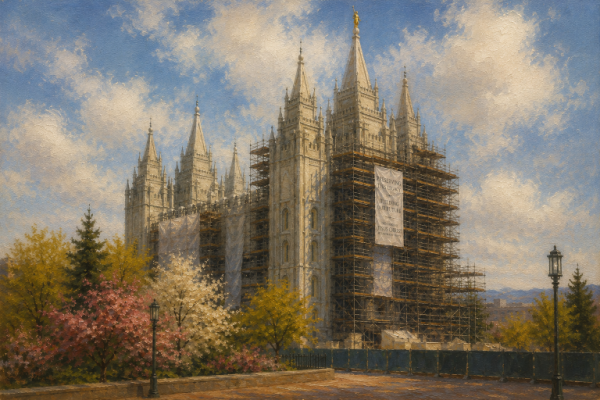
The temple was dedicated in 1893. When it was built, engineers did not have the modern understanding of earthquakes that exists today. The Wasatch Fault, which runs through northern Utah, is capable of producing significant seismic activity. Engineers now have technology that can greatly improve a building’s ability to withstand a major earthquake.
The renovation is intended to preserve the temple for future generations. If Church leaders have the knowledge and resources to strengthen the building, it would be difficult to argue that they should simply ignore those opportunities and hope for a miracle instead.
In LDS theology, faith is not usually expressed by refusing to act. Faith is expressed by acting in harmony with revealed truth and sound.
I remember hearing a quote once that basically said: “The Lord will not do for us what we can do for ourselves.”
While the Lord certainly performs miracles, He often expects His people to use the abilities, intelligence, and resources He has already provided.
Some people wonder whether God’s protection should make earthquake-proofing unnecessary. After all, haven’t temples been dedicated and set apart as sacred places? The answer is yes, temples are sacred. But LDS doctrine does not teach that dedicated buildings are automatically immune from natural disasters. In fact, scripture and history suggest the opposite.
The ancient temple in Jerusalem was destroyed more than once. The Nephite temple civilization eventually disappeared. Early Latter-day Saint temples faced persecution, damage, abandonment, and destruction. The temple in Nauvoo was burned after the Saints were forced to leave Illinois.
These events did not mean God had abandoned His people or that the temples were somehow unworthy of divine protection. Rather, they demonstrate that God sometimes allows natural and human-caused events to unfold according to the laws and agency of the mortal world.
Latter-day Saints believe that God governs the universe through laws. Gravity works. Fire burns. Floods flood. Earthquakes shake the earth. The Lord can intervene whenever He chooses, but He does not always suspend natural laws.
That reality helps explain why the Church takes practical measures to protect its buildings.
Another important consideration is stewardship.
Church leaders have a responsibility to care for sacred resources. The Salt Lake Temple is not merely an historic building. It is one of the most recognizable symbols of the Restoration and a place where sacred ordinances are performed. Millions of members worldwide feel a connection to it.
If leaders know there is a realistic risk that a major earthquake could severely damage the structure, stewardship would suggest taking reasonable steps to preserve it.
Imagine a bishop discovering that the roof of a meetinghouse was unsafe. Most members would not expect him to simply pray for protection and leave the problem unaddressed. They would expect him to repair the roof. Fixing the roof would not demonstrate a lack of faith. It would demonstrate responsible stewardship.
The same principle applies on a much larger scale to the Salt Lake Temple.
There is also a human safety component. The renovation is not only about protecting stone walls and historic architecture. It is about protecting people who will worship there for generations to come.
Church leaders have repeatedly emphasized the value of human life. If engineers can reduce the likelihood of injury or loss of life during a future earthquake, it makes sense to do so.
Some may still ask, “But couldn’t God simply protect the temple if He wanted to?”
Absolutely. Latter-day Saints firmly believe He could.
The scriptures are filled with examples of divine intervention. The Lord parted the Red Sea, preserved Daniel in the lions’ den, and protected the pioneers in remarkable ways. God has the power to preserve any building He chooses.
The question, however, is not whether God can perform miracles. The question is whether He has instructed His people to avoid preparation and depend solely on miracles.
The answer throughout scripture appears to be no.
The Lord generally expects His people to exercise wisdom, use available resources, and act responsibly. Then they trust Him for the outcomes they cannot control.
Perhaps the best way to view the Salt Lake Temple renovation is not as a substitute for faith but as an expression of faith. Church leaders believe the temple will continue serving future generations. They believe it is worth preserving. They believe God has blessed His children with knowledge and engineering skills to accomplish that purpose.
Faith and preparation are not opposites. In the gospel, they often work together.
Latter-day Saints trust that Heavenly Father can protect His temples through miraculous means if He chooses. At the same time, they recognize that He often works through ordinary means—through inspired leaders, skilled engineers, careful planning, and wise stewardship.
Making the Salt Lake Temple earthquake-resistant is not a statement that God cannot protect His house. It is a recognition that God frequently asks His children to do their part while trusting Him to do His.
Gramps