
Question
Dear Gramps,
If on the first day of creation the light was called Day and the darkness Night, where did the light come from if the sun wasn’t created until the fourth day? Thanks!
Shannon
Answer
Shannon,
One of the most persistent misunderstandings concerning the Creation story is the interpretation of the word “day.” In modern English, “day” typically refers to a 24-hour period, determined by the Earth’s rotation relative to the Sun. However, as numerous Latter-day Saint scholars and leaders emphasize, the Hebrew word used in Genesis—*yom*—carries a broader meaning. It can denote not only a literal day but also an undefined period or era.
When you refer to the scriptural reference that the earth was made in seven days, … those days were not the 24-hour periods that were defined after the earth was set up in this solar system. The word “day” in Genesis should be understood as an indeterminate period of time, rather than as a literal solar day. Indeed, the Book of Abraham and Moses frequently use “time” in place of “day,” further emphasizing this non-literal usage.
Hugh Nibley, renowned Latter-day Saint scholar, elaborates: “Our texts make it very clear that we are not to measure the time and periods involved by our chronometers and calendars. Until Adam underwent that fatal change of habitat … nothing is to be measured in our years, ‘for… the Gods had not appointed unto Adam his reckoning’ (Abraham 5:13).” The periods are numbered but never measured—these scriptural “days” describe phases of organization rather than precise schedules.
Many readers question the seeming contradictions among the scriptural, temple, and scientific accounts of creation. For example, Genesis describes the creation of light before the sun, and the emergence of plants before the sun, moon, and stars. Others note apparent discrepancies in the recounting of events between the books of Genesis, Moses, Abraham, and the teachings presented in Latter-day Saint temples.
It is essential to acknowledge, as noted by Latter-day Saint leaders and scholars, that these differences are not errors nor contradictions in doctrine. Rather, they result from different literary goals and intended teachings. The complexity of Creation could not truly be encapsulated in such arbitrary divisions in such a brief narrative. … This was a difference in literary methodology, not attempts at historical accuracy. … The Genesis and Abraham accounts were not an attempt at the actual chronology of creation, but rather to illustrate the general stages of a project. Each account uses literary symbols and poetic devices to emphasize spiritual truths rather than provide a play-by-play record.
This symbolism is consistent with ancient scriptural traditions: the creation accounts in scripture, as well as the temple, both serve to teach principles—about order, purpose, and God’s role in the universe—through structured narrative, drama, and ritual. As Nibley writes, “The sequence of creation isn’t supposed to be historical. The true chronology of creation is far beyond the scope of a short ceremony. It was written, not as a historical record, but as a literary device designed to teach a point.” Comparing the four Gospels, which often vary in chronology and details, he argues that the value lies not in perfect chronological harmony but in the overarching message and symbolism they convey.
A frequent question pertains to the “light” mentioned on the first day of creation, given before the creation or organization of sun, moon, and stars on the fourth day (Genesis 1:3–19). Did God create light before creating the celestial bodies that produce it? According to Latter-day Saint understanding, this first light was not the sun, but something more fundamental and profound.
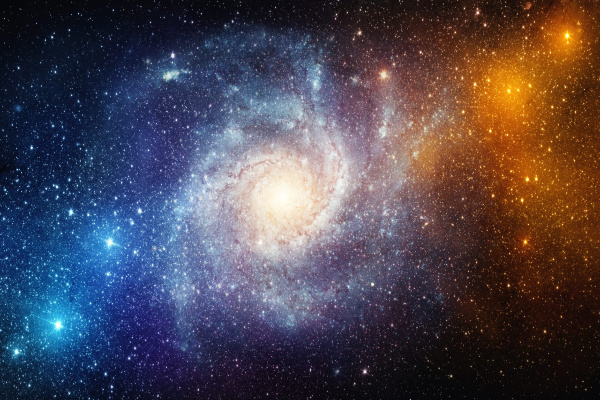
The scriptures teach that God himself is the source of light. Doctrine and Covenants 88:6-13 describes the “light of Christ” as the power that is “in all and through all things,” illuminating sun, moon, stars, and all creation. Elder John Taylor explained, “God caused light to shine upon [the earth] before the sun appeared in the firmament for God is light, and in him there is no darkness. He is the light of the sun … the light of the moon … the light of the stars….” This idea—that creation begins with an infusion of divine light or energy, paralleling cosmological concepts such as the Big Bang—emphasizes the spiritual dimension inherent in the earliest stages of creation.
Nibley, too, remarks that the “light” is not limited to the visible spectrum, but includes all wavelengths and energies necessary for life, organization, and the carrying out of God’s purposes. The spiritual symbolism here is powerful: Christ is called “the light of the world,” and this light divides between darkness and light, both physically and morally (see John 1:5) Later, in the progression of creation, God organizes smaller “lights”—the sun, moon, and stars—as products and manifestations of that original, divine source.
The process and purpose of creation are revealed as more than assembling matter or setting the stage for biological life; they reflect God’s love, forethought, and ongoing guidance. Modern revelation affirms that this world—and all worlds—were organized according to divine law and order. As Kent Jackson summarizes, “God set the sun, the moon, and the stars in the heavens and gave them their laws, conditions, and bounds which they cannot pass except by his command. They all move in perfect harmony in their sphere and order and are as wonders, lights, and signs unto us.”
Furthermore, the creation accounts end with the Sabbath—a day of rest, not because God needed respite, but as a symbol of completion, joy, and reflection. The command to remember the Sabbath is a reminder to contemplate the majesty of God’s works and our stewardship of the earth.
Gramps