
Question
Gramps,
Do we know why Saul asked for 100 Philistine foreskins instead of some other body part?
MG
Answer
MG,
One of the more unusual requests in the Old Testament is found in 1 Samuel 18. After David defeated Goliath and became popular among the people, King Saul grew increasingly jealous of him. Hoping to get rid of David without appearing to murder him outright, Saul offered his daughter Michal in marriage—but with an unusual bride price. Instead of wealth or livestock, Saul demanded 100 Philistine foreskins.
At first glance, it seems like a strange and even disturbing request. Why foreskins? Why not heads, weapons, or some other proof that David had defeated 100 Philistines? While the Bible never gives a direct explanation, several reasons fit the historical setting and are consistent with Latter-day Saint understanding of the scriptures.
The first thing to understand is Saul’s true motive. The text makes it very clear that Saul wasn’t interested in collecting trophies. He wanted David dead.
The king desireth not any dowry, but an hundred foreskins of the Philistines, to be avenged of the king’s enemies. But Saul thought to make David fall by the hand of the Philistines. (1 Samuel 18:25)
Saul expected David to die trying. Sending one man into enemy territory to kill one hundred Philistine warriors was practically a suicide mission. If David died in battle, Saul could claim it was simply the cost of war rather than being blamed for murdering his most successful military leader.
But why ask specifically for foreskins?
One practical reason may have been identification.
The Philistines were uncircumcised, while Israelite males were circumcised as part of the covenant God established with Abraham (Genesis 17). Circumcision was a visible sign of belonging to the covenant people. Throughout the Old Testament, the Israelites frequently referred to their enemies as “the uncircumcised Philistines.”
If David had simply brought back heads, hands, or swords, there could have been questions about whether they actually belonged to Philistines. Saul wanted unmistakable proof that David had killed Israel’s covenant enemies—not Israelites or members of another nation. Since Philistine males were uncircumcised, the foreskins provided undeniable evidence.
While the Bible never explicitly states this was Saul’s reasoning, it makes good sense historically and fits with the way circumcision distinguished covenant Israel from neighboring nations.
There’s another possibility as well.
The request itself was deeply humiliating to the Philistines. In the ancient Near East, defeating an enemy wasn’t only about winning a battle. It often involved publicly shaming them. Removing and presenting the foreskins symbolized complete victory over Israel’s uncircumcised enemies. It emphasized not only military success but also Israel’s triumph over those outside God’s covenant.
This wasn’t because circumcision itself had magical significance. Rather, it pointed back to the covenant God had made with Abraham. Throughout the Old Testament, circumcision reminded Israel that they were a chosen people who had entered into a covenant relationship with the Lord.
From an Latter-day Saint perspective, covenants are central to God’s dealings with His children. Physical circumcision under the law of Moses eventually gave way to higher spiritual covenants through Jesus Christ. Today, baptism serves as the outward sign of entering into the covenant path rather than circumcision.
The Apostle Paul taught that what truly matters is not the outward ordinance but the condition of the heart. He wrote:
For he is not a Jew, which is one outwardly… But he is a Jew, which is one inwardly; and circumcision is that of the heart. (Romans 2:28-29)
Latter-day Saints understand this to mean that outward ordinances should reflect inward faithfulness. Just as circumcision symbolized Israel’s covenant relationship, baptism and temple covenants symbolize our commitment to Jesus Christ.
Ironically, Saul’s plan backfired in spectacular fashion. Rather than bringing back 100 Philistine foreskins, David doubled the number.
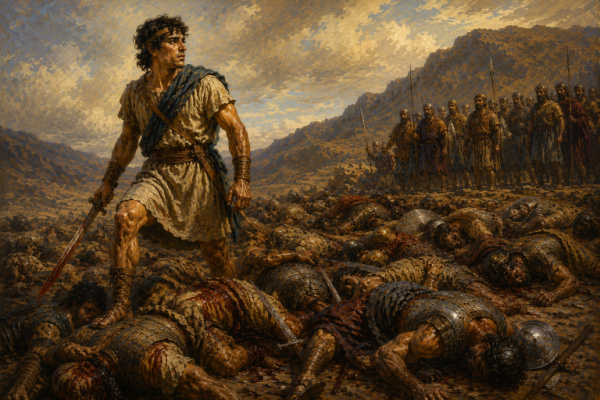
David…slew of the Philistines two hundred men; and David brought their foreskins, and they gave them in full tale to the king. (1 Samuel 18:27)
David didn’t merely complete Saul’s impossible challenge—he exceeded it by one hundred additional victories. Saul had hoped David would be killed. Instead, David’s success only confirmed that the Lord was blessing him.
This became yet another piece of evidence that the Spirit of the Lord was with David rather than with Saul. The account also reveals an important principle that appears throughout scripture. Wicked people often believe they can manipulate circumstances to accomplish their own purposes, but the Lord can turn those very plans into blessings for the righteous.
Joseph was sold into Egypt by jealous brothers, yet God used that betrayal to preserve an entire nation during famine. Haman built gallows for Mordecai but ended up dying on them himself. Saul repeatedly tried to eliminate David, yet each attempt only strengthened David’s position as Israel’s future king.
Latter-day Saints often see the Lord’s hand working in similar ways today. While He doesn’t always prevent hardship, He has the power to use difficult circumstances to fulfill His purposes and bless those who remain faithful.
Another interesting point is that the Bible never praises Saul’s request. Scripture simply records it. Sometimes readers assume that because something appears in the Bible, God approved of it. That’s not necessarily true.
The Old Testament often reports events exactly as they happened without commenting on whether every action was righteous. Saul’s demand was motivated by jealousy, fear, and attempted murder. Those motives clearly conflicted with God’s will.
David’s willingness to complete the task demonstrated his loyalty to the king and his courage in battle, but the story’s focus isn’t the collection of gruesome trophies. The emphasis is on God’s protection of David despite Saul’s repeated attempts to destroy him.
So, do we know for certain why Saul requested 100 Philistine foreskins?
The honest answer is no. The scriptures don’t specifically explain his reasoning.
However, the most likely explanation is that they served as unmistakable proof that David had killed uncircumcised Philistine warriors. The request also would have been deeply humiliating to Israel’s enemies and reflected the distinction between covenant Israel and the uncircumcised Philistines.
From an LDS perspective, though, the larger lesson isn’t about the foreskins themselves. It’s about God’s ability to protect His servants and accomplish His purposes despite the schemes of wicked men. Saul intended the request to become David’s death sentence. Instead, it became another witness that the Lord was guiding David’s life.
Sometimes the strangest details in scripture point us toward much bigger truths. In this case, an unusual bride price reminds us that God can overturn the plans of the wicked, strengthen those who trust Him, and quietly advance His work—even amid circumstances that seem impossible from a human point of view.
Gramps