

Question
Gramps,
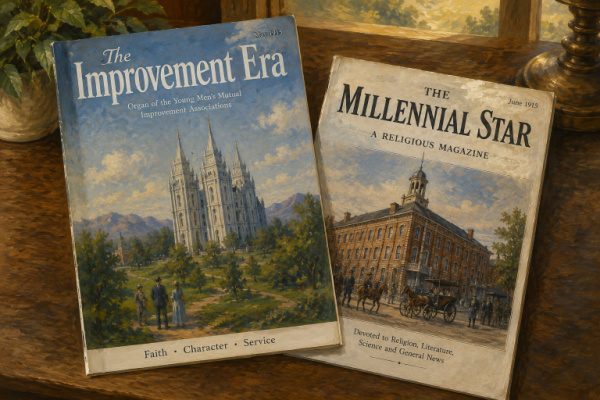
Why don’t either the Church website or its Gospel Library app have archives of pre-Ensign magazines like Improvement Era and Millennial Star? Surely those could also be helpful resources when about to give a talk in sacrament meeting, stake conference, and other Church functions.
Samuel
Answer
Gramps,
It’s a fair question, and one that doesn’t have a simple official answer.
The Church has never published a detailed explanation for why these older magazines aren’t part of the Gospel Library app or the main Church website’s standard library. However, several reasonable explanations help make sense of the decision.
One of the biggest reasons is the purpose of the Gospel Library itself. The app isn’t intended to be a complete historical archive of everything the Church has ever published. Instead, it’s intended to serve as the Church’s current study library. Its primary purpose is to provide members with the scriptures, General Conference messages, current Church magazines, handbooks, manuals, and other approved teaching resources that support worship, personal study, family study, missionary work, and Church callings.
If every Church publication from the past 190 years were included, the library would become enormous. Thousands of issues of magazines, journals, and newsletters would make it much more difficult for members to quickly find the resources they use every week. By limiting the collection to current, correlated materials, Gospel Library remains simple, organized, and easy to navigate.
Another important consideration is the nature of many of those older publications.
Magazines like the Improvement Era and Millennial Star are wonderful historical resources, but they were produced during a very different period in Church history. Before the Church’s correlation program was developed during the 1960s and 1970s, magazines often included articles by Church leaders, scholars, historians, and other contributors that expressed their understanding of gospel topics. While many of these articles remain inspiring and insightful, not every article represented official Church doctrine or policy.
In other words, the fact that something appeared in an official Church magazine decades ago doesn’t necessarily mean it was intended to become a binding doctrine for the Church. Some articles reflected personal opinions, interpretations, or scholarship that may have changed as additional revelation and understanding came through living prophets and apostles.
That doesn’t diminish the value of those magazines. It simply means they need to be read with an understanding of the historical context in which they were written.
Today’s Gospel Library focuses on resources that have been carefully reviewed and correlated to reflect current doctrine and current Church practices. That helps ensure members are studying materials that align with the teachings of the living prophets and apostles.
There are also practical reasons why these older magazines may not appear in Gospel Library.
Digitizing, proofreading, indexing, tagging, and maintaining well over a century of publications is a tremendous undertaking. Even after old magazines have been scanned, they often require extensive work to make them searchable and accurate. Maintaining such a massive archive within an app used by millions of members every day would require significant ongoing resources.
Fortunately, the Church has not hidden these publications.
Many older Church magazines are available through the Church History collections and other online historical archives. Researchers, historians, and interested members can still access much of this material when they want to study the development of Church history, learn about early missionary work, or read teachings from previous generations.
So, can these magazines still be useful today?
Absolutely.
If you’re preparing a sacrament meeting talk, teaching a class, or giving a presentation at another Church function, an older magazine article can provide interesting historical background or a thoughtful quotation. Sometimes these publications contain beautiful insights that are just as meaningful today as when they were first published.
However, it’s generally wise to use them as supplemental resources rather than primary sources.
The Church consistently encourages members to build lessons and talks primarily from the scriptures, recent General Conference addresses, current Church manuals, and the Liahona. These resources represent what the First Presidency and Quorum of the Twelve Apostles are emphasizing for the Church today.
This reflects an important principle of Latter-day Saint belief: we are led by living prophets. While we treasure the teachings of past prophets and leaders, we also recognize that continuing revelation means the Lord continues to guide His Church. Sometimes policies change. Sometimes emphasis changes. Occasionally, our understanding of a doctrine becomes clearer over time.
Because of that, when an older statement appears to differ from more recent teachings, members generally give greater weight to the scriptures and the current teachings of the living prophets and apostles.
This doesn’t mean older publications are unreliable or unimportant. Quite the opposite—they are valuable windows into the history of the Restoration. They help us understand how the Church grew, how members lived the gospel in earlier generations, and how the Lord has continued to guide His people over time.
In many ways, the difference comes down to purpose.
Historical magazines like the Improvement Era and Millennial Star serve as archives that preserve the Church’s rich history. Gospel Library, on the other hand, serves as the Church’s modern study library—a carefully selected collection of resources intended to help members live and teach the gospel today.
Both have great value, but they serve different needs.
So while it would certainly be convenient to have every historical Church publication available inside Gospel Library, the Church appears to have chosen a different approach. Members who want current, authoritative teaching have an organized library that reflects the Church’s present emphasis. Those who wish to explore the rich history of the Restoration can still access many historical publications through the Church’s archival resources.
In the end, the two collections complement one another. One helps us understand where we’ve been, while the other helps guide us where the Lord is leading His Church today.
Gramps
Related Posts
 Should my mentally handicapped son hold the priesthood in the Mormon Church?
 Why doesn’t the Mormon Church have crosses on their buildings as do other Christian churches?
 Should little children be permitted to bear their testimonies in Sacrament Meeting?
 How Can I Teach My Children Not to Watch Pg-13 Rated Movies?