
Question
Gramps,
Did early LDS women hold the priesthood?
Roy
Answer
Roy,
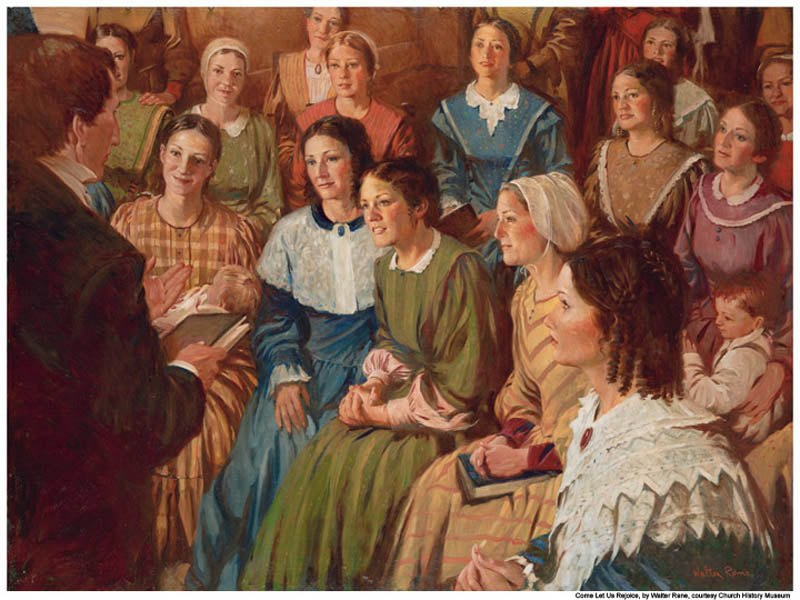
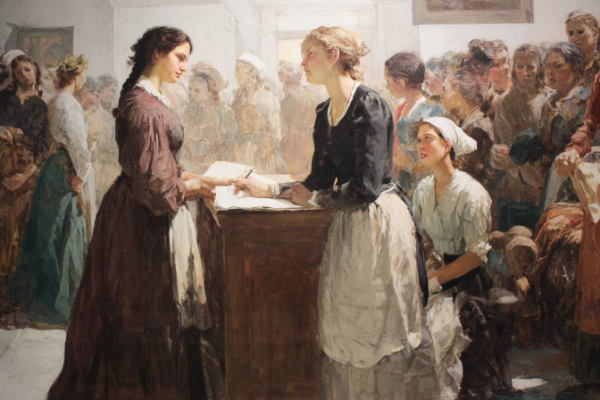
When The Church of Jesus Christ of Latter-day Saints was organized in 1830, religious authority and the concept of priesthood were in flux and developing. In 1842, Joseph Smith, Jr., the prophet-founder, organized the Female Relief Society of Nauvoo: the oldest continually operating women’s organization in the United States. During its first meetings, Joseph Smith addressed the assembled women, encouraging them to “move according to the ancient Priesthood,” intending that the Relief Society be “a select Society separate from all the evils of the world, choice, virtuous and holy — said he was going to make of this Society a kingdom of priests as in Enoch’s day.”
On these occasions, the minutes record that Joseph Smith used language indicating parallels—though not equivalence—between the Relief Society and the priesthood. He is recorded instructing the Society to operate “according to the ancient Priesthood,” hinting at a pattern but not at ordination in the sense later associated with priesthood offices.
Joseph Smith and John Taylor indeed ordained Emma Smith and her counselors to preside over the society. However, as later clarified by Joseph Fielding Smith (the Church’s 10th President), the term “ordain” in the early Church was sometimes used synonymously with “set apart,” a general term for being appointed to a religious office or duty. Over time, “ordain” has become reserved for the formal conferral of priesthood offices, all of which are currently reserved for men, while “set apart” describes appointments to Church responsibilities, including those filled by women.
Brigham Young, Joseph’s successor, later stated that women “never can hold the keys of the Priesthood apart from their husband,” underlining the difference between Church government and the self-governing spheres established for women. Nevertheless, women immediately gained position and visibility as leaders within their spheres, especially through the Relief Society.
Within the Church, the “priesthood” is God’s delegated power and authority to act in His name for the salvation of humanity. It is conferred on worthy male members, who are then ordained to offices such as deacon, teacher, priest, bishop, elder, high priest, Seventy, and Apostle. Women are not ordained to these offices. The Church’s handbook and instructional materials explicitly state that ordination and priesthood governance are reserved for men, typically beginning at age 11 or 12 for boys.
Though women are not ordained to the priesthood office, they play vital roles in performing sacred temple ordinances for other women. This is most apparent in the performance of “initiatory” rites (washings and anointings), where decency and ritual propriety require ordinance workers and recipients to be of the same gender.
Joseph Fielding Smith explained:
“A person may have authority given to him, or a sister to her, to do certain things in the Church that are binding and absolutely necessary for our salvation, such as the work that our sisters do in the House of the Lord … They have authority given unto them to do some great and wonderful things, sacred unto the Lord, and binding just as thoroughly as are the blessings that are given by the men who hold the Priesthood. And you sisters who labor in the House of the Lord can lay your hands upon your sisters, and with divine authority, because the Lord recognizes positions which you occupy.”
This “authority” is not the same as holding a priesthood office. Still, it is priesthood authority in the sense that these ordinances are only performed by the authority of the temple president, who holds priesthood keys. Thus, women officiate in sacred ordinances, but under delegated priesthood authority, not by ordination.
The unique role of women in temple ordinances has been highlighted by contemporary Church leaders. President Dallin H. Oaks observed:
“We are not accustomed to speaking of women having the authority of the priesthood in their Church callings, but what other authority can it be? … When a woman—young or old—is set apart to preach the gospel as a full-time missionary, she is given priesthood authority to perform a priesthood function. The same is true when a woman is set apart to function as an officer or teacher in a Church organization under the direction of one who holds the keys of the priesthood. Whoever functions in an office or calling received from one who holds priesthood keys exercises priesthood authority in performing her or his assigned duties.”
Thus, women do exercise priesthood authority (delegated, by appointment) in some functions, especially in sacred ordinances in temples. They do not, however, hold priesthood offices—a key distinction in Latter-day Saint theology.
In the early Church, women often exercised spiritual gifts, such as healing the sick through the laying on of hands, just as men did. Joseph Smith taught Relief Society members, drawing on Mark 16:17, that “these signs, such as healing the sick, casting out devils etc. should follow all that believe,” and that there “could be no more sin in any female laying hands on the sick than in wetting the face with water … It is no sin for anybody to do it that has faith.” These faith-based blessings were not priesthood ordinances but expressions of spiritual gifts. Over the 20th century, the encouragement for women to offer such healing blessings outside the temple was discouraged, and today such blessings are reserved for holders of priesthood office.
Joseph Smith’s vision included leading women as well as men into sacred temple rituals, culminating in the “fulness of the priesthood,” with the ultimate promise (for both men and women) to become “kings and priests” and “queens and priestesses,” an expression of Mormon theosis or divinization. These highest temple blessings are promised for eternity and point to a joint participation in the fullness of God’s power, though their full meaning remains, in some measure, mysterious and is spoken of in the future tense.
While men exclusively hold priesthood offices and occupy governance roles, such as bishops and stake presidents, women lead all-female organizations, including the Relief Society, the Young Women, and the Primary (for children). Church governance—the formal, presiding decision-making roles—remains the domain of ordained men. However, women’s contributions, particularly in guiding the spiritual and temporal welfare of other women, are repeatedly affirmed as vital and divinely inspired.
Gramps