

Question
Gramps,
Was the Holy Ghost in full force on the earth during Christ’s ministry on the earth?
Clifford
Answer
Clifford,
The question of whether the Holy Ghost was “in full force” during the mortal ministry of Jesus Christ invites a careful and meaningful distinction in Latter-day Saint theology. The answer is both simple and nuanced: the Holy Ghost was active and present, but the full gift of His constant companionship was not widely available until after Jesus Christ was resurrected and glorified.
To understand this clearly, we need to distinguish between two doctrinal concepts: the influence of the Holy Ghost and the gift of the Holy Ghost.
In Latter-day Saint belief, the Holy Ghost is the third member of the Godhead, a personage of spirit whose mission is to testify of truth, provide revelation, comfort, warn, and sanctify. His influence has always been present on the earth. Prophets from Adam onward received divine guidance through the Spirit. Revelation has never been absent where faith and righteousness existed.
However, the gift of the Holy Ghost—meaning the right to His constant companionship—is something more. It is given after baptism by the laying on of hands by proper priesthood authority. Elder David A. Bednar explained:
“The gift of the Holy Ghost is bestowed only after proper and authorized baptism and by the laying on of hands by those holding the Melchizedek Priesthood. (Receive the Holy Ghost)
During Christ’s mortal ministry, this gift was not yet broadly conferred. The Apostle John recorded: “the Holy Ghost was not yet given; because that Jesus was not yet glorified” (John 7:39). Latter-day Saints understand this to mean that while the Holy Ghost was certainly influencing individuals, the fullness of His constant companionship had not yet been widely bestowed.
Elder Bruce R. McConkie taught this distinction clearly:
“Before the mortal ministry of Christ, the Holy Ghost was given to the faithful, but the gift of the Holy Ghost as a constant companion was not enjoyed in the same fullness.” (Bruce R. McConkie, A New Witness for the Articles of Faith (1985), p. 262)
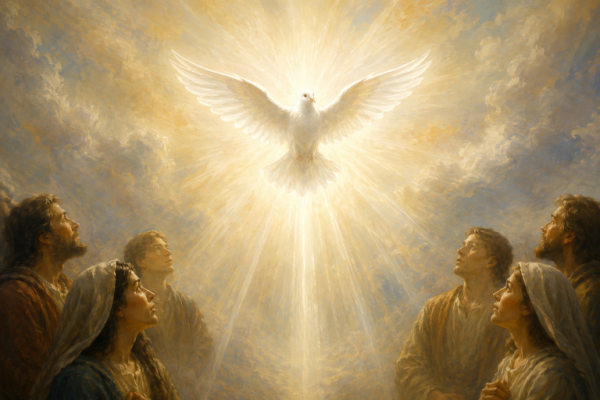
This helps us better understand what was happening during the Savior’s ministry. The Spirit was undeniably active. Jesus Christ Himself was conceived by the power of the Holy Ghost. At His baptism, the Spirit descended like a dove, symbolizing divine approval. Individuals received powerful spiritual witnesses—Peter’s testimony that Jesus is the Christ came through revelation.
Yet there are also clear signs that the Spirit was not yet fully present among Christ’s followers. The apostles at times struggled with understanding, showed fear, and lacked spiritual clarity. However, something changed dramatically after Christ’s resurrection.
In Acts 2, on the Day of Pentecost, the apostles experienced a powerful outpouring of the Spirit. They spoke with boldness, clarity, and spiritual power. Latter-day Saints understand this as a pivotal moment when the gift of the Holy Ghost began to be more fully manifested among Christ’s followers.
The Book of Mormon provides an even more vivid example. In 3 Nephi 19, after the resurrected Savior appears to the Nephites, He authorizes His disciples to baptize and confer the Holy Ghost. The people are then filled with overwhelming spiritual power—praying, rejoicing, and encircled by divine presence. This moment reflects a heightened spiritual condition made possible only after Christ’s glorification.
Why did this change occur? The answer lies in the Atonement of Jesus Christ.
The Holy Ghost’s role includes sanctifying individuals—making them holy. This sanctifying power depends on the completed Atonement. Elder Joseph B. Wirthlin taught:
“If they would open their hearts to the refining influence of this unspeakable gift of the Holy Ghost, a glorious new spiritual dimension would come to light.” (The Unspeakable Gift)
Before Christ completed His suffering, death, and resurrection, the full effects of that sanctification could not yet be fully applied. Once the Atonement was complete, the way was opened for individuals to receive not just occasional spiritual impressions, but ongoing sanctification through the constant companionship of the Holy Ghost.
President Henry B. Eyring emphasized the importance of this blessing in our day:
“I give my witness that the living Christ sends the Holy Ghost, the Comforter, to those we are pledged to help Him comfort.” (The Comforter)
This constant companionship is one of the great blessings restored through the Prophet Joseph Smith. With priesthood authority reestablished, individuals today can receive the gift of the Holy Ghost after baptism and enjoy its guidance regularly—something not universally available during Christ’s mortal ministry.
So, was the Holy Ghost “in full force” during Christ’s ministry?
The most accurate Latter-day Saint answer is this: the Holy Ghost was actively influencing, testifying, and guiding, but the full, covenant-based gift of His constant companionship was not yet widely given until after Jesus Christ’s resurrection and glorification.
Understanding this distinction deepens our appreciation for both the Savior’s Atonement and the gift of the Holy Ghost today. Because of Jesus Christ, the heavens are more open. The Spirit can be with us continually—not just in moments, but in daily life—guiding decisions, offering comfort, warning of danger, and sanctifying our hearts.
Members of The Church of Jesus Christ of Latter-day Saints believe this gift is one of the greatest blessings of mortality. Each week, as they partake of the sacrament, they renew the promise that they may “always have his Spirit to be with them” (Doctrine and Covenants 20:77).
That promise is profound. It means that through Jesus Christ, we live in a time when the Holy Ghost is not only present, but can be constantly with us.
Gramps