

Question
Gramps,
Can you provide comparisons and differences between Japanese Shinto shrines and temples of The Church of Jesus Christ of Latter-day Saints, when Church missionaries are assigned to Japan to teach investigators who are practitioners of the Japanese national religion, Shinto? Godspeed you in your research.
Samuel
Answer
Samuel,
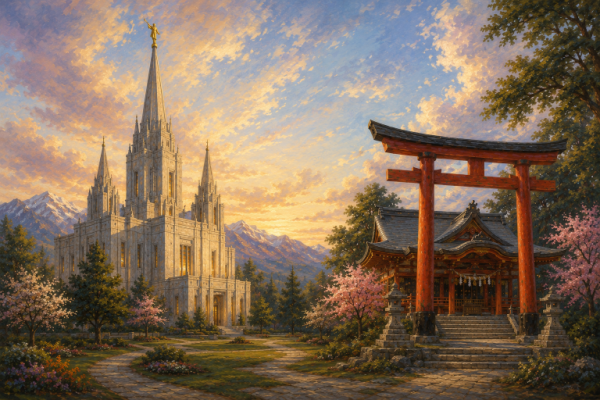
At first glance, a temple of The Church of Jesus Christ of Latter-day Saints and a Japanese Shinto shrine seem to have very little in common. One belongs to a Christian restorationist faith that began in nineteenth-century America, while the other reflects religious traditions that have existed in Japan for centuries. Their doctrines, purposes, and histories are very different.
Yet when we look beyond the surface, some fascinating parallels emerge. Both places are viewed as sacred spaces set apart from ordinary life. Both encourage worshippers to prepare themselves before entering. Both connect people with heaven in symbolic ways. And both remind visitors that there are places where the divine and the mortal meet.
Of course, the similarities should not be stretched too far. LDS temples and Shinto shrines serve different religious functions and are built upon different theological foundations. Nevertheless, comparing them can help us appreciate how people across cultures seek sacred experiences.
One of the most obvious similarities is the idea that certain places are holy.
For Latter-day Saints, temples are considered the “House of the Lord.” They are dedicated buildings where sacred ordinances are performed and where members seek a closer relationship with God. Temples are distinct from regular meetinghouses, where weekly worship services are held.
Similarly, Shinto shrines are sacred places dedicated to the worship and veneration of kami. The word “kami” is often translated as gods, spirits, or divine beings, though none of those terms perfectly captures the concept. Shrines are viewed as places where people can approach the sacred and offer prayers.
In both traditions, there is a clear distinction between ordinary space and holy space. Crossing onto temple grounds or passing through a shrine’s entrance carries symbolic meaning. It marks a movement from the everyday world into a place devoted to spiritual matters.
Another interesting similarity is the emphasis on preparation.
Before entering an LDS temple, members are expected to live according to certain spiritual standards and receive a temple recommend through interviews with local priesthood leaders. This preparation is intended to help worshippers approach sacred ordinances with faith and reverence.
At a Shinto shrine, visitors often participate in ritual purification before approaching the main sanctuary. A common practice is to wash the hands and rinse the mouth at a purification fountain called a temizuya. This act symbolizes cleansing before entering a sacred environment.
The purposes of these preparations differ, but the principle remains the same: sacred experiences deserve thoughtful preparation rather than casual participation.
Both traditions also use physical movement to teach spiritual truths.
In many LDS temples, worshippers progress through rooms and ceremonies that symbolize humanity’s relationship with God and the journey back into His presence. Temple worship is designed to be deeply symbolic and instructional.
Likewise, a visit to a Shinto shrine often involves a symbolic path. Visitors may pass through one or more torii gates, walk along designated approaches, and move gradually toward the shrine’s most sacred areas. Each step helps create a sense of leaving the ordinary world behind.
Neither tradition sees sacred space as merely a building. The approach itself becomes part of the spiritual experience.
Architecture plays an important role in both traditions.
LDS temples are often designed to inspire feelings of peace, reverence, and holiness. Their carefully maintained grounds, artistic details, and symbolic features encourage reflection and worship.
Japanese Shinto shrines also place great emphasis on beauty and harmony. Many are located in forests, near mountains, or alongside other natural settings. Their architecture frequently reflects simplicity, balance, and a connection to nature.
Although the styles differ dramatically, both traditions recognize that physical surroundings can influence spiritual feelings. Beautiful sacred spaces invite worshippers to slow down, reflect, and focus on things of eternal significance.
Many religions hold that certain places serve as points of connection between heaven and earth.
Latter-day Saints often view temples as places where God’s presence can be felt in a special way. Temples are also associated with covenants that connect families across generations and link mortality with eternity.
In Shinto tradition, shrines are places where humans may approach the kami and seek blessings, guidance, protection, or gratitude. Shrines serve as important points of contact between the human and spiritual realms.
Again, the theology behind these beliefs differs significantly, but both traditions recognize sacred places as locations where people seek divine connection.
While the similarities are fascinating, the differences are even more significant.
The most important distinction is theological.
LDS temples are centered on worship of God the Eternal Father and faith in Jesus Christ. Temple ordinances focus on covenants, salvation, exaltation, and eternal family relationships. Everything that occurs in an LDS temple is connected to the gospel of Jesus Christ.
Shinto shrines, by contrast, are not Christian institutions. They focus on reverence for kami, ancestral traditions, community worship, and harmony with the natural and spiritual worlds. Concepts such as salvation, atonement, and covenant relationships with God are not central to Shinto belief as they are in Latter-day Saint theology.
Access also differs. Most areas of a Shinto shrine are generally open to the public and often welcome visitors regardless of religious background. LDS temples, after dedication, are reserved for members of the Church who meet established standards of worthiness. However, temples are opened to the public during open-house periods before dedication.
The activities performed within these sacred spaces also differ. Temple ordinances such as baptisms for the dead, endowments, and sealings have no direct equivalent in Shinto practice. Likewise, many shrine rituals and traditions have no counterpart in Latter-day Saint worship.
Perhaps the most meaningful lesson from comparing LDS temples and Japanese Shinto shrines is not that they are the same—they clearly are not. Rather, people from very different cultures often express a common desire to seek the sacred.
Whether it is a temple rising above a city skyline or a shrine nestled among ancient trees, sacred places remind us that human beings have long searched for connection with something greater than themselves.
Latter-day Saints would see the ultimate purpose of temple worship as drawing closer to God through Jesus Christ and making eternal covenants. Followers of Shinto approach shrines with different beliefs and expectations. Yet both traditions demonstrate the powerful role that sacred spaces can play in helping people pause, reflect, worship, and seek divine influence in their lives.
In a world that often feels hurried and noisy, both temples and shrines stand as reminders that some places are meant to lift our thoughts beyond the ordinary and toward the eternal.
Gramps