
Question
Gramps,
I’m trying to better understand a discrepancy I’ve noticed between the explicitly clear teachings in The Book of Mormon and modern teachings about after judgment. The Book of Mormon very clearly teaches that there is a heaven and there is a hell, both post-judgment, not pre-judgment. How do you reconcile this teaching with modern teachings about kingdoms of glory? This seems to be a big deal.
Thanks,
Robert
Answer
Robert,
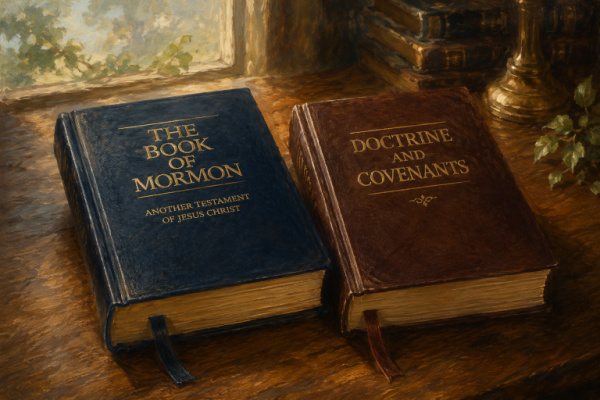
The Book of Mormon repeatedly teaches that after the Final Judgment, there are two ultimate outcomes: the righteous inherit eternal life with God, while the wicked are cast off into everlasting punishment. Then, in 1832, Joseph Smith and Sidney Rigdon received the vision now recorded in Doctrine and Covenants 76, revealing three kingdoms of glory—the celestial, terrestrial, and telestial kingdoms. Instead of only heaven and hell, Latter-day Saints now teach multiple degrees of glory, with only the sons of perdition inheriting outer darkness.
For many people, this raises an honest question: Did LDS doctrine change? If the Book of Mormon is “the most correct of any book on earth,” why doesn’t it clearly teach the three kingdoms?
From an LDS perspective, the answer is that it didn’t change—it expanded. The Restoration is built on the principle of continuing revelation. Rather than revealing every truth at once, the Lord has consistently taught His children “line upon line, precept upon precept” (2 Nephi 28:30). The Book of Mormon establishes the foundation of God’s plan of salvation, while later revelations provide greater detail on truths previously unrevealed.
As you read the Book of Mormon, one thing quickly becomes apparent. Its prophets consistently describe humanity in broad categories. People are righteous or wicked, believers or unbelievers, followers of Christ or followers of Satan. Their purpose wasn’t to explain every detail of eternity but to persuade people to come unto Christ and prepare for the judgment of God.
Jacob taught:
And it shall come to pass that when all men shall have passed from this first death unto life, insomuch as they have become immortal, they must appear before the judgment-seat of the Holy One of Israel; and then cometh the judgment, and then must they be judged according to the holy judgment of God.
And assuredly, as the Lord liveth, for the Lord God hath spoken it, and it is his eternal word, which cannot pass away, that they who are righteous shall be righteous still, and they who are filthy shall be filthy still; wherefore, they who are filthy are the devil and his angels; and they shall go away into everlasting fire, prepared for them; and their torment is as a lake of fire and brimstone, whose flame ascendeth up forever and ever and has no end. (2 Nephi 9:15-16)
King Benjamin likewise contrasted the eternal destiny of the righteous and the wicked (Mosiah 2:38-39):
Therefore if that man repenteth not, and remaineth and dieth an enemy to God, the demands of divine justice do awaken his immortal soul to a lively sense of his own guilt, which doth cause him to shrink from the presence of the Lord, and doth fill his breast with guilt, and pain, and anguish, which is like an unquenchable fire, whose flame ascendeth up forever and ever.
And now I say unto you, that mercy hath no claim on that man; therefore his final doom is to endure a never-ending torment.
Alma explained in Alma 41:3-4:
And it is requisite with the justice of God that men should be judged according to their works; and if their works were good in this life, and the desires of their hearts were good, that they should also, at the last day, be restored unto that which is good.
And if their works are evil they shall be restored unto them for evil. Therefore, all things shall be restored to their proper order, every thing to its natural frame—mortality raised to immortality, corruption to incorruption—raised to endless happiness to inherit the kingdom of God, or to endless misery to inherit the kingdom of the devil, the one on one hand, the other on the other
These passages never state that everyone who inherits heaven receives exactly the same reward. They simply contrast the final destiny of the righteous and the wicked. That additional understanding came through Doctrine and Covenants 76.
The revelation describes the celestial, terrestrial, and telestial kingdoms.
“These are they whose bodies are celestial…” (D&C 76:70)
“And again, we saw the terrestrial world…” (D&C 76:71)
“And again, we saw the glory of the telestial…” (D&C 76:81)
One especially remarkable verse says:
“And thus we saw… the glory of the telestial, which surpasses all understanding.” (D&C 76:89)
Rather than replacing the Book of Mormon, this revelation expands our understanding of God’s justice and mercy.
Latter-day Saints believe that all three kingdoms are kingdoms of glory made possible through Jesus Christ. Only the celestial kingdom is where the Father and the Son dwell in Their fullness (D&C 76:62). In that fullest sense, it is heaven, while outer darkness corresponds to the final state traditionally described as hell.
The Book of Mormon’s mission is not to answer every theological question. Moroni explained that its purpose is to convince all people that Jesus is the Christ.
President Dallin H. Oaks taught:
“The Final Judgment is not just an evaluation of a sum total of good and evil acts—what we have done. It is an acknowledgment of the final effect of our acts and thoughts—what we have become.” (The Challenge to Become)
Before concluding, it’s worth acknowledging something important. For some readers, calling Doctrine and Covenants 76 simply “continuing revelation” may not fully answer the question. They might reasonably ask, “If the three kingdoms of glory are such an important doctrine, why didn’t the Book of Mormon prophets teach them plainly?”
From an LDS perspective, however, this pattern is consistent with the way God has revealed truth throughout history. Jesus told His Apostles:
I have yet many things to say unto you, but ye cannot bear them now. (John 16:12)
After His resurrection, He continued teaching them for forty days (Acts 1:3):
President Russell M. Nelson taught:
“There is so much more that your Father in Heaven wants you to know.” (Revelation for the Church, Revelation for Our Lives)
Latter-day Saints, therefore, see the revelation on the degrees of glory not as a correction of the Book of Mormon but as an expansion of previously revealed truth.
So, is the difference between the Book of Mormon and Doctrine and Covenants 76 a big deal? It’s understandable why people notice it. From the Latter-day Saint perspective, however, there is no evidence that doctrine changed. Rather, it illustrates one of the central claims of the Restoration—that God continues to reveal truth through living prophets.
Whether someone ultimately accepts that explanation depends on an even larger question: Did Joseph Smith receive genuine revelation from God? If he did, then Doctrine and Covenants 76 represents inspired additional light that builds upon the foundation laid in the Book of Mormon. If he did not, the apparent difference would likely remain a significant challenge.
When the Book of Mormon and the Doctrine and Covenants are read together, they complement one another. The Book of Mormon lays the foundation by teaching the essential truths necessary for salvation through Jesus Christ. Later revelation opens the curtain a little farther, helping us better understand the marvelous breadth of God’s plan for His children. From an LDS perspective, that is exactly what continuing revelation is meant to do.
Gramps