
Question
Gramps,
I’ve always been under the impression that there is one prophet on the earth at a time, but I also know periods of the bible and the Book of Mormon overlap. So is that contradictory?
Chase
Answer
Chase,
If you have ever heard the idea that “there is only one prophet on the earth at a time,” it can sound a little confusing when you read the Bible and the Book of Mormon together. After all, the two books overlap in history, and during some of those periods, several prophets were clearly living at the same time.
So, is that contradictory? Not according to Latter-day Saint doctrine. The important thing is understanding what the Church means by “one prophet” at a time.
The scriptures themselves make it clear that many prophets can live at the same time. One of the best examples comes from the very beginning of the Book of Mormon.
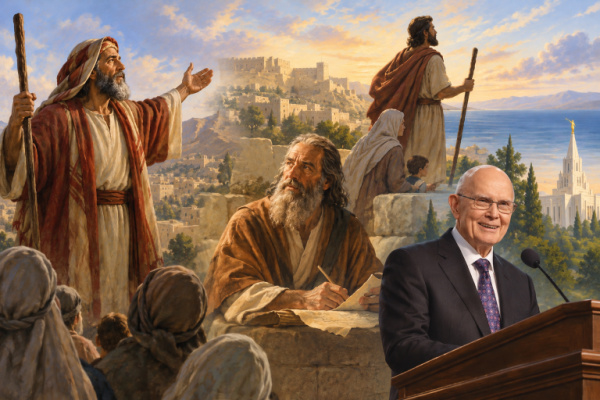
Nephi tells us that during the first year of King Zedekiah’s reign, around 600 B.C., “there came many prophets” to the people of Jerusalem, warning them that they needed to repent or Jerusalem would be destroyed.
One of those prophets was Lehi. The Lord gave Lehi visions and commanded him to preach repentance. Eventually, Lehi and his family left Jerusalem and began their journey to the promised land. But Lehi wasn’t the only prophet around at the time.
Jeremiah was also prophesying in Jerusalem during this same general period. The Church’s instructional material specifically notes that “Jeremiah prophesied in Jerusalem during the same time as the prophet Lehi.”
The Book of Mormon actually gives us an even broader picture by saying that there were “many prophets” in Jerusalem. So clearly, “one prophet” cannot mean that only one person on the entire earth can be a prophet. This is where priesthood keys become important.
In the restored Church, the President of The Church of Jesus Christ of Latter-day Saints is the presiding prophet, seer, and revelator. He is the person who holds the keys necessary to receive revelation for the Church as a whole.
Doctrine and Covenants 43:2–4 teaches that the Lord’s revelations and commandments for the Church come through the person appointed to preside.
The Church’s Gospel Topics material explains:
“When the Lord wants to direct His Church, He speaks through the living prophet who serves as the President of the Church.”
So when Latter-day Saints say there is “one prophet on the earth,” they are generally talking about the one prophet who presides over the Lord’s Church and is authorized to receive revelation for the entire Church. That is different from saying there can be only one person anywhere on earth who has a prophetic calling or receives revelation from God.
There is another reason this can get confusing. Latter-day Saints sustain the members of the First Presidency and the Quorum of the Twelve Apostles as “prophets, seers, and revelators.”So, technically, the Church has more than one prophet.
However, there is a distinction between being a prophet, seer, and revelator and holding the keys of the President of the Church. The Church explains that although the First Presidency and Twelve are all sustained as prophets, seers, and revelators, the President of the Church is the one authorized to receive revelation for the entire Church.
President Ezra Taft Benson explained this distinction very directly:
“Only one man stands as the Lord’s spokesman to the Church and the world, and he is the president of the Church.”
The Bible follows the same general pattern. It doesn’t present prophecy as something limited to a single person living at a time. For example, during the period leading up to Jerusalem’s destruction, several prophets were active. Jeremiah was preaching in Jerusalem while Lehi was also receiving revelation from God.
That doesn’t mean Jeremiah and Lehi were competing prophets. They had different circumstances, audiences, and responsibilities. Jeremiah was called to minister among the people in Jerusalem, while Lehi was eventually commanded to take his family into the wilderness and establish a new branch of God’s covenant people.
This is actually an important principle in understanding how God has worked with His children throughout Scripture. God can call prophets to different people at the same time.
The Book of Mormon gives us another example of this principle because its prophets were ministering to the Nephites while prophets were also ministering to people in the Old World.
That makes sense when we remember that the Bible and the Book of Mormon are records of God’s dealings with different groups of people. The Bible primarily records God’s dealings with people in the Old World, while the Book of Mormon records God’s dealings with another group of Israelites who were led away from Jerusalem.
There is therefore no reason, from an LDS perspective, that God could not have prophets working among different groups of His children at the same time.
The easiest way to understand the phrase “one prophet on the earth” is this: there can be many prophets, but there is one presiding prophet who holds the keys to direct the Lord’s Church as a whole.
That’s what Latter-day Saint leaders mean when they emphasize the importance of having a living prophet.
President Ezra Taft Benson famously taught:
“The most important prophet, so far as we are concerned, is the one who is living in our day and age.”
His point was that while we have the words of ancient prophets available to us, the living prophet has the responsibility of providing revelation and guidance for the Church in the circumstances of our own time.
So Jeremiah could be a prophet. Lehi could be a prophet. Nephi could be a prophet. Alma could be a prophet. And at the same time, in the modern Church, the President of the Church is the presiding prophet with the keys to receive revelation for the entire Church.
In other words, “one prophet” doesn’t mean “only one prophet exists.” It means there is one presiding prophet who holds the keys to speak authoritatively for the Church as a whole.
Once that distinction is understood, the apparent conflict between the Bible and the Book of Mormon disappears. The fact that their histories overlap actually provides a good scriptural example of the difference between having multiple prophets and having one presiding prophet with the keys of the Church.
Gramps