
Question
Gramps,
Why would the prophet and the first counselors urge us to get the Covid 19 vaccine and say it’s proven to be safe and effective if so many people were having health problems after taking it?
Aubrey
Answer
Aubrey,
When the COVID-19 pandemic began, people everywhere were frightened, confused, and worried about what the future would hold. Many people became seriously ill, hospitals were overwhelmed, and families lost loved ones. When vaccines became available, the leaders of The Church of Jesus Christ of Latter-day Saints encouraged members to get vaccinated.
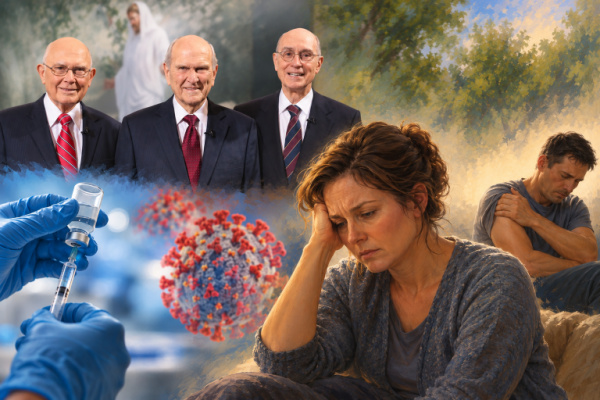
But looking back, some people have an honest question: Why did President Russell M. Nelson and his counselors, Dallin H. Oaks and Henry B. Eyring, encourage vaccination and say the vaccines were safe and effective, even as some people experienced serious health problems after receiving them?
That is a fair question. Let’s look at what the Church actually said, what medical evidence can tell us, and what LDS doctrine teaches about prophetic leadership.
On August 12, 2021, the First Presidency issued a message encouraging Church members to get vaccinated against COVID-19. They wrote:
“Available vaccines have proven to be both safe and effective.”
They also encouraged members to follow the recommendations of medical experts and government leaders. \
It is important to understand the circumstances in which this message was given. In 2021, COVID-19 was still causing serious illness and death, and the Delta variant was spreading. Church leaders were trying to help protect members, particularly those who were older or more vulnerable to severe illness.
President Nelson was also a physician and heart surgeon before becoming a Church leader. He and his counselors relied on the medical information available to them and encouraged members to follow public-health recommendations. Their message appears to have been motivated by a sincere desire to protect people’s lives. However, understanding their intentions does not mean we must assume that every medical claim made at the time was perfectly complete or that every individual would have the same experience.
Yes, some people experienced serious adverse events following COVID-19 vaccination, and it would be wrong to dismiss their experiences or pretend that every person who received a vaccine had no problems. Many people experienced temporary side effects such as fatigue, headaches, muscle aches, and fever. In rare cases, more serious problems were identified. For example, medical authorities recognized a risk of myocarditis and pericarditis, which are inflammation of the heart muscle and the tissue surrounding the heart, particularly in certain groups following some mRNA vaccines. Other rare complications were also investigated.
The Centers for Disease Control and Prevention (CDC) provides information about these risks and vaccine safety. Its COVID-19 vaccine safety page explains what health authorities have identified and how adverse events are monitored:
At the same time, we need to distinguish between a health problem that happened after vaccination and one that was actually caused by the vaccine. Timing alone does not establish causation. Researchers investigate patterns, compare outcomes, and look for evidence of a connection. In some cases, a connection is established; in others, it is not.
This distinction matters, but it should never be used to brush aside someone who is suffering. A person who develops a serious health problem deserves to be heard, evaluated, and treated with compassion, whether the cause has been established or not. The fact that a vaccine has benefits for many people does not mean it is completely risk-free. Likewise, the fact that some people experience adverse effects does not automatically mean the vaccine provides no benefit. Both realities can be true.
This is where LDS doctrine becomes especially important.
Latter-day Saints believe that prophets are called by God and receive revelation to guide His Church. However, the Church’s own teachings make an important point: Church leaders are not infallible. They are mortal men who work with the knowledge, understanding, and revelation available to them.
The Church discusses this in its official resource on prophets.
We believe that God guides His Church through prophets, but that does not mean every statement a prophet makes about medicine, science, history, or other subjects is a direct revelation from God. There is a difference between a prophet teaching the gospel under divine inspiration and a prophet offering counsel about a practical matter.
Regarding COVID-19 vaccination, the First Presidency encouraged members to follow medical experts and government leaders. Their message presented vaccination as a public health measure intended to reduce the dangers posed by the pandemic. It was not presented as a new revelation or a doctrine of the Church.
That distinction matters.
We should not automatically assume that every detail of a prophet’s advice on a medical question has been revealed directly by Heavenly Father. Nor should we assume that a prophet has been deceived simply because medical understanding develops or because some people experience outcomes that were not fully anticipated.
Why would God allow this to happen? This is a difficult question, especially for someone who trusted Church leaders and later experienced a serious health problem after vaccination.
LDS doctrine teaches that we live in a mortal world where illness, suffering, and death are part of the human experience. We also believe that God has given us agency and expects us to use our minds, seek knowledge, and make responsible decisions.
The Doctrine and Covenants teaches:
“Seek learning, even by study and also by faith.” (Doctrine and Covenants 88:118)
Notice that the verse includes both study and faith. We do not have to choose between believing in God and carefully examining medical evidence. Sometimes we make decisions based on the best information available, only to discover later that the situation was more complicated than we understood. That is true in medicine and in many other areas of life.
We should also be careful not to assume that someone who experienced a bad outcome lacked faith, made a sinful choice, or failed to follow God. Health problems are not reliable measures of a person’s righteousness. And if someone believes the vaccine caused their illness, it is reasonable to want answers. That person deserves compassion and a serious medical evaluation, not criticism for asking questions.
Were the Church leaders wrong? The most honest answer is that we cannot determine from the Church’s statement alone whether every aspect of its advice was correct for every individual. The leaders were responding to a dangerous pandemic and relying on medical guidance available at the time. COVID-19 vaccines provided protection against severe disease, but they also carried risks, some of which were rare and became better understood through continued monitoring.
In medicine, “safe” generally does not mean “without any risk.” It means the benefits and risks have been evaluated, and the intervention is considered appropriate for a particular population or situation. Individual circumstances can differ, and medical recommendations can change as new evidence becomes available.
Whether the Church’s leaders should have communicated the uncertainties more clearly is a reasonable question to discuss. We do not need to pretend that every decision made during the pandemic was perfect in order to maintain faith in Jesus Christ.
I believe there are three important lessons we can take from this experience.
First, we can respect our prophets without assuming they possess unlimited knowledge about every subject. Their divine calling is real within LDS belief, but they remain mortal and do not know everything.
Second, we should use both spiritual guidance and reliable evidence when making personal medical decisions. Prayer, scripture study, consultation with qualified medical professionals, and an honest examination of the evidence can work together.
Third, we should treat people who have suffered after vaccination with compassion. We should not automatically assume that every reported problem was caused by a vaccine, but neither should we dismiss genuine adverse reactions simply because they are uncommon.
Above all, we should remember that our faith is centered on Jesus Christ, not on the assumption that every human decision will be perfect.
The Church encourages members to seek answers to difficult questions through careful study, reliable sources, and faith. Its resource on answering gospel questions offers guidance on thoughtfully investigating challenging subjects:
We can acknowledge the good intentions of Church leaders, recognize the limitations of human knowledge, and take into account the experiences of people who suffered deeply.
And we can do all of that while continuing to seek truth, exercise our agency, and trust in Jesus Christ. Faith does not require us to ignore difficult questions. Sometimes, asking those questions honestly is part of how we grow in understanding.
Gramps