
Question
Gramps,
A member of my branch said that after President Nelson’s first wife passed away, they held interviews to find a second wife. This person also made it seem like a prophet must be married. Do you know if this is true?
Thank you,
Michael
Answer
Michael,
This is one of those stories that tends to circulate quietly in Church culture—someone heard it from someone else, and before long, it starts to sound official. But when you slow it down and really look at it, the claim doesn’t hold up very well.
Let’s walk through it together in a straightforward, conversational way.
The idea you were told is that after the first wife of Russell M. Nelson passed away, the Church somehow organized interviews to help him find a second wife—and that, more broadly, a prophet must be married in order to serve.
That’s a pretty specific claim. And the first thing to say clearly is this: there is no reliable evidence that anything like that ever happened.
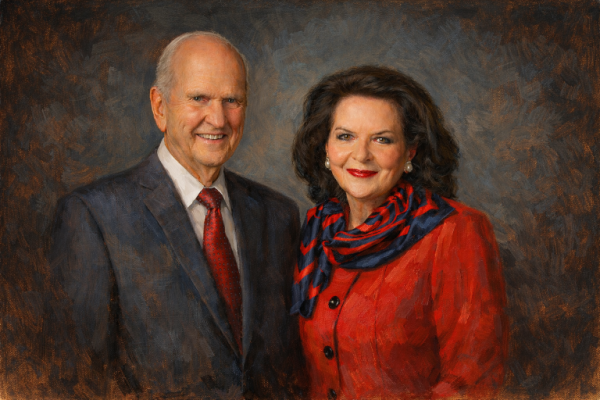
President Nelson’s first wife, Dantzel White Nelson, passed away in 2005 after decades of marriage. By all accounts, it was a deeply meaningful relationship. About a year later, he married Wendy Watson (now Wendy Nelson). Their story has actually been shared publicly in various settings, and it sounds exactly like what you’d expect from two faithful adults later in life—they met through Church and social connections, built a friendship, and eventually felt prompted that marriage was right.
There’s no indication—none—that Church headquarters conducted interviews, screened candidates, or played any formal role in selecting a spouse for him. That kind of process would be very out of character for how personal decisions are handled in the Church, even for senior leaders.
It’s important to remember that prophets and apostles, while called of God, are still living very real human lives. They experience loss, loneliness, companionship, and hope just as anyone else does. Marriage, especially later in life after losing a spouse, is a deeply personal decision. In Latter-day Saint belief, it’s something guided by prayer and individual revelation—not by committees.
So where might that rumor have come from?
Sometimes people see patterns and assume there must be a system behind them. President Nelson remarried. Other Church leaders who have lost spouses have also remarried. From the outside, someone might speculate, “Maybe that’s required,” and then that idea slowly morphs into something more structured, like “they must help arrange it.” But that leap just isn’t supported by facts.
Now, the second part of your question—whether a prophet must be married—is a little more nuanced.
There is no doctrine or policy that says a prophet must currently have a living spouse in order to serve as President of the Church.
That’s worth saying again, because it clears up a lot of confusion: there is no checklist item in Church doctrine that says “must be married” to be a prophet.
However, it is true that every modern president of the Church has been married at some point. That’s a pattern—but not the same thing as a requirement.
Why does that pattern exist?
Partly because of the stage of life these men are in. Prophets are typically called later in life, after decades of service as bishops, stake presidents, and apostles. By that time, most have long since married and raised families. So statistically, it would actually be unusual for a man in that position not to have been married.
There’s also a doctrinal layer to this. In Latter-day Saint theology, eternal marriage is central to God’s plan. Teachings about families, covenants, and exaltation are at the heart of the gospel. So it makes sense that prophets—who teach and model these principles—have lived them personally.
But again, that doesn’t mean they must be married when they serve.
For example, after Dantzel passed away, President Nelson continued serving as a senior apostle as a widower. His ability to serve, lead, and exercise priesthood authority wasn’t paused or limited because he wasn’t married during that period. That alone tells us something important—marital status isn’t what qualifies someone for prophetic leadership.
When he was called as President of the Church in 2018, he had already remarried. But there’s no evidence suggesting that remarriage was a prerequisite for that calling. In Latter-day Saint belief, prophets are called by revelation—through inspiration given to those who already hold priesthood keys—not by meeting a list of external conditions.
This is where it helps to separate culture from doctrine.
In Church culture, marriage is strongly emphasized—and for good reason. It’s a beautiful, central part of the gospel. But sometimes that emphasis can unintentionally lead people to assume things are more rigid than they actually are. A good principle (marriage is important) can slowly turn into an assumption (“you must be married for certain roles”), and then eventually into a rumor (“the Church arranges marriages for leaders”).
That’s usually how stories like this grow.
Another helpful lens is to ask: Does this align with how the Church typically operates?
When it comes to deeply personal decisions—like who to marry—the consistent teaching is that individuals seek guidance from the Lord themselves. Even prophets follow that pattern. They teach it, and they live it.
President Nelson himself has often emphasized personal revelation—encouraging members to seek the Lord’s guidance in their own lives. It would be very inconsistent if, in something as personal as marriage, that principle suddenly didn’t apply to him.
At the end of the day, the simplest explanation is usually the right one.
President Nelson lost his wife, grieved, continued serving faithfully, and eventually found companionship again with someone he felt inspired to marry. No interviews. No formal selection process. Just a faithful man making a personal, prayerful decision.
And honestly, there’s something really comforting about that.
It reminds us that even prophets walk through the same kinds of life experiences we do. They face loss. They move forward. They seek guidance. They build relationships. Their lives are guided by revelation—but not micromanaged by an institution, as rumors sometimes suggest.
So if you hear that story again, you can feel confident saying: there’s no credible evidence for it, and it doesn’t reflect how the Church or its leaders actually operate.
Gramps