
Question
Gramps
What was the significance of foot washing and why is it not practiced today?
Deb
Answer
Dear Deb,
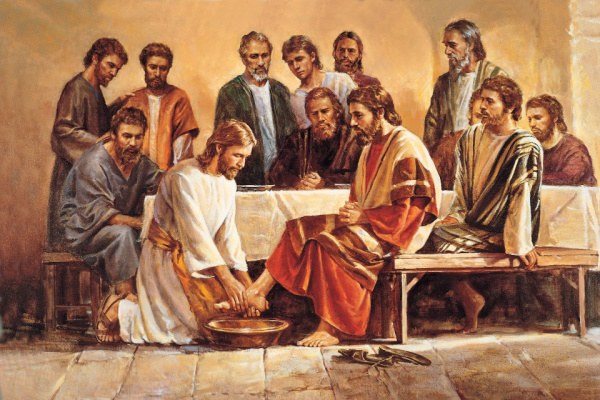
Long before the Restoration, foot washing was a familiar custom throughout the ancient Near East. Travelers, having journeyed dusty roads in sandals, arrived with soiled feet. Hospitality demanded a washing—either self-performed or by the host’s servant. Over time, this act transcended simple cleanliness, evolving into a powerful symbol of service and humility. Its ultimate scriptural reference appears in the New Testament, where Jesus Christ, on the eve of his crucifixion, girds himself with a towel and kneels to wash his disciples’ feet. This striking gesture of love and humility was charged with layered meaning—a testament to the inversion of power and the obligation of service within His kingdom.
Jesus’ actions, as recorded in John 13, elevate this common act:
“Ye call me Master and Lord: and ye say well; for so I am. If I then, your Lord and Master, have washed your feet; ye also ought to wash one another’s feet. For I have given you an example that ye should do as I have done to you. Verily, verily, I say unto you, The servant is not greater than his lord; neither he that is sent greater than he that sent him.”
Christ’s example reframed service—not as a menial task, but as a sacred obligation and the heart of discipleship.
In time, the early Christian church recognized foot washing as a formal ordinance, a tradition later echoed and magnified in the Restoration era by The Church of Jesus Christ of Latter-day Saints.
The restoration of ancient ordinances was a hallmark of Joseph Smith’s prophetic ministry. In the 1830s, as the Church grew in structure, the Prophet looked to precedents set by Christ and sought to implement them among his followers. Detailed records document foot washing as a distinct ritual among priesthood leaders and in temple settings.
In January 1833, Joseph Smith gathered thirteen brethren, washing each of their feet in emulation of Jesus. The intensely sacred nature of these events is emphasized in contemporary accounts. After Joseph washed each elder’s feet—kneeling, as Christ had done—his own feet were washed by Frederick G. Williams, symbolizing unity and personal commitment. Joseph explained the purpose: to make the elders “clean from the blood of this generation,” cleansing and sealing them to eternal life if faithful. Participation in this ordinance was often viewed as a preparation for sacred work, ensuring spiritual purity before undertaking major endeavors, such as missionary labor or temple service.
In March 1836, on the eve of the dedication of the Kirtland Temple, a dramatic scene unfolded. Hundreds of priesthood holders gathered as Joseph and his counselors washed the feet of the Twelve Apostles, the Seventy, and other Church leaders. These men had come fasting; as the ordinance proceeded, the spirit of Pentecost filled the temple—men prophesied, spoke in tongues, and prepared to take the gospel “to all nations” as endowed witnesses of Christ. This extended ritual functioned as both a literal and symbolic endowment, underscoring the connection between purity before God and readiness for divine service.
The act of foot washing in the Restoration was never a mere formality. It fused Old Testament precedent with New Testament example, serving as initiation, purification, and demonstration of humility. Rooted in Exodus and Christ’s own ministry, it served as a bridge between ancient priesthood practices and modern revelation.
Moreover, Joseph Smith explicitly taught that this ordinance was necessary “as much as it was in the days of the Savior” and that it should unite the hearts of those who served, strengthening their faith against the power of Satan. Historically, it was reserved for “official members”—apostles, seventies, and other leaders—designating it as both exclusive and highly sacred.
While the outward form and frequency of foot washing have diminished in contemporary Church practice, its legacy endures in the focus on service, humility, and unity. Its presence is still felt in the rare and sacred “second anointing” ordinance, where it serves as a culminating act of unity between a husband and wife, symbolically echoing Mary’s washing of Jesus’ feet and referencing both ancient custom and restored doctrine.
Foot washing, as explained by Church leaders and scholars, transforms everyday acts into sacred opportunities. Prayerfully serving others, especially in mundane or humble ways, invites the spirit and deepens relationships. By choosing to serve in what some might view as menial tasks, disciples emulate Christ, who “stooped lower than all” to lift those around him.
When Christ washed His disciples’ feet, He wasn’t simply cleansing them for dinner; He was preparing them for their greatest spiritual work—carrying His message to the world. Joseph Smith understood this parallel, viewing the ordinance as a means of making participants “clean from the blood of this generation,” thereby ready to bear holy responsibility. In the temple context, the same logic applies: foot washing signals readiness for a holier walk, ultimately foreshadowing the blessings of eternal life.
The ultimate paradox of the foot washing ordinance is its reversal of worldly status. Christ, the Master, becomes the servant; priesthood leaders, anointed and appointed, kneel at the feet of those they serve. “He that is greatest among you, let him be least,” taught Jesus.
Although modern culture rarely requires literal foot washing as a sign of hospitality, its spirit endures. Whether literal or symbolic, the meaning abides: to serve is to lead, to love is to lift, and to sanctify is to unify. As David O. McKay stated in 1951, “What an example of service to those great servants, followers of the Christ! He that is greatest among you, let him be least. So we sense the obligation to be of greater service.”
Gramps