
Question
Dear Gramps,
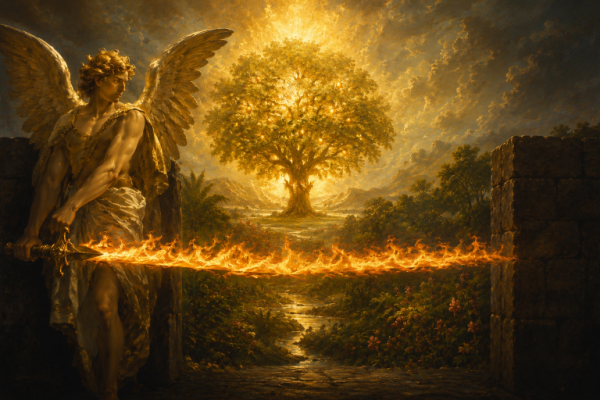
Thanks for being so great with your gospel responses. I’ve always loved the imagery of a Flaming Sword. Why do you think the Savior created a Flaming Sword & Cherubim to guard the tree of life? Why were both required when the Savior could have created just one thing that would do the job? Thanks again!
Ev
Answer
Ev,
In the book of Genesis, one of the most intriguing moments comes right after Adam and Eve are cast out of the Garden of Eden. The Lord places “cherubims, and a flaming sword which turned every way, to keep the way of the tree of life” (Genesis 3:24). For many readers, that verse raises an interesting question: Why both? If the Savior had the power to create anything, why use both cherubim and a flaming sword to guard the tree of life? Why not just one or the other?
According to the theology of The Church of Jesus Christ of Latter-day Saints, the answer may reveal something profound about the nature of God, justice, mercy, priesthood authority, and the sacred path back into His presence.
Latter-day Saints believe the Garden story is not merely symbolic fiction nor merely ancient history. It is deeply doctrinal and teaches eternal truths about mortality, agency, redemption, and exaltation. The details matter. When scripture mentions both cherubim and a flaming sword, it is likely intentional.
One important principle in LDS theology is that God does not act arbitrarily. The Savior’s actions are purposeful and layered with meaning. Elder Bruce R. McConkie once taught that the Fall introduced both physical and spiritual death into the world. Adam and Eve could no longer remain in God’s presence in their fallen condition. If they had immediately partaken of the tree of life after the Fall, they would have lived forever in their sins, without experiencing mortality, growth, repentance, or redemption through Jesus Christ.
That is why access to the tree had to be restricted.
The Book of Mormon gives additional insight into this doctrine. The prophet Alma explained:
“Now, we see that the man had become as God, knowing good and evil; and lest he should put forth his hand, and take also of the tree of life, and eat and live forever, the Lord God placed cherubim and the flaming sword” (Alma 42:2).
Alma goes on to explain that this delay created a “probationary state,” a time for mankind to repent and prepare to meet God. Without that separation, the entire Plan of Salvation would have been disrupted.
So why both a flaming sword and cherubim?
One possible answer is that they represent two different aspects of God’s nature and government.
The flaming sword may symbolize divine justice and the consequences of sin. Fire throughout scripture often represents the holiness and glory of God. It purifies, illuminates, and destroys impurity. The sword imagery suggests judgment, separation, and protection. A sword prevents unauthorized entry. It is active, powerful, and impossible to ignore.
Interestingly, the scripture says the sword “turned every way.” This creates the image of complete protection. There was no loophole, no alternate path, and no sneaking back into Eden. Humanity could not bypass the conditions God established.
From an LDS perspective, this teaches that no unclean thing can dwell in the presence of God. Spiritual laws are real. Justice is not optional. The Savior Himself upholds eternal law even as He prepares the way for mercy.
The cherubim, however, may symbolize something different.
Throughout scripture, cherubim are closely associated with the presence of God and sacred space. In the Old Testament, cherubim were embroidered into the veil of the tabernacle and later the temple. Two cherubim rested atop the Ark of the Covenant in the Holy of Holies. In temple symbolism, cherubim often represent heavenly beings who guard sacred things and testify to God’s glory.
This connection becomes especially meaningful in LDS temple theology.
Latter-day Saints view temples as places where heaven and earth symbolically meet. Sacred ordinances and covenants prepare individuals to return to the presence of God. In many ways, the Garden of Eden narrative parallels the temple journey. Humanity is separated from God, learns through mortal experience, enters into covenants, and eventually seeks to return to His presence through Jesus Christ.
In that light, the cherubim guarding the tree of life may represent more than security guards. They may symbolize divine authority, holiness, and the sacred order established by God. Access to eternal life is not casual or automatic. It comes through a covenant relationship with Jesus Christ.
The combination of cherubim and the flaming sword may therefore teach that returning to God requires both justice and holiness. One guards physically and symbolically; the other represents heavenly authority and sacred access.
There may also be another layer to this.
In LDS theology, the Savior perfectly balances mercy and justice. He does not eliminate eternal law; He fulfills it. The presence of both guardians may illustrate that God’s work is accomplished through multiple divine principles acting together rather than through simplistic force alone.
The flaming sword alone might emphasize fear and punishment. Cherubim alone might emphasize sacredness and heavenly order. Together, they communicate both the seriousness of separation from God and the sacred hope of eventual return.
That balance appears throughout the gospel.
Justice without mercy would condemn all mankind. Mercy without justice would destroy agency and accountability. The Savior harmonizes both through the Atonement. Likewise, the guardians of Eden may symbolically reflect multiple dimensions of divine truth operating together.
Another interesting possibility is that the dual guardianship teaches that eternal life is protected not merely from intrusion, but from misuse.
The tree of life represents eternal life, immortality, and the love of God. Partaking worthily requires transformation. Fallen humanity was not yet prepared to receive that fullness. The Savior’s restriction was therefore not cruel; it was merciful.
Sometimes God withholds blessings until His children are ready to receive them.
That principle appears repeatedly in scripture. Ancient Israel was not prepared for the higher law. Sacred temple ordinances are given carefully and reverently. Even spiritual knowledge often comes “line upon line, precept upon precept” (2 Nephi 28:30).
The guarding of the tree of life fits this same pattern. Humanity first needed mortality, opposition, growth, covenants, repentance, and ultimately the redemption made possible through Jesus Christ.
President Russell M. Nelson has frequently taught that God’s work is centered on bringing His children back into His presence. The story of Eden is therefore not merely about exclusion. It is about preparation for eventual reunion.
That changes the tone of the entire passage.
The cherubim and flaming sword were not permanent barriers meant to destroy hope. They were temporary protections established until the Savior could open the way through His Atonement and Resurrection.
In fact, one of the beautiful themes throughout scripture is that Christ eventually becomes the “way” back to the tree of life. In the Book of Mormon, the vision of the tree of life in 1 Nephi 8 represents the love of God revealed through Jesus Christ. What was once guarded becomes accessible again through covenant discipleship.
Through Christ, the path reopens.
Perhaps that is one reason both the flaming sword and cherubim were necessary. The Lord was teaching from the very beginning that returning to eternal life would involve more than overcoming danger. It would require transformation, holiness, covenant relationship, divine authority, and redemption through the Savior Himself.
The barriers in Eden ultimately point us toward Jesus Christ.
He is the one who satisfies justice. He is the one who grants mercy. He is the keeper of sacred things. He is the way back into the presence of the Father.
And maybe that is the deeper message hidden within the imagery of Genesis: the road back to the tree of life would never be simple, but it would always be possible through the Savior.
Gramps