
Question
Gramps,
In 3rd Nephi, there was daylight for a day, a night, and a day at the birth of the Savior. Is there any evidence of this happening outside of the Book of Mormon?
Shasta
Answer
Shasta,
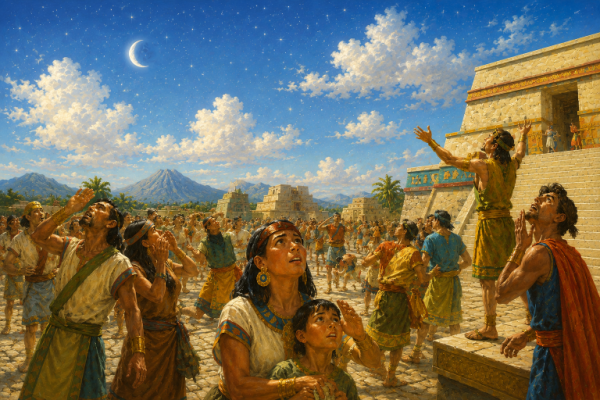
One of the more fascinating miracles recorded in the Book of Mormon is the sign given at the birth of Jesus Christ in the Americas. According to the account in 3 Nephi, believers witnessed something extraordinary: light throughout an entire “day and a night and a day” without darkness.
From a Latter-day Saint perspective, the answer is both interesting and somewhat complex. There are traditions, theories, and historical observations that some people find compelling, but there is no universally accepted historical proof outside the Book of Mormon that definitively confirms the event. Even so, many Latter-day Saints believe there are meaningful reasons why the account deserves thoughtful consideration.
The prophecy itself came years before the Savior’s birth through the prophet Samuel the Lamanite. Standing on the walls of Zarahemla, he declared:
“There shall be great lights in heaven, insomuch that in the night before he cometh there shall be no darkness.” (Helaman 14:3-4)
Samuel also prophesied that a new star would appear and that the signs would testify that the Son of God was coming into the world. For believers among the Nephites, these prophecies became a source of hope during a time when many mocked and rejected faith.
The fulfillment came exactly as Samuel had foretold. In 3 Nephi 1, the record states:
“At the going down of the sun there was no darkness; and the people began to be astonished because there was no darkness when the night came.” (3 Nephi 1:15)
The account continues:
“It was the day that the Lord should be born, because of the sign which had been given.” (3 Nephi 1:19)
For Latter-day Saints, the precision of the fulfillment is significant. The miracle did not happen randomly. It came as prophesied and at the exact time foretold. That pattern—prophecy followed by fulfillment—is a major theme throughout scripture.
So what evidence exists outside the Book of Mormon?
Over the years, some researchers and scholars have sought references in ancient records to unusual celestial events around the time of Christ’s birth. There are Chinese records of bright stars or novae, Roman references to unusual heavenly signs, and traditions among some ancient peoples describing extraordinary lights in the sky.
However, none of those records directly describes a night without darkness in the same way the Book of Mormon does. Some possible astronomical events from roughly 5-7 BC, such as planetary conjunctions or exploding stars, may help explain why people across the world noticed unusual activity in the heavens, but they do not fully account for the specific miracle described in 3 Nephi.
Some LDS scholars have explored whether a supernova or another atmospheric phenomenon could have contributed to extraordinary nighttime brightness. Others have suggested the miracle may have involved divine power beyond ordinary natural explanation. In many ways, that fits the broader pattern of miracles in scripture. After all, the scriptures also describe the Red Sea parting, Christ walking on water, and darkness covering the land at His crucifixion.
One important point often overlooked is that the Book of Mormon never explicitly says the entire world experienced uninterrupted daylight. The sign may have been intended specifically for the people of the Americas as a witness to the Savior’s birth.
A helpful Church article titled “Christmas in the New World” discusses this idea and notes that the miracle was given so “there should be no cause for unbelief among the children of men.” That wording echoes Samuel’s prophecy in Helaman 14:28:
“Many shall see greater things than these, to the intent that they might believe.”
That verse helps explain the spiritual purpose behind the sign. The miracle was not simply about creating amazement or satisfying curiosity. It was intended to strengthen faith in Jesus Christ.
That perspective matters because sometimes people approach the Book of Mormon as though every truth within it must first be proven scientifically before it can be believed. Yet LDS theology teaches that spiritual truths are often confirmed through revelation and the witness of the Holy Ghost as much as through physical evidence.
At the same time, the Church has never discouraged sincere study or investigation. Many Latter-day Saints appreciate archaeology, astronomy, and historical research related to scripture. In fact, thoughtful inquiry can sometimes deepen appreciation for the Book of Mormon’s complexity and consistency.
Still, believers generally recognize that not every miracle will leave behind clear scientific documentation. Ancient historical records are incomplete even for major world events. Countless writings have been lost over time, and many civilizations preserved history through oral tradition rather than written records.
It is also worth remembering that the sign in 3 Nephi was deeply symbolic. Jesus Christ repeatedly described Himself as the Light of the World. In the New World, the resurrected Savior declared:
“I am the light and the life of the world.” (3 Nephi 9:18)
The Apostle John recorded a similar declaration in the New Testament:
“I am the light of the world.” (John 8:12)
Seen through that lens, the miraculous light at Christ’s birth carries profound meaning. The coming of the Savior literally brought light into a darkened world. For believers in the Americas, the heavens themselves testified that the Messiah had arrived.
There is also an important human element to the story. Before the sign appeared, faithful believers faced ridicule and even threats of death because others claimed Samuel’s prophecy would fail. The account in 3 Nephi says that many began to lose hope as the appointed day approached.
Then, at what may have seemed like the last possible moment, the sign came.
That part of the story resonates with many modern readers. Sometimes, faith requires patience as we wait for promises to be fulfilled. The people who trusted the words of the prophets were eventually vindicated, even when circumstances seemed impossible.
Ironically, the Book of Mormon also shows that miracles alone do not guarantee lasting faith. After witnessing astonishing signs, many people eventually returned to pride and unbelief. The record repeatedly teaches that signs may inspire attention, but true conversion comes through choosing to follow Christ.
So, is there evidence outside the Book of Mormon for the day, night, and day without darkness? There are intriguing theories, scattered historical traditions, and astronomical possibilities, but no universally accepted proof. From an LDS theological perspective, though, that does not diminish the significance of the miracle.
For believers, the sign’s greater purpose was never simply to create historical evidence. It was to testify that Jesus Christ truly was the Son of God and the promised Savior of the world. The light in the sky pointed people toward the true Light—the Savior Himself.
Gramps