

Question
Gramps,
I just recently rediscovered your website! My question: Church farms require full labor on the Sabbath, or their employment is terminated, whereas most farmers (where I am located) who are members of the Church are able to halt most operations on Sunday. Often, people dealing with these local farmers are surprised to learn they aren’t doing business with them on Sunday, when the Church itself is still fully operating. Is there something I’m not aware of about Church farm work that could reconcile this? Thanks!
Jeremy
Answer
Jeremy,
Thank you for rediscovering the website and for asking such an interesting question! I can understand why this situation might seem confusing. If Latter-day Saints are taught to keep the Sabbath day holy and avoid unnecessary work on Sunday, why would Church-owned farms require employees to work that day? And why would local members who operate their own farms often shut down their operations instead?
The answer involves an important distinction between the Church’s teachings about the Sabbath, the practical needs of agricultural operations, and the circumstances of individual employees. However, we need to be careful not to assume that every Church farm requires Sunday labor or that employees will automatically be terminated for refusing to work. I could not verify a general Church-wide policy establishing either practice.
The Church’s doctrine about keeping the Sabbath is quite clear. In Doctrine and Covenants 59:9-10, the Lord commands His people to go to the house of prayer, offer their sacraments, and rest from their labors. Sunday is intended to be a day of worship, spiritual renewal, and devotion to God.
So why might agricultural work still take place on Sunday?
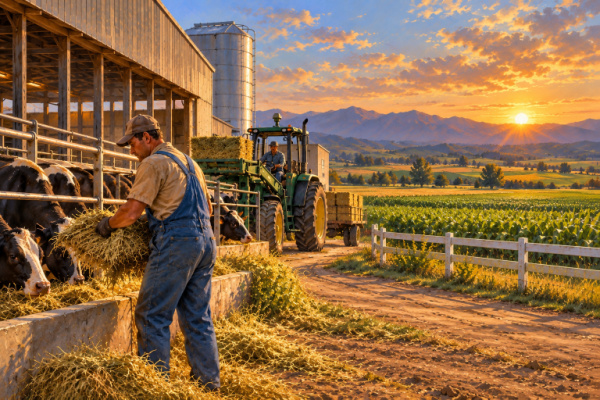
One possibility is that certain farm operations cannot simply be stopped without consequences. Livestock must be fed and watered, animals may need medical attention, and milking operations often have to follow regular schedules. Crops and other agricultural activities can also be affected by weather, seasonal conditions, and time-sensitive needs.
Of course, these considerations apply to both privately owned and Church-owned farms. Many Latter-day Saint farmers make arrangements to complete their regular work on other days and limit Sunday activities to essential care for animals or other unavoidable responsibilities. Others may face circumstances that require more work on the Sabbath.
This brings us to an important distinction: the difference between essential work and routine work.
Essential work involves responsibilities that cannot reasonably be postponed without causing harm, neglect, or significant problems. For example, a farmer may need to feed livestock, provide water, milk dairy cows, or respond to an emergency involving a sick animal. These responsibilities may have to be performed on Sunday because animals depend on daily care. Some agricultural tasks may also be time-sensitive because of weather conditions or other circumstances beyond the farmer’s control.
Routine work, on the other hand, involves activities that can generally be rescheduled without causing significant harm or disruption. Depending on the circumstances, examples might include ordinary office duties, nonurgent equipment maintenance, routine paperwork, or agricultural tasks that could reasonably wait until Monday.
Of course, the distinction is not always clear-cut. A task that can normally wait until Monday might become urgent due to an unexpected storm, equipment breakdown, or another emergency. The circumstances matter.
The Church has not established a universal rule declaring that every task that can be postponed must be postponed or that every task performed on Sunday is wrong. Nevertheless, this distinction gives us a helpful way to think about the purpose of the Sabbath. Caring for livestock may be necessary, but that does not automatically mean every agricultural operation must continue at its normal pace on Sunday.
The Savior Himself taught that doing good on the Sabbath is appropriate. In Matthew 12:11–12, Jesus explained that helping an animal in need was acceptable on the Sabbath and taught that it is lawful to do good on that day.
The lesson is not that the Sabbath no longer matters when work is inconvenient. Rather, the Lord expects us to understand the purpose of the Sabbath and exercise good judgment when genuine needs arise.
The Church’s teaching materials also recognize that some people must work on the Sabbath. Preach My Gospel discusses circumstances in which people may be required to work by their employers or need to provide for themselves, their families, or their communities. Members in these situations are encouraged to maintain the spirit of the Sabbath as much as possible and may counsel with their Church leaders.
That guidance is helpful because it recognizes that not every situation is the same. A nurse caring for patients, a firefighter responding to an emergency, and a farmer caring for livestock may all face responsibilities that cannot conveniently wait until Monday.
But that still leaves your main question: Why would the Church itself operate differently from local members who own farms?
It is worth remembering that the Church is a religious organization, but it also operates agricultural properties and other enterprises. Its operations can involve employees, production schedules, livestock, food supplies, and other practical responsibilities. The fact that a property belongs to the Church does not automatically mean every activity performed there is a religious ordinance or that every operational decision is an expression of doctrine.
At the same time, Church ownership should not be taken as proof that working every Sunday is necessary or that such work is automatically consistent with the ideal of Sabbath observance. The details matter. Some work may be essential, while other work might be scheduled differently. Without knowing which farm is involved, what duties employees perform, and what employment rules apply, it would be unfair to assume we know the reason for the schedule.
There is also a difference between an employee who must work on Sunday to keep a job and a self-employed farmer who can choose when to conduct business. An independent farmer may have greater flexibility to arrange the week’s work around Sunday worship. An employee may have less control over the schedule. That difference does not necessarily mean one person is more faithful than the other.
Naturally, if an employer requires Sunday work, a Latter-day Saint employee may need to weigh employment responsibilities, family needs, and personal religious convictions. The Church encourages members to honor the Sabbath, but its teaching materials also recognize that some employment circumstances cannot easily be avoided.
This is why we should be cautious about judging an individual employee’s faithfulness solely because they are working on Sunday. We may not know the circumstances involved.
Ultimately, your question raises a fair point. The Church teaches members to make the Sabbath a holy day, and it is reasonable to ask whether the Church’s own agricultural operations reflect that principle. Practical necessities can explain some Sunday labor, but they do not establish that all Sunday work is necessary.
The most accurate answer is that the doctrine of Sabbath observance is clear, while the particular employment practices of an individual Church farm need to be verified separately. I could not confirm an official, Church-wide rule requiring full Sunday labor at Church farms or mandating termination for employees who decline to work that day.
Thank you again for raising the question. It is a good reminder that applying gospel principles in the real world sometimes requires us to look carefully at the circumstances rather than assume that every situation has the same answer.
Gramps