
Question
Gramps,
I have a question regarding the Sacrament. Multiple church leaders and gospel-oriented manuals teach that Jesus Christ instituted the Sacrament in remembrance of both his body and his blood. While reading my scriptures, I came across Genesis 14:18-19, which seems to say that Melchizedek partook in some sort of sacramental ordinance. But didn’t Melchizedek live 2000 years before Jesus Christ? My question is simply this: given that our knowledge of ancient rituals is limited to a few accounts, including the Bible and modern-day revelation, was it a sacrament spoken of in these two verses?
Thanks.
Dave
Answer
Dave,
It’s a thoughtful question, and while the scriptures don’t provide a complete answer, Latter-day Saint doctrine offers enough insight to help us understand what was likely happening.
The first thing to remember is that the sacrament, as members of The Church of Jesus Christ of Latter-day Saints know it today, was instituted by Jesus Christ shortly before His crucifixion. During the Last Supper, He took the bread, blessed it, and gave it to His Apostles as a symbol of His body. He then took the cup and taught that it represented His blood, which would soon be shed for the remission of sins (see Matthew 26:26–28 and Luke 22:19–20).
Following His Resurrection, the Savior instituted the same ordinance among the Nephites, commanding them to continue partaking of bread and wine in remembrance of Him (3 Nephi 18:1-11).
Today, members of the Church partake of bread and water each Sunday as directed in Doctrine and Covenants 20:75–79 to remember the Savior’s sacrifice and renew their baptismal covenants.
Elder Jeffrey R. Holland emphasized why this ordinance is so important:
“Every ordinance of the gospel focuses in one way or another on the atonement of the Lord Jesus Christ, and surely that is why this particular ordinance [the sacrament] with all its symbolism and imagery comes to us more readily and more repeatedly than any other in our life.” (This Do in Remembrance of Me)
That helps us understand why the sacrament instituted by Jesus Christ is unique. It is the memorial ordinance of His completed Atonement.
So what about Melchizedek?
Genesis records:
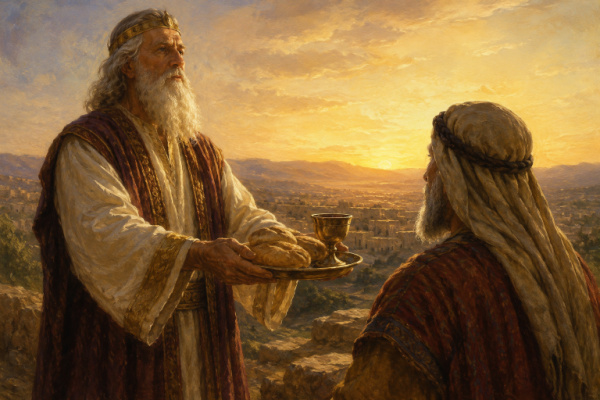
“And Melchizedek king of Salem brought forth bread and wine: and he was the priest of the most high God. And he blessed him…” (Genesis 14:18–19)
The passage never explains why Melchizedek brought bread and wine. It simply tells us that he did. Although many readers naturally associate bread and wine with the sacrament, Genesis never says that the bread represents Christ’s body or that the wine represents His blood. Nor does it describe the event as a memorial ordinance.
Instead, the safest conclusion according to LDS doctrine is that Melchizedek’s offering was a sacred priesthood act that pointed people to Jesus Christ. Like many Old Testament ordinances, it likely foreshadowed the coming Messiah.
The scriptures show that God had been teaching His children about Jesus Christ long before His mortal ministry. Adam, for example, was commanded to offer sacrifices. When an angel asked why he did so, Adam replied that he did not know except that the Lord had commanded him. The angel then explained:
“This thing is a similitude of the sacrifice of the Only Begotten of the Father.” (Moses 5:7)
Likewise, the prophet Amulek taught that ancient sacrifices pointed forward to “a great and last sacrifice.” After Christ’s Atonement, followers of the Savior would instead offer “a broken heart and a contrite spirit” (see Alma 34:13-15).
Melchizedek’s bread and wine fit naturally into that pattern. They appear to have been symbolic of the coming Redeemer, even though the scriptures stop short of identifying them as the sacrament.
The Prophet Joseph Smith also commented on this passage. In an 1843 discourse, he simply observed:
“Bread and wine were also administered by Melchizedek to Abraham.” (The Joseph Smith Papers, Discourse, 11 June 1843)
Notice what Joseph Smith does—and does not—say. He confirms that Melchizedek administered bread and wine, but he never identifies the event as the sacrament instituted by Jesus Christ. Interestingly, the Joseph Smith Translation also does not expand Genesis 14 by identifying this event as the sacrament. While that doesn’t prove it wasn’t, it suggests the Lord has not chosen to reveal additional details.
Another principle restored through the gospel is that Jesus Christ has always been the center of God’s plan. Faithful prophets in every dispensation looked forward to His coming through revealed ordinances, symbols, and covenants.
The Lord declared:
“This greater priesthood administereth the gospel.” (Doctrine and Covenants 84:17–19)
It’s also important to remember that our knowledge of ancient worship is limited. The Old Testament often records only brief summaries of events, and many details of priesthood ordinances have been lost. The Church’s Bible Dictionary describes Melchizedek as “one of the greatest of high priests,” reminding us that his ministry was much more extensive than the few verses preserved in Genesis.
Because of that limited record, we cannot say with certainty that Melchizedek administered the sacrament. The safest conclusion, according to LDS doctrine, is that his offering of bread and wine foreshadowed Jesus Christ, much like other ancient ordinances and sacrifices that pointed to the coming Messiah. The sacrament itself, however, was formally instituted by the Savior during the Last Supper and later given to the Nephites as the memorial ordinance His disciples continue to observe today.
Whether looking forward as Melchizedek did or looking back each Sabbath as we partake of the sacrament, the message is ultimately the same. Every true ordinance points us to Jesus Christ. Melchizedek’s bread and wine testified to the promised Redeemer, while the sacrament testifies that the Redeemer came, offered Himself as the great and last sacrifice, and invites us to remember Him every week.
Gramps