

Question
Gramps,
Will black people become white when they reach heaven, or after the resurrection?
Michele
Answer
Michele,
I will admit that I was quite taken aback and felt a slight cringe at the question. I will attempt to answer it in the same spirit in which I am hoping it was asked.
According to the current doctrine of The Church of Jesus Christ of Latter-day Saints, there is no teaching that a person’s race or skin color changes after death, at the resurrection, or in the celestial kingdom.
So where did this idea come from? Like many misconceptions, it has a complicated history involving scripture, speculation, and statements by some past Church leaders. Understanding the difference between official doctrine and historical opinions helps answer the question clearly.
The Church teaches that every person is a beloved child of Heavenly Parents. Our eternal worth has never depended on race, skin color, nationality, or ethnicity. President Russell M. Nelson taught:
“The Creator of us all calls on each of us to abandon attitudes of prejudice against any group of God’s children.”
That message reflects the Church’s current and consistent teaching that all people are equal before God.
One reason people ask this question is that passages in the Book of Mormon mention skin color. For example, 2 Nephi 5 describes the Lamanites receiving “a skin of blackness,” while 3 Nephi 2 later says that some Lamanites became “white.” For many years, some members assumed these verses referred to literal skin color and even believed they suggested that righteous people would eventually become physically white.
However, today’s Church does not teach that interpretation as doctrine.
Earlier editions of the Book of Mormon described the Lamanites as becoming “a white and delightsome people.” It currently says they became “a pure and delightsome people.” That wording matches 2 Nephi 30:6.
Many Latter-day Saint scholars also point out that scripture frequently uses colors symbolically. Throughout the Bible, words like white, black, light, and darkness often represent purity, holiness, sin, knowledge, or spiritual conditions rather than literal skin color. While faithful Latter-day Saints may disagree about every detail of these passages, there is no official doctrine teaching that exalted people undergo a racial transformation.
Another reason for the confusion is that some Church leaders in the nineteenth and twentieth centuries expressed opinions linking righteousness to lighter skin. Those statements reflected assumptions that were common in American society at the time. While those leaders sincerely believed what they taught, the Church has made it clear that not every statement by a Church leader constitutes official doctrine.
In 2013, the Church published the Gospel Topics essay Race and the Priesthood, which directly addressed these historical ideas. The essay states:
“Today, the Church disavows the theories advanced in the past that black skin is a sign of divine disfavor or curse… or that blacks or people of any other race or ethnicity are inferior in any way to anyone else.”
That statement is significant because it officially rejects theories that associate skin color with righteousness or divine favor.
The Church’s teachings about the Resurrection also give us no reason to believe that race will disappear. The Resurrection restores our bodies to a perfected, immortal condition. Alma taught that “all things shall be restored to their proper and perfect frame” (Alma 40:23). The scriptures describe resurrected bodies as being immortal, free from disease, pain, and death, but they never say that God changes someone’s ethnicity or racial characteristics.
President Joseph Fielding Smith explained that the Resurrection restores the body in a perfected condition. Perfection refers to freedom from death, disease, and corruption—not to conforming everyone to one physical appearance.
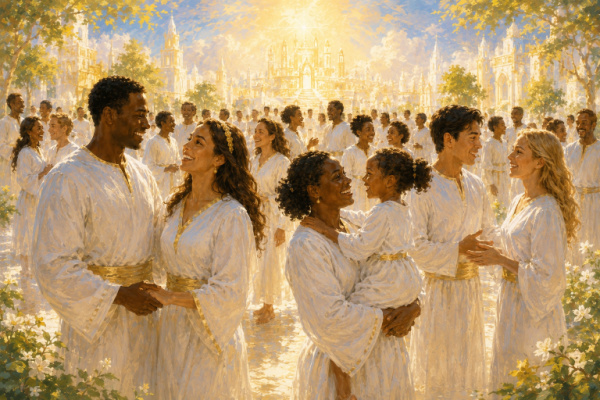
In fact, the restored gospel celebrates diversity rather than eliminating it. John saw in a vision that people from “all nations, and kindreds, and people, and tongues” would stand before God (Revelation 7:9). Nothing in that description suggests that those differences will disappear in eternity. Instead, it emphasizes that God’s family includes people from every background.
Perhaps the strongest scriptural statement comes from the Book of Mormon itself:
“The Lord denieth none that come unto him, black and white, bond and free, male and female… and all are alike unto God.” (2 Nephi 26:33)
This verse does not promise that people become physically alike. Instead, it teaches that they are already equal in God’s eyes. Our value has never depended on the color of our skin.
When we think about eternal life, the scriptures focus on something far more important than appearance. They teach that our hearts, our covenants, and our relationship with Jesus Christ determine our eternal destiny. The Resurrection removes the effects of death. The Atonement of Jesus Christ makes it possible for us to become spiritually clean. Exaltation changes our nature through Christ, not our race.
So, will black people become white in heaven or after the Resurrection?
According to the doctrine of The Church of Jesus Christ of Latter-day Saints, the answer is no. There is no official teaching that race or skin color changes in eternity. Historical statements suggesting otherwise are not part of the Church’s current doctrine and have been specifically rejected when based on theories of racial superiority or divine disfavor.
The restored gospel teaches something much more beautiful. Every person—regardless of race or ethnicity—is literally a child of God with infinite worth. Through Jesus Christ, we are invited to become pure, holy, and like our Heavenly Father. That transformation is spiritual, not racial.
In the end, heaven is not about everyone looking the same. It is about everyone becoming one in Christ while retaining the eternal identity God has given each of His children.
Gramps