
Question
Gramps,
Will King Solomon go to the Celestial Kingdom?
Theo
Answer
Theo,
The question of whether King Solomon will go to the Celestial Kingdom is an interesting one because the Bible describes him as a king who received great blessings from God but later turned away from the Lord. The Book of Mormon also speaks strongly against some of Solomon’s actions. When we look at this question through the teachings of The Church of Jesus Christ of Latter-day Saints, however, we need to distinguish between what the scriptures actually teach and what we might assume about Solomon’s eternal destiny.
The short answer is that Latter-day Saint scripture gives us serious reasons to question whether Solomon will receive exaltation, but we should be careful not to claim more certainty about his final judgment than the scriptures provide. His story is a powerful reminder that receiving God’s blessings does not remove our responsibility to remain faithful to Him.
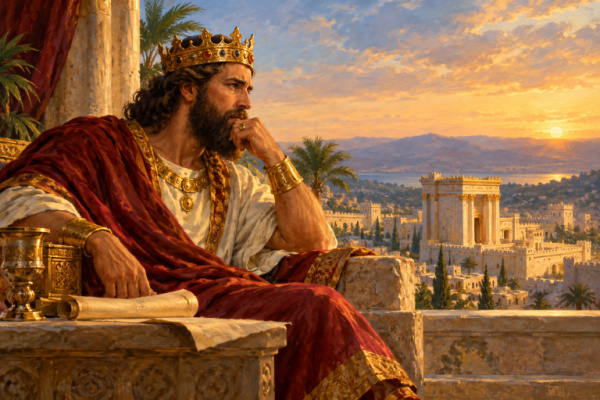
King Solomon’s story begins with remarkable spiritual promise. He was the son of King David and became king of Israel after his father. When the Lord appeared to Solomon in a dream, He invited him to ask for whatever he wanted. Solomon asked for an understanding heart so he could judge the people wisely. The Lord was pleased with his request and blessed him with wisdom, riches, and honor (see 1 Kings 3:5-14).
Solomon also built the temple in Jerusalem, which became a central place of worship for ancient Israel. At its dedication, he offered a beautiful prayer asking the Lord to hear the prayers of His people (see 1 Kings 8:22-53).
But Solomon’s life took a troubling turn.
According to 1 Kings 11:1-10, Solomon married many foreign women who worshipped other gods. The Scriptures say that as he grew older, his wives turned his heart away from the Lord. Solomon began following other gods and built places of worship for them. The Bible describes this as a serious departure from the faithfulness God expected of him.
The Lord had warned Israel’s kings against multiplying wives and turning their hearts away from Him (see Deuteronomy 17:17). Solomon’s choices were therefore more than a personal weakness; they represented a rejection of the spiritual responsibilities he had been given.
The Book of Mormon also addresses Solomon’s behavior. In Jacob 2:24, the Lord declares:
“Behold, David and Solomon truly had many wives and concubines, which thing was abominable before me, saith the Lord.”
This passage is important because it shows that Solomon’s conduct was not presented as an example for the Lord’s people to follow. The Lord’s condemnation of his behavior is clear.
At the same time, Latter-day Saint scripture teaches that plural marriage is not automatically sinful in every circumstance throughout history. Doctrine and Covenants 132:38–39 discusses David and Solomon in connection with their wives and concubines. Verse 38 states that they, along with other servants of God, received wives and concubines, but sinned in things they received not from the Lord. The passage then specifically states that David fell from his exaltation because of his actions involving Uriah and Bathsheba.
This distinction matters. According to Latter-day Saint teaching, the issue is not simply how many wives a person had. The issue includes whether a practice was authorized by God and whether the person remained faithful to Him. Solomon’s particular sin involved marrying women who turned his heart away from the Lord.
So, what does all this mean for Solomon’s eternal destiny?
In Latter-day Saint theology, the celestial kingdom is the highest of the three kingdoms of glory described in Doctrine and Covenants 76. However, receiving exaltation in the highest degree of the celestial kingdom involves more than having once been faithful, receiving spiritual gifts, or accomplishing great things for God. It requires faith in Jesus Christ, repentance, obedience to God’s commandments, and faithfulness to sacred covenants.
Doctrine and Covenants 131:1-4 explains that there are three degrees within the celestial kingdom and that celestial marriage is necessary to obtain the highest degree. Doctrine and Covenants 132:19–20 further explains the promises associated with that covenant and the need to abide in it.
Solomon’s story raises serious concerns about whether he met the requirements for exaltation. He received extraordinary blessings but later turned away from the Lord. His wisdom and accomplishments did not excuse his disobedience.
However, there is an important distinction between saying that Solomon’s actions were sinful and claiming that we know every detail of his final judgment. The scriptures describe his spiritual decline, but they do not provide a complete account of everything that occurred between Solomon and God at the end of his life. We should therefore be cautious about claiming to know more about his eternal fate than the revealed record tells us.
Latter-day Saints believe that God is perfectly just and knows the heart, understanding, opportunities, and choices of every individual. His judgment takes all of those things into account. That does not make Solomon’s disobedience unimportant, but it does remind us that the Lord is the final judge.
Ultimately, we cannot confidently declare that King Solomon will inherit the celestial kingdom, and his scriptural record gives us substantial reason to question whether he will receive exaltation. His story is a warning that even someone who begins with great faith, spiritual gifts, and blessings can turn away from God.
Solomon’s life also reminds us that wisdom alone is not enough. Knowing what is right and actually living according to that knowledge are two different things. The Lord wants more than our talents, accomplishments, or moments of spiritual greatness. He wants our hearts.
And perhaps that is one of the most important lessons we can take from Solomon’s story: it is not enough to begin our spiritual journey well. We must continue to follow the Lord, repent when we fall short, and remain faithful to Jesus Christ throughout our lives.
Gramps