
Question
Gramps,
Who are the saved ones at Christ’s second coming?
Sylvia
Answer
Sylvia,
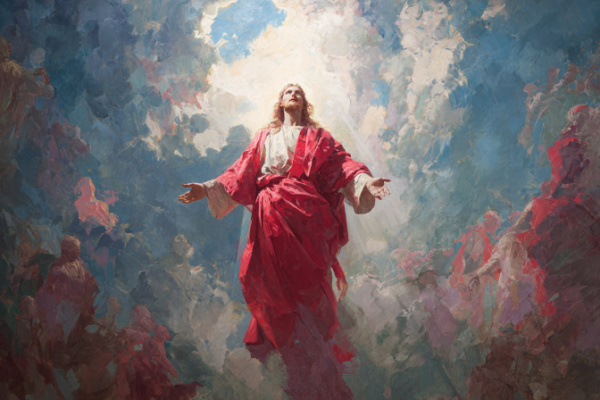
The Second Coming, often called “the great and dreadful day,” will unfold in stunning drama. According to prophetic statements, Christ will not come only once, but make several key appearances: to a future temple in Missouri, at Adam-ondi-Ahman, on the Mount of Olives, and finally in the clouds of heaven in power and glory—a spectacle visible to all living humanity. At that final moment, “the dead Saints burst forth from their tombs, and ‘those who are alive and remain’ are ‘caught up’ with them to meet him. The ungodly rush to hide themselves from his presence… He comes with all the hosts of the righteous glorified. The breath of his lip strikes death to the wicked. His glory is a consuming fire.”
The teachings of The Church of Jesus Christ of Latter-day Saints emphasize that this event will divide humanity, not simply by outward labels—such as membership in the Church or any religious organization—but by the real condition of the heart and one’s willingness to yield to God’s will. As the scriptures poignantly declare, “the Lord seeth not as man seeth; for man looketh on the outward appearance, but the Lord looketh on the heart” (1 Samuel 16:7). In this divine assessment, true righteousness and wickedness will be measured not by social standing or denominational affiliation, but by how each soul has responded to the light and truth it received.
Marvin J. Ashton had this to say:
When the Lord measures an individual, He does not take a tape measure around the person’s head to determine his mental capacity, nor his chest to determine his manliness, but He measures the heart as an indicator of the person’s capacity and potential to bless others.
Why the heart? Because the heart is a synonym for one’s entire makeup. We often use phrases about the heart to describe the total person. Thus, we describe people as being “big-hearted” or “goodhearted” or having a “heart of gold.” Or we speak of people with faint hearts, wise hearts, pure hearts, willing hearts, deceitful hearts, conniving hearts, courageous hearts, cold hearts, hearts of stone, or selfish hearts.
The measure of our hearts is the measure of our total performance. As used by the Lord, the “heart” of a person describes his effort to better self, or others, or the conditions he confronts.
Many Christians imagine that only those formally committed to Christ will be saved at His coming. However, the scriptural precedents cited in the Book of Mormon hint at a broader and more inclusive standard of mercy and justice. For example, during the destruction prior to Christ’s visit in the Americas, not all survivors were church members; rather, they were those who, though previously unaware or even hostile, were capable of repentance and faith. This pattern supports the notion that God spares and redeems all who He knows will become truly converted—regardless of current religious identity.
A core teaching of the Church during the Millennium—the thousand-year reign following the Second Coming—is that only those “who can abide at least a terrestrial law” will be permitted to dwell on the renewed earth. Doctrine and Covenants 76 describes three general groups eligible for resurrection and eternal life: those who attain celestial, terrestrial, or telestial glory. During the Millennium, only “both terrestrial and celestial people” will remain, as the glory of Christ’s presence will itself destroy all who cannot abide even a terrestrial standard of law and purity. These survivors, chosen not by human judgment but by divine prerogative, will hail from “all faiths and no faith,” having demonstrated honesty, uprightness, and a willingness to repent when given the chance.
The resurrection is deeply interwoven with the Second Coming in Latter-day Saint doctrine. The first resurrection began with Christ and encompasses all the righteous people of the earth. Those who have accepted the gospel, made and kept sacred covenants, and received necessary ordinances—either in life or vicariously—will come forth “in the morning of the first resurrection” to inherit the highest blessings of eternal life.
But what about those who never heard of Jesus Christ? As explained by modern prophets, the answer is both merciful and just: Those who had not heard the gospel preached to them, but who were of such a character that if they had heard it they would have believed, accepted, and lived completely worthy lives…will be resurrected to the celestial glory they merit, once temple work is completed on their behalf. This highlights the significance of temple ordinances and family history, which extend the redeeming power across all generations.
In stark contrast, those who have willfully rejected God’s law and lived in wickedness are not resurrected at the time of Christ’s coming. Instead, the evil people who are living on the earth when the Savior comes will not be resurrected at that time, but will be remanded to the custody of Satan for a thousand years. At the end of the Millennium, these will finally rise, inheriting telestial glory—or, in the case of the irredeemably rebellious known as “sons of perdition,” outer darkness itself.
Some may wonder, with so many being banished at the Second Coming, who is left to preach repentance in the spirit world during the Millennium? The answer lies in the careful order of resurrection. Not all righteous spirits will be resurrected at once; a “skeleton crew” remains, including those who are permitted to tarry due to a desire to continue missionary work, and others are granted resurrection only as their proxy ordinances are completed. As Joseph Fielding Smith explained, “resurrected beings will help us correct the mistakes we have made in doing research concerning our dead ancestors…Note that these persons, already being resurrected, are not requesting their own records or ordinances, but rather those of others who have not yet received the ordinances and thus have not yet been resurrected.”
A further layer of Latter-day Saint doctrine addresses not just survival or resurrection, but eternal life—to be saved in the highest sense, to inherit all that God has. When Joseph Smith spoke of being “sealed up unto eternal life” or having one’s “calling and election made sure,” he referred to distinct manifestations of assurance from God Himself. The Church’s teachings clarify these as “different kinds of conditional assurances that one will have eternal life.” While all worthy souls may hope for exaltation, some are given unique promises—sometimes by direct revelation from the voice of Jesus Christ, known as receiving “the more sure word of prophecy” or experiencing “the Second Comforter.” Joseph Smith described this experience as “the personage of Jesus Christ to attend him or appear unto him from time to time.” While these blessings are rare, they express the ultimate fulfillment of God’s promise to those who are valiant in their testimony and endure in faith and service.
The plan of salvation, as taught in The Church of Jesus Christ of Latter-day Saints, is not a narrow path reserved only for a select few. Instead, it is a sweeping program of redemption reaching all the Father’s children—past, present, and future. Those who did not experience mortality, or who lived outside the light of the Restoration, will yet receive a full and fair opportunity to accept or reject the gospel either in this life or the next. The only ones ultimately lost are those, like Satan and his followers, who have known Christ’s glory yet persist in unrepentant rebellion.
How are we to prepare? The words of Latter-day Saints leaders urge us to “stand with confidence in the presence of God, now”—not driven by fear, but by joyful anticipation and spiritual readiness. Prophets plead for us to become “wise virgins,” keeping covenants and living by the Spirit so that, at His coming, we may greet the Savior as friends and heirs, not as strangers. The Millennium will be a time of peace, healing, temple work, and collective joy, as mortals and immortals together participate in the furthering of God’s redemptive work.
Gramps