

Question
Gramps,
When heaven was a place of peace and righteousness, and everything was good, where did Satan get his negative intention from?
Frank
Answer
Frank,
Contrary to deterministic views that hold that evil arises solely from environmental causes, the Church teaches that agency is a divine gift. This agency allows individuals not only to be influenced by their surroundings but, more importantly, to make choices and act upon the world. In the words cited from the Book of Mormon by a Church source:
“Wherefore, the Lord God gave unto man that he should act for himself. Wherefore, man could not act for himself save it should be that he was enticed by the one or the other… an angel of God… had fallen from heaven; wherefore, he became a devil, having sought that which was evil before God.” (2 Nephi 2:16-17)
Thus, Satan’s evil did not arise because of any external, corrupt environment. As the full fruits of moral agency, Lucifer exercised his own will, seeking power, glory, fame, and domination and choosing to oppose all that was good.
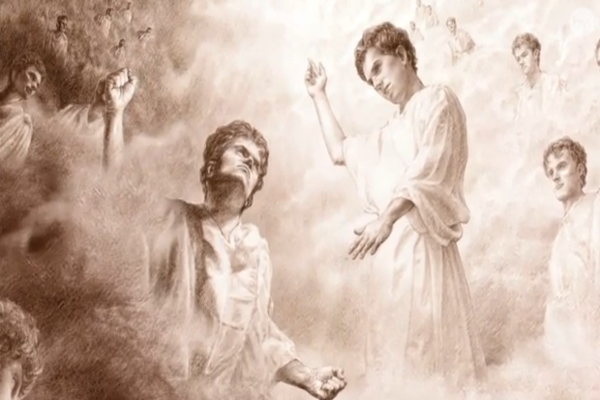
Scripture and prophetic teachings further clarify that God’s plan was presented in the pre-mortal realm, culminating in the selection of a Savior through the voluntary offering of Jesus Christ, the Firstborn of the Father’s spirit children. Lucifer, desiring to alter the plan for his own ends, rebelled—seeking to destroy the agency of man and demanding God’s honor for himself. As a result, he and those who followed him (a third of the hosts of heaven) were cast out, and denied the opportunity of mortal experience and eternal progression.
Speaking on this, Joseph Fielding Smith noted:
“The punishment of Satan and the third of the host of heaven who followed him, was that they were denied the privilege of being born into this world and receiving mortal bodies. They did not keep their first estate and were denied the opportunity of eternal progression. The Lord cast them out into the earth, where they became the tempters of mankind—the devil and his angels.” (Doctrines of Salvation,1:65)
A key tenet of the restored gospel is that opposition is essential for growth, learning, and progression—both for individuals and cosmic purposes. The Church teaches that there is “opposition in all things,” and that the presence of Satan plays a role in this greater plan.
It is important to recognize that, according to Church teachings, God did not create Satan intending for him to be evil; rather, Satan’s rebellion was an aberrant exercise of agency.
The Father seamlessly wove Satan’s rebellion into the working of the plan of salvation, so that it would go forward regardless of Satan’s evil actions. But the Father did not ordain Satan to rebel. God is not the father of evil.
By misusing his agency, Satan made himself the enemy of all righteousness. The opposition he now provides has become instrumental in helping the rest of God’s children exercise and refine their own agency—to experience both good and evil, and to “choose liberty and eternal life” or “captivity and death” (2 Nephi 2:27).
The necessity of an adversary becomes clear in the development of moral character. It is said that no knife was ever sharpened without being put to a grindstone. By such action, soft steel wears away, but hard steel is sharpened. So it is with the temptations of Satan. By being subjected to and overcoming the influence of the adversary, we gain moral strength until we can overcome all evil with righteousness.
Satan’s continued efforts to thwart God’s work—even as he seeks the misery of all mankind—are permitted within set boundaries because overcoming them leads to sanctification and spiritual growth.
Satan, as the embodiment of evil and adversary to all that is good, exerts significant influence in the world. Testimonies from early Church apostles and contemporary experiences recount events where Satan’s opposition has been both dramatic and tangible. Nevertheless, the Church teaches that Satan’s power is not absolute but is circumscribed by the sovereignty and wisdom of God.
For despite Satan’s seeming power, God is in complete control and sets the Adversary’s limits… God allows the adversary to work against Him as part of that opposition.
As made clear in scriptural teaching (e.g., Revelation 9), any power Satan has is granted under divine allowance, and for a set period or scope. Thus, no matter how great the darkness, it is always under God’s ultimate authority.
Satan’s greatest tools are deception, temptation, and accusation. He is described as the “father of all lies” and as actively seeking to blind, ensnare, and destroy the souls of men. Ancient and modern revelations describe him as “going up and down, to and fro in the earth, seeking to destroy the souls of men” (see Doctrine & Covenants 10:27; Job 1:7).
However, Satan can only exert influence insofar as people grant it to him by choosing to listen to his enticements rather than following Christ:
“One reason for the power Satan has is that we give it to him… the Saints are also involved in binding Satan: ‘And because of the righteousness of his people, Satan has no power; wherefore, he cannot be loosed for the space of many years; for he hath no power over the hearts of the people, for they dwell in righteousness, and the Holy One of Israel reigneth’ (1 Nephi 22:26).”
Church teachings stress that protection against the influence of the devil is found by obedience to the commandments and laws of the gospel of Jesus Christ. Ultimately, though the adversary rages, the faithful are assured a complete and lasting victory through the grace and power of Jesus Christ.
A common misconception arises from the vital role opposition plays: Should we be grateful for Satan’s rebellion? Church teachings clarify that while opposition is necessary, God does not create evil nor design any soul to rebel for the benefit of others. Rather, all of God’s children were created for growth, joy, and eternal progression. Satan and his followers acted in rebellion of their own will. To ascribe to God the creation of Satan for the sole purpose of rebellion is to misunderstand both His nature and justice.
There is a difference between knowing what your creation will do, and the purpose for which we are created… God’s work and glory is to bring to pass the immortality and eternal life of his children. If God created Satan to rebel, how would that satisfy Satan’s creation, for even God created Satan so that he could become more like Him?”
Thus, the existence and actions of Satan serve as a backdrop for the exercise of agency but are not objects of gratitude in themselves; the glory and praise are always due to God and to Christ, who provide the way of deliverance.
The Church teaches that the fate of Satan and his hosts is irrevocable alienation from the presence of God, having lost their first estate. The scriptures are clear that punishment and consequences follow only where laws have been willfully violated. Satan’s efforts, though permitted for a time, will ultimately result in his defeat and the full vindication of God’s plan of redemption.
Gramps