
Question
Gramps,
I heard it announced that there will be a solemn assembly during General Conference in April. What exactly is a solemn assembly?
Shelli
Answer
Shelli,
General Conference is the heart of The Church of Jesus Christ of Latter-day Saints’ yearly calendar. Convened every April and October, it unites millions of members worldwide in a spiritual experience that transcends borders. General conference is much more than a series of talks—it’s an opportunity for members to receive spiritual guidance and prophetic direction, to participate in hymns of faith, and to sustain the leadership of the Church in a symbolic gesture of unity.
During standard General Conference sessions, leaders and members come together—sometimes in person at the Conference Center in Salt Lake City, often via broadcast or internet from homes and chapels across the world. Each session blends musical numbers with messages from the First Presidency, Quorum of the Twelve Apostles, and other Church leaders. One distinctive feature is the sustaining vote, held semiannually, during which members express their support for Church leaders by raising their hands. Yet, while meaningful, these sustainings occur quickly and simply—without singling out individual quorums or groups.
As powerful as these conferences are, they maintain a certain familiarity—an organized, joyful, and instructional spirit. For many, it’s a well-loved tradition, an anchor of faith in a turbulent world. The unique character of General Conference—accessible, regular, and inclusive—makes it different from any form of worship found in other major world religions.
While General Conference is regular, the solemn assembly is rare. As explained by Elder David B. Haight,
“A solemn assembly, as the name implies, denotes a sacred, sober, and reverent occasion when the saints assemble under the direction of the First Presidency. Solemn assemblies are used for three purposes: the dedication of temples, special instruction to priesthood leaders, and sustaining a new President of the Church.”
Often, a solemn assembly is held as part of (or during) a General Conference session, though its structure, reverence, and purpose set it apart.
The term solemn assembly is not unique to modern times. It descends from the Hebrew Bible, where it described significant, community-wide gatherings for holy purposes. The Book of Mormon also references grand assemblies correlating to national renewal and covenant-making. In The Church of Jesus Christ of Latter-day Saints, the restoration of this practice began in the early 19th century, particularly with the dedication of the Kirtland Temple in 1836. Doctrine and Covenants, a canonical Church text, repeatedly counsels: “Call your solemn assemblies” (see Doctrine & Covenants 133:6), highlighting their foundational role in Church life.
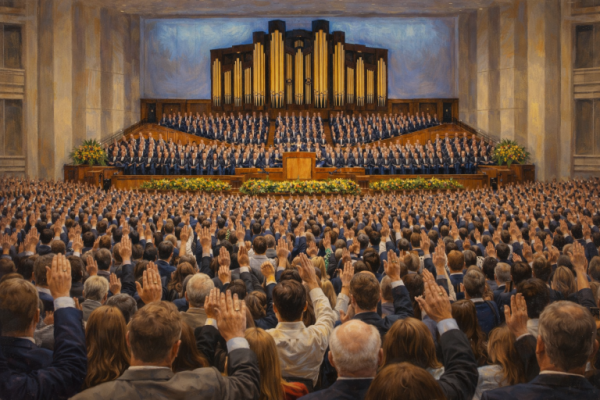
What makes a solemn assembly so distinct is its deep ceremonial structure. When a new President of the Church is to be sustained, or a temple is dedicated, the assembly follows a precise, scriptural order. The pattern was established by Joseph Smith and has continued ever since. Rather than having all members raise their hands in unison, the groups are asked to arise and vote by quorum or auxiliary—beginning with the First Presidency, then the Quorum of the Twelve Apostles, the Seventies, the Presiding Bishopric, high priests, elders, Aaronic Priesthood holders, the Relief Society, Young Women, and finally, all members together.
This pattern is more than administrative—it symbolizes Church unity, priesthood order, and the transfer of prophetic authority from one leader to another. As President Gordon B. Hinckley explained when conducting the solemn assembly for President Howard W. Hunter, the act is profound in both individual and collective responsibility: “Wherever you are, you are invited to stand when requested and express by your uplifted hands whether you choose to sustain those whose names will be put before you.”
One of the most vivid illustrations of a solemn assembly’s power came during the 2020 General Conference, when President Russell M. Nelson announced a worldwide solemn assembly to commemorate the bicentennial of the First Vision and invited all members to participate in the sacred Hosanna Shout—a shout of praise and gratitude dating back to both ancient times and the early history of the Church.
Solemn assemblies resonate with echoes from ancient Israelite festivals and the royal assemblies of the Book of Mormon. Religious scholar Hugh Nibley details how ancient Near Eastern and Nephite societies gathered for annual or momentous Great Assemblies, both spiritual and national, replete with rituals, hymns, covenant-making, and public affirmation of leadership—a tradition mirrored and renewed in the restoration. The Book of Mosiah, for example, describes King Benjamin convening his people in a massive gathering to make covenants and accept new leadership, a form paralleled by the solemn assemblies later adopted by modern-day The Church of Jesus Christ of Latter-day Saints.
Joseph Smith reinstituted this practice as commanded by revelation, organizing the Kirtland Temple’s first solemn assembly with elaborate preparation, solemnity, and a hierarchy of order. Doctrine and Covenants Section 88 outlines the need for such sacred gatherings: “The house of the Lord must be prepared, and the solemn assembly called and organized in it according to the order of the house of God.” These assemblies were not—and are not—meant to be routine; rather, they are occasions for maximum spiritual focus, unity, and outpouring of the Spirit.
One symbolic ritual often included in solemn temple dedication assemblies is the Hosanna Shout, echoing the acclamations accorded to royalty and deities in ancient times. The congregation stands, waves white handkerchiefs, and proclaims: “Hosanna, Hosanna, Hosanna to God and the Lamb,” expressing ultimate praise and reverence.
Each participant in a solemn assembly is not merely a spectator but a witness to sacred transference and covenant. As then-Elder George Albert Smith once noted,
“The obligation that we make when we raise our hands … is a most sacred one. It does not mean that we will go quietly on our way and be willing that the prophet of the Lord shall direct this work, but it means … that we will stand behind him; we will pray for him; we will defend his good name, and we will strive to carry out his instructions as the Lord shall direct.”
The solemn assembly thus stands at the crossroads of tradition, ritual, and living revelation, shaping the spiritual future of The Church and binding together its past, present, and future.
While solemn assemblies were once attended only by those physically present in a temple or tabernacle, advances in communication have extended participation to millions worldwide. President Hinckley observed in the 1990s that
“Many times the number seated in the Tabernacle are assembled in other church halls across the United States and Canada, as well as in other parts of the world … All of you, wherever you may be, are invited to participate in this solemn and sacred undertaking.”
Today, anyone with internet access can join, stand, and sustain Church leaders in real time—testifying to the promise that the body of the Church is truly global.
While some religious ceremonies across the world have faded into mere tradition, in The Church of Jesus Christ of Latter-day Saints, solemn assemblies remain vibrant and transformative. Each is accompanied by prayer, fasting, and an invitation to approach the event with heightened spirituality and personal preparation.
Whether you find yourself waving a white handkerchief in a temple, standing at home in front of a screen, or quietly raising your hand in a distant chapel, the call to assemble solemnly links you to a profound, living tradition—bound by covenant, sustained by faith, and reaching for the divine.
Gramps