
Question
Gramps,
What does the “rolling away of the stone” symbolize?
Kevin
Answer
Kevin,
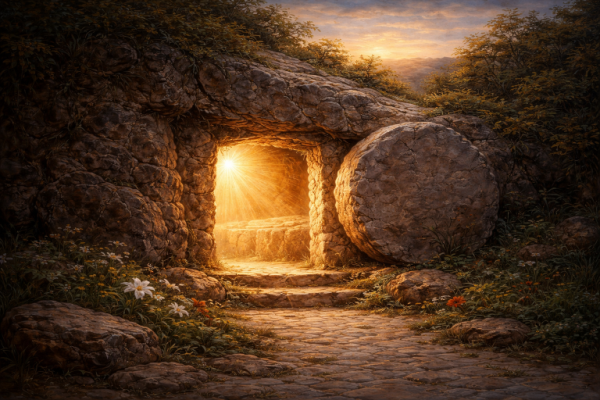
The image is simple, but it sticks with you: a massive stone, rolled away from the tomb’s entrance. It’s one of the most recognizable moments in all of Christianity—the moment when the tomb of Jesus Christ is found empty on that first Easter morning. But if you pause and sit with it for a minute, the “rolling away of the stone” starts to feel like more than just a physical detail in the story. In Latter-day Saint thought, it becomes deeply symbolic—layered with meaning about resurrection, transformation, and even our own personal journeys.
At the most basic level, the stone being rolled away is practical. It allows the witnesses—Mary Magdalene and others—to see that the Savior is no longer in the tomb. The Resurrection has happened. Death has been overcome. That alone is everything. As taught in The Book of Mormon and the Bible alike, the Resurrection of Christ is the central event that makes immortality possible for all of us. Because He rose, we will too.
But here’s where it gets interesting. The stone wasn’t rolled away so that Jesus could get out.
That might sound a little surprising at first, but think about it. A resurrected, glorified being—one who later appears in rooms with locked doors—doesn’t need help moving a rock. The stone was rolled away so that others could look in. It was for the witnesses, not for Him.
That idea opens up a really beautiful symbolic layer. The “rolling away of the stone” becomes less about Christ’s limitation and more about our access to truth. God removes barriers so we can see, understand, and believe. In a very real sense, it represents revelation.
In Latter-day Saint theology, revelation is everything. It’s how we come to know that Jesus is the Christ, how we receive guidance, and how we grow spiritually. Sometimes it can feel like truth is sealed off—like there’s a heavy stone in the way. But just as surely as that stone was moved on Easter morning, God has the power to remove whatever stands between us and spiritual understanding.
You could even think of it this way: the empty tomb is a testimony, but the rolled-away stone is an invitation.
Another layer of symbolism arises when we consider obstacles. Stones are heavy. Immovable. Final. In ancient times, a stone sealing a tomb meant the end—there was no coming back from that. So when that stone is rolled away, it’s not just a logistical detail; it’s a declaration that what seemed permanent isn’t actually permanent.
That hits close to home, doesn’t it?
We all have “stones” in our lives—things that feel too heavy to move. Grief. Sin. Doubt. Regret. Sometimes, even just discouragement or feeling spiritually stuck. The Resurrection story quietly reminds us that no stone is too heavy for the Lord. What looks final to us rarely is from God’s perspective.
In fact, in Latter-day Saint doctrine, one of the key messages of the Atonement of Jesus Christ is that change is always possible. Through repentance and grace, burdens can be lifted, hearts can be changed, and new beginnings can happen. The stone rolling away is almost like a visual metaphor for repentance itself—something once sealed and shut is suddenly opened, and light floods in.
There’s also a forward-looking aspect to this symbol. The stone being removed doesn’t just reveal that Christ is gone—it points to where He is now: risen, living, and active. Latter-day Saints emphasize that Jesus Christ is not just a historical figure but a living Savior who continues to guide His Church. As taught in Doctrine and Covenants, He speaks, leads, and directs even today.
So the open tomb becomes a symbol of ongoing connection. Heaven isn’t closed. Communication isn’t cut off. The stone isn’t just rolled away once—it represents the ongoing reality that access to God is open.
There’s even a subtle personal application here that I really love. Sometimes we wait for God to move the stone before we do anything. We think, “Once this problem is gone, then I’ll believe,” or “Once I feel stronger, then I’ll act.” But in the Resurrection story, the women come to the tomb wondering who will move the stone for them—and they discover it’s already been done.
How often is that true for us?
We worry about obstacles that, in God’s timing, are already being handled. We approach situations expecting barriers and, to our surprise, find that the way has been prepared. It doesn’t mean life is easy, but it does mean we’re not alone in facing what feels immovable.
And finally, there’s a deeply hopeful, almost quiet meaning in all of this. The stone was rolled away early in the morning, at the start of a new day. That timing feels intentional. It’s symbolic of new beginnings—of light replacing darkness, of hope replacing despair.
In Latter-day Saint belief, Easter isn’t just about what happened to Christ; it’s about what happens to all of us because of Him. Every person who has ever lived will be resurrected. Every tomb, in a sense, will have its stone rolled away.
That’s not just symbolic—it’s a literal doctrine. And it’s incredibly comforting.
So when you think about that stone rolling away, it’s worth seeing it from a few angles all at once. It’s a sign that Christ lives. It’s an invitation to come and see. It’s a reminder that obstacles can be removed, that revelation is real, and that new beginnings are always possible.
And maybe most personally, it’s a quiet assurance that whatever “stone” you’re facing right now isn’t the end of your story. Not even close.
Gramps