
Question
Hi Gramps,
I was reading in John 6, and noticed that when the Savior blesses and distributes the 5 loaves and 2 fish, it doesn’t mention a portion per person. That reminded me of the Sacrament – how, while the bread and water are only a small piece, it can still help us reflect and draw closer to the Savior while partaking. Any thoughts?
Harrison
Answer
Harrison,
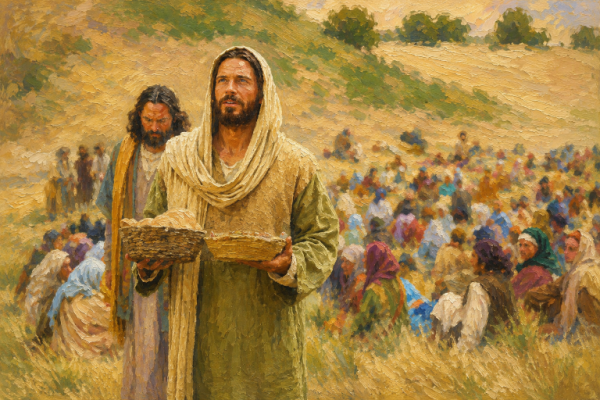
The account of the feeding of the five thousand is one of the most well-known miracles in the New Testament. Found in all four Gospels, it describes how Jesus Christ took five loaves and two fish, blessed them, and miraculously fed a multitude of thousands. For Latter-day Saints, this miracle is not only a display of divine power and compassion—it also carries deep symbolic meaning. One meaningful question is whether this event can be understood as a type, or foreshadowing, of the sacrament.
In Latter-day Saint theology, types and shadows are a central means by which the Lord teaches truth. The Book of Mormon teaches that “all things…are the typifying of him” (2 Nephi 11:4). With that lens, the feeding of the five thousand can reasonably be seen as rich in sacramental symbolism—even though it is not itself an ordinance.
One of the clearest parallels is the use of bread. In the miracle, Christ takes the loaves, gives thanks, breaks them, and distributes them. This pattern closely mirrors the sacrament. At the Last Supper, He likewise “took bread…gave thanks, and brake it.” That same pattern continues today in sacrament meeting. The repetition of this sequence reflects a consistent divine pattern of teaching through action.
Modern apostles have emphasized the centrality of this ordinance. Dallin H. Oaks taught that “the ordinance of the sacrament…makes the sacrament meeting the most sacred and important meeting in the Church.” Seeing the feeding of the five thousand as a type of the sacrament helps us better understand why this ordinance holds such a central place in Latter-day Saint worship.
The Gospel of John further strengthens this connection. Immediately after the miracle, Christ teaches the “Bread of Life” sermon. He declares, “I am the bread of life,” and teaches that unless people partake of Him spiritually, they have no life in them (John 6:35, 53). While this language was difficult for many at the time, Latter-day Saints recognize in it a powerful preview of the sacrament.
From this perspective, the miracle feeds the body—but Christ uses it to teach about feeding the soul. The sacrament becomes the formal, covenantal way in which this spiritual nourishment is regularly experienced. As Elder Oaks also taught, “as we partake of the sacrament each week, we…renew the covenants we made when we were baptized.” (“Always Have His Spirit“).
There are also meaningful parallels in the setting. In the feeding of the five thousand, Christ organizes the people, has them sit down, and personally ensures that all are fed. There is order, reverence, and divine provision. Similarly, sacrament meeting is a gathered, intentional act of worship where disciples come prepared to receive.
Another powerful connection is the idea of covenant. While the miracle itself does not explicitly include covenant language, it leads directly into teachings that do. In Latter-day Saint doctrine, the sacrament is a covenant-renewing ordinance. Each week, members partake as a witness of their willingness to follow Christ, remember Him, and keep His commandments (Doctrine and Covenants 20:77, 79). This helps frame the miracle as a preparatory experience—one that teaches dependence on Christ before inviting deeper commitment.
The abundance of the miracle also carries symbolic meaning. Not only are the five thousand fed, but twelve baskets of fragments remain. This detail emphasizes the sufficiency and overflow of Christ’s power. Spiritually, this reflects the infinite nature of the Atonement—there is always enough grace for every soul.
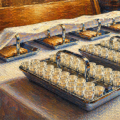
At this point, an important and very practical question arises: if the sacrament consists of only a small piece of bread and a small cup of water, how can something so physically minimal have such a powerful spiritual effect? How can it truly help us reflect and draw closer to the Savior?
The answer lies in understanding that the power of the sacrament is not in the quantity of the elements, but in what they represent and how we receive them. The bread and water are intentionally small and simple. They are not meant to satisfy physical hunger, but to focus our attention entirely on Christ. In a sense, their smallness is part of their power—it removes distraction and invites deliberate, inward reflection.
President Russell M. Nelson taught that during the sacrament, “we commemorate His Atonement in a very personal way.” That personal dimension is key. Even though everyone partakes together, the experience is meant to be deeply individual. Each person reflects, remembers, and recommits in their own heart.
In this way, the sacrament mirrors the feeding of the five thousand in a subtle but meaningful contrast. In the miracle, there is an abundance of bread to meet physical needs. In the sacrament, there is only a small portion—but it points to an infinite spiritual reality. The small piece of bread becomes a symbol of Christ’s body, and the small cup of water represents His blood. Through these simple emblems, our minds and hearts are directed to the infinite sacrifice of the Savior.
Elder Oaks explained that the sacrament is an opportunity to “always have His Spirit to be with [us].” That promise (Doctrine and Covenants 20:77) is not dependent on how much bread we eat, but on how sincerely we remember Him and keep our covenants. The ordinance works through faith, intent, and the Spirit—not physical quantity.
There is also something quietly powerful about the repetition. Week after week, the same simple elements are presented. Over time, this consistency helps anchor our discipleship. It creates space for reflection, repentance, gratitude, and renewed commitment. Just as daily bread sustains physical life, the sacrament sustains spiritual life—not through volume, but through regular, meaningful participation.
At the same time, it is important to be clear: the feeding of the five thousand is not the sacrament itself. The sacrament, as an ordinance, was formally instituted later and includes priesthood authority and covenantal prayers. However, as a type or foreshadowing, the miracle beautifully points forward to it.
Ultimately, viewing the feeding of the five thousand as a type of the sacrament deepens our appreciation of both. It highlights Christ as the source of all nourishment—physical and spiritual. It reminds us that whether through a miraculous feast or a small piece of bread, what He offers is always enough.
Each week, as we partake of the sacrament, we come spiritually hungry. And though what we receive may seem small, it connects us to something infinite. Just as the multitude was filled by the Savior long ago, we too can be filled—through remembrance, covenant, and the quiet, powerful influence of His Spirit.
Gramps