
Question
Gramps,
If Heavenly Father is no respecter of persons, why does the Bishop get served the sacrament first before the rest of the congregation?
Debra
Answer
Dear Debra,
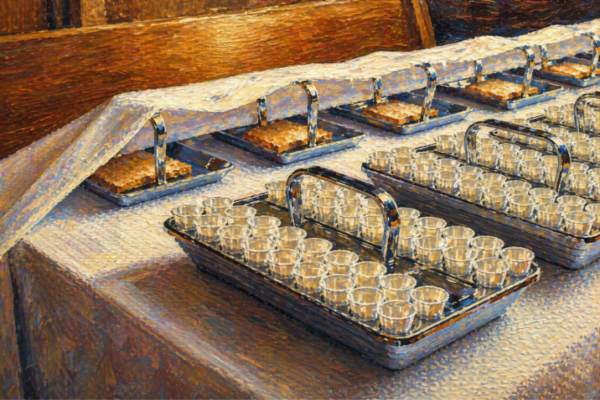
If you’ve spent much time in a Latter-day Saint sacrament meeting, you’ve probably noticed a small but consistent detail: when the sacrament is passed, the Bishop is served first. It’s one of those quiet patterns that can feel so routine we don’t always stop to think about it. But once you do notice it, the question naturally comes up—why?
At first glance, it might seem like a matter of rank or importance. But in Latter-day Saint theology, the reason has much more to do with priesthood responsibility and order than with status.
To understand it, it helps to look at what the Bishop represents in a sacrament meeting. In The Church of Jesus Christ of Latter-day Saints, the Bishop is the presiding high priest of the ward. That means he holds priesthood keys—the authority to direct how ordinances and responsibilities are carried out in that congregation. He isn’t just participating in the meeting; he is responsible before God for what happens there, including the administration of the sacrament.
Because of that role, the sacrament is presented to him first.
The Church’s General Handbook explains the pattern simply:
“The presiding leader receives it first, after which there is no set order.” (General Handbook: Serving in The Church of Jesus Christ of Latter-day Saints, section on administering the sacrament)
That one sentence tells us a lot. First, this isn’t just tradition—it’s intentional Church instruction. And second, it’s not specifically about the Bishop as a person. It’s about whoever is presiding. If a stake president or another presiding authority is present, he would receive the sacrament first instead.
This fits into a much broader principle in Latter-day Saint belief: ordinances are always performed under the direction of someone who holds priesthood keys. You see that pattern everywhere—baptisms, confirmations, temple ordinances, and missionary work. The sacrament follows that same structure. It is not just passed out casually; it is administered under proper authority.
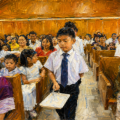
There’s also a meaningful teaching element built into this practice. When the deacons first carry the sacrament to the presiding officer, it quietly reinforces the Church’s organization. It shows that there is order, that someone presides, and that sacred ordinances are conducted under direction rather than independently.
This idea connects with a broader principle taught by Boyd K. Packer, who emphasized that in the Church, the one who presides is responsible for what happens in a meeting. That responsibility is not symbolic—it’s real. The presiding officer is accountable for ensuring that ordinances are performed correctly and reverently.
That helps explain another practical reason for the pattern. Because the Bishop is responsible for the sacrament, having him receive it first allows him to confirm that everything has been done properly. If there were a mistake in the sacrament prayer, for example, he could correct it immediately before the ordinance is distributed to the rest of the congregation.
Understanding priesthood keys makes this even clearer. Dallin H. Oaks has taught that priesthood keys are the authority to direct the use of priesthood power. In a ward, the Bishop holds those keys. That means the sacrament is administered under his direction, and presenting it to him first reflects that responsibility.
And that responsibility is not a light one. Speaking about bishops, Elder Oaks said:
“The burden [of a bishop] is a heavy one…” (“Bishop, Help!” General Conference, April 1997)
Part of that “burden” includes overseeing sacred ordinances like the sacrament each week—making sure they are done properly, reverently, and in accordance with the Lord’s pattern.
It’s also worth pointing out what this practice does not mean. It does not mean the Bishop is more worthy, more important, or more in need of the sacrament than anyone else. In fact, one of the central messages of the sacrament is that everyone stands on equal ground before the Savior. Every person in the chapel is invited to remember Jesus Christ, renew their covenants, and seek His grace.
So the Bishop receiving the sacrament first isn’t about elevating him—it’s about recognizing his role.
There’s even a quiet symbolism in the pattern. The sacrament is first presented to the one who presides, and then it flows outward to the rest of the congregation. It reflects how the Church operates: under the direction of those who are called and authorized, with blessings extended to all.
At the same time, the Church hasn’t framed this as a complex or heavily emphasized doctrine. It’s a simple, consistent practice rooted in order, responsibility, and reverence. One of those small details that, when you understand it, opens a window into how the Lord organizes His Church.
In the end, though, the most important part of the sacrament isn’t who receives it first—it’s what it represents. Whether you’re sitting on the stand or in the back row, the invitation is the same: to remember Jesus Christ, take His name upon you, and keep His commandments.
So yes, the Bishop is served first—but not because he is first in importance. He is served first because he is responsible. And that small, steady pattern each Sunday quietly reflects a larger truth: that God’s work is carried out in order, under priesthood authority, and always centered on Jesus Christ.
Gramps