
Question
Gramps,
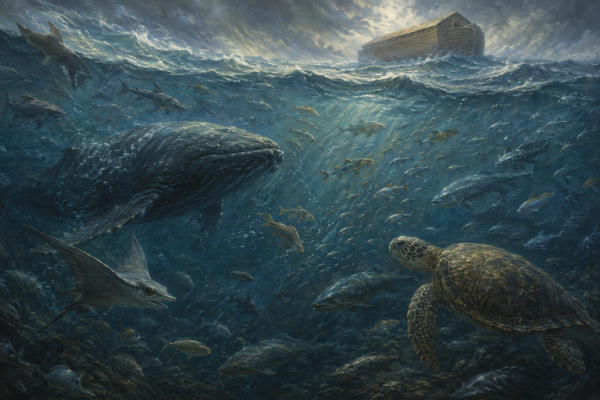
What happened to the fish and sea creatures during the flood? Noah doesn’t mention them. Do we just assume they survived because they were in the water?
Peggy
Answer
Peggy,
Latter-day Saint doctrine doesn’t provide an official answer about what happened to aquatic life during the Flood. However, the scriptures and teachings of Church leaders offer a few principles to help us consider the question.
The first thing to notice is that God’s instructions to Noah focused on air-breathing land animals. The Lord said:
“And of every living thing of all flesh, two of every sort shalt thou bring into the ark” (Genesis 6:19).
As you continue reading the account, the emphasis is consistently on creatures that lived on land and breathed air. Birds, cattle, creeping things, and beasts were gathered into the ark because they could not survive a worldwide flood outside of it.
The account never instructs Noah to collect fish or other aquatic creatures. That’s an important observation because if preserving sea life had required Noah’s intervention, we would likely expect the Lord to mention it.
Some readers, therefore, conclude that fish and other sea creatures simply survived in the water. That is certainly one possibility. Since they already lived in aquatic environments, many assume they would not have needed the protection of the ark.
However, the scriptures stop short of actually saying that.
In fact, some passages describing the Flood use language that focuses specifically on creatures that lived on land. For example, Genesis 7:22 says:
“All in whose nostrils was the breath of life, of all that was in the dry land, died.”
That wording seems intentional. It highlights the destruction of terrestrial life rather than providing a detailed account of every creature living in the oceans.
Latter-day Saints also accept the account in the Book of Moses, which similarly emphasizes that the wicked people and the creatures living upon the earth perished while Noah and those with him in the ark were preserved. (Noah Gospel Topics)
Could some aquatic life have died during the Flood? Certainly. Even if fish were not required to enter the ark, the Flood would have dramatically changed the earth. Freshwater and saltwater environments could have been affected, sediment stirred up, and many aquatic habitats altered. The scriptures simply don’t tell us how those environmental changes affected marine life.
Because of that silence, it is wise not to claim more certainty than the scriptures provide.
There is another principle from restored doctrine that offers some comfort, however. Latter-day Saints believe that God’s concern extends to all of His creations, not just human beings.
Doctrine and Covenants 29:24 teaches:
“All things shall become new, even the heaven and the earth, and all the fullness thereof, both men and beasts, the fowls of the air, and the fishes of the sea.”
This remarkable passage specifically mentions the fishes of the sea as part of God’s future renewal of the earth.
President Joseph Fielding Smith taught:
“The animals, the fishes of the sea, the fowls of the air, as well as man, are to be re-created, or renewed, through the resurrection, for they too are living souls.” (Conference Report, October 1928, p. 100.)
He also wrote:
“Every creature on the earth, whether it be man, animal, fish, fowl, or other creature, that the Lord has created, is redeemed from death on the same terms that man is redeemed.” (Answers to Gospel Questions, Vol. 2, pp. 48–51.)
Those statements are significant because they remind us that fish are not an afterthought in God’s plan. They are part of His creations and, according to President Smith, are included in the redemption of the earth.
The Prophet Joseph Smith also taught that animals have spirits and are part of God’s eternal creations. Speaking about John’s vision in Revelation, he said:
“John heard the words of the beasts giving glory to God, and understood them.”
He continued by explaining that God glorifies Himself in saving the creations He has made, including beasts, birds, fish, and mankind. (History of the Church, 5:343–344)
These teachings don’t answer exactly what happened during the Flood, but they do show that Heavenly Father cares about aquatic creatures.
Some Latter-day Saints have also connected the Flood with the symbolic cleansing or “baptism” of the earth. Elder Bruce R. McConkie wrote:
“In the days of Noah the Lord sent a universal flood which completely immersed the whole earth and destroyed all flesh except that preserved on the ark. … This flood was the baptism of the earth.” (Mormon Doctrine, 2nd ed., “Flood of Noah.”)
Whether one accepts every aspect of that interpretation or not, it still doesn’t answer the question of individual fish species. The purpose of those teachings is to emphasize the cleansing of the earth rather than explain marine biology.
So where does that leave us?
The honest answer is that we simply don’t know exactly what happened to every fish and sea creature during Noah’s Flood.
Sometimes the most faithful answer is also the simplest one: the Lord chose not to reveal every detail. The scriptures tell us what we need to know to understand Noah’s faith, God’s justice, His mercy in preserving life, and His covenant with humanity afterward. Questions about the fish are interesting, but they aren’t central to the message of the Flood.
So yes, it’s reasonable to assume many aquatic creatures survived because they lived in the water. Just remember that this is an inference—not an official doctrine of The Church of Jesus Christ of Latter-day Saints. Where revelation is silent, it’s usually best for us to be silent too.
Gramps