
Question
Hi Gramps,
Can women act in faith and raise their arm to the square to command evil spirits to leave? It’s not something I’d like to do, but I have a friend in a bad situation, and while I have no intention of going anywhere near it, I’d like to know if it’s something I could do. I don’t think it would be fair if women couldn’t do it, as it leaves us helpless in such (hopefully very rare) situations if we are by ourselves. And to add on to this, can we bless our own homes?
Eliza
Answer
Eliza,
Women absolutely can exercise faith in Jesus Christ, pray for protection, resist evil, and invite the Holy Ghost into their homes and lives. However, LDS doctrine makes an important distinction between having access to God’s priesthood power and having priesthood authority to perform a particular ordinance or priesthood act.
That distinction is important when we talk about casting out evil spirits. The first thing to understand is that women are not spiritually helpless without a man standing nearby.
The current General Handbook teaches that priesthood power is God’s power used to bless His children. It specifically says that God’s priesthood power flows to all members of the Church—both male and female—as they keep the covenants they have made with Him.
The Handbook also teaches that all Church members who keep their covenants—women, men, and children—are blessed with God’s priesthood power in their homes, strengthening themselves and their families.
That’s pretty significant.
Women can pray. They can fast. They can receive revelation through the Holy Ghost. They can exercise faith in Jesus Christ. They can resist temptation and evil. They can ask Heavenly Father for protection.
President Dallin H. Oaks taught:
“Unlike priesthood keys and priesthood ordinations, the blessings of the priesthood are available to women and to men on the same terms.” (The Keys and Authority of the Priesthood)
President Russell M. Nelson has likewise taught that every woman and every man who makes and keeps covenants with God and participates worthily in priesthood ordinances has direct access to God’s power.
The Church explains this principle here: “What Must Women and Men Do to Have Access to Priesthood Power?“
So a woman should never think, “I’m alone, and because I’m a woman, God can’t help me.” That isn’t LDS doctrine.
There is a difference between praying against evil and performing an act that requires priesthood authority. The scriptures certainly teach that evil spirits can be cast out. During the Savior’s ministry, for example, Jesus gave the Twelve power over unclean spirits.
And he called unto him the twelve, and began to send them forth by two and two; and gave them power over unclean spirits; (Mark 6:7)
The scriptures also give us an important warning about attempting to exercise authority we don’t actually possess.
In Acts 19:13-20, some men attempted to cast out an evil spirit by invoking the name of Jesus Christ. The spirit responded, “Jesus I know, and Paul I know; but who are ye?”
The Church’s New Testament student manual explains this account and discusses the importance of genuine authority:
That is one reason I would not recommend that a woman—or anyone without the appropriate priesthood authority—attempt to perform a formal exorcism by raising the arm to the square and commanding an evil spirit to leave.
The raised arm itself isn’t what gives someone power. The physical gesture doesn’t create priesthood authority. The Church’s General Handbook explains priesthood authority and the sacred nature of priesthood ordinances. So simply saying “in the name of Jesus Christ” doesn’t automatically give someone authority to perform every act described in scripture. This doesn’t mean women have to stand helplessly by if they feel threatened by evil. Quite the opposite.
The New Testament gives this instruction:
“Submit yourselves therefore to God. Resist the devil, and he will flee from you.” (James 4:7)
Notice that James doesn’t say only priesthood holders can resist the devil. Every disciple of Jesus Christ can turn toward God and resist evil.
A woman who is frightened or believes she is experiencing something evil can pray sincerely to Heavenly Father. She can ask for protection. She can call upon the Savior. She can invite the Holy Ghost into the situation. For example, there is nothing wrong with a woman praying something like:
“Heavenly Father, please protect me and this home. Please remove anything that is not of Thee and help me feel the peace and protection of the Holy Ghost. I place my faith in Jesus Christ.”
That is prayer—not a priesthood ordinance. And there is an important difference.
Suppose a woman is alone in her home and genuinely believes something frightening or evil is happening. Does LDS doctrine leave her powerless because there isn’t a priesthood holder there?
No.
She can pray.
She can exercise faith.
She can ask Heavenly Father for protection.
She can call upon Jesus Christ.
She can read the scriptures.
She can invite the Holy Ghost into her home.
She can leave the situation if she feels unsafe.
She can contact a trusted family member, a church leader, or a priesthood holder.
And if there is a possibility that the situation involves physical danger, abuse, a mental-health crisis, drugs, or another serious problem, she should seek appropriate help rather than assuming that everything has a supernatural explanation.
There is certainly no LDS teaching that says a woman should put herself in danger trying to confront an evil spirit. Safety comes first. This is where the current General Handbook gives us a particularly helpful answer. The Church does allow homes to be dedicated by the authority of the Melchizedek Priesthood. The General Handbook explains that a home is dedicated by a Melchizedek Priesthood holder.
But then it addresses exactly the situation where there isn’t a Melchizedek Priesthood holder in the home. The Handbook says that if there isn’t a Melchizedek Priesthood holder in the home, the family may invite a friend, relative, or ministering brother who holds the Melchizedek Priesthood to dedicate it. Or the family can gather to offer a prayer, guided by the Spirit. That’s a wonderful distinction.
A woman who lives alone—or a woman whose husband isn’t a priesthood holder—doesn’t have to wait for someone else before she can ask Heavenly Father to bless her home.
She can gather those in her household and pray.
She can ask Heavenly Father to make the home a place of peace.
She can ask for protection.
She can invite the Holy Ghost to dwell there.
She can pray that the people who enter the home will feel love, peace, and the influence of the Savior.
What she would not do is claim that she is dedicating the home by the Melchizedek Priesthood authority. That particular dedication is performed by a Melchizedek Priesthood holder.
But prayer is available to everyone. I think this is ultimately the most important point.
Sometimes discussions about the priesthood can accidentally leave women with the impression that they have very little spiritual authority or power unless a man is present. That isn’t what the Church teaches. The current General Handbook states that priesthood power flows to both male and female members who keep their covenants. President Oaks made the same point in his General Conference message, “The Keys and Authority of the Priesthood,” teaching that the blessings of the priesthood are available to women and men on the same terms. Women and men have different priesthood responsibilities and different roles in the Church, but that does not mean women are cut off from God’s power.
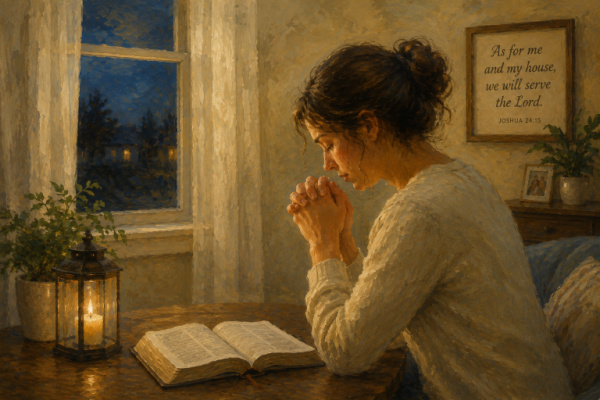
A woman can kneel down alone in her home and pray to Heavenly Father.
She can ask for the Savior’s protection.
She can receive personal revelation.
She can feel the Holy Ghost.
She can resist evil.
She can ask God to bless her family and her home.
And she can have confidence that Heavenly Father hears her.
Gramps