

Question
Gramps,
In the Book of Mormon it talks about “the land of their inheritance.” What does that mean? A literal piece of land given to a person for eternity? Or something else?
Wayne
Answer
Wayne,
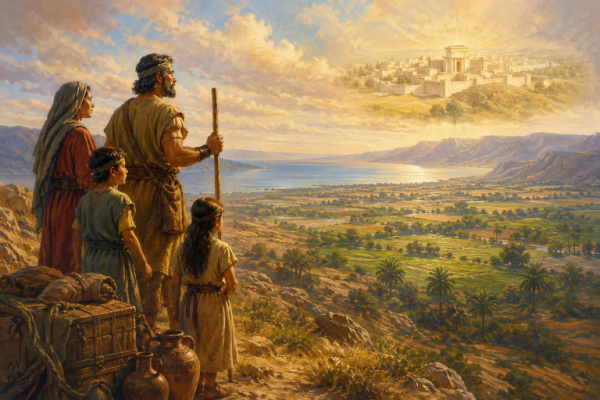
IIn the Book of Mormon, “the land of their inheritance” can refer to a very real, physical piece of land. But the idea is also connected to God’s covenants with Israel and ultimately to a much greater spiritual and eternal inheritance. One of the clearest examples is Lehi’s family.
When Lehi and his family arrived in the promised land, Lehi explained that the Lord had covenanted with him that this land would be an inheritance for his descendants. He said:
“We have obtained a land of promise, a land which is choice above all other lands; a land which the Lord God hath covenanted with me should be a land for the inheritance of my seed.” (2 Nephi 1:5)
That sounds pretty literal—and in this case, it is. Lehi was talking about an actual land. His family had left Jerusalem, crossed the ocean, and settled in a new land. The Lord had promised this land to Lehi’s descendants.
The interesting part, though, is that the promise wasn’t simply, “This is your property, and you get to keep it no matter what.” The promise came with a covenant. Lehi explained that if the people kept God’s commandments, they would be blessed on the land. But if they became wicked, they could lose the land.
In fact, just a few verses later, Lehi warned that if his descendants rejected the Lord, other nations would come and take away their lands. So the land was certainly real, but there was much more involved than simply owning real estate. This idea goes all the way back to God’s covenant with Abraham, Isaac, and Jacob.
God promised Abraham that his descendants would receive a land of inheritance. The land of Canaan became an important part of that covenant. The descendants of Abraham were given an inheritance in the promised land, and the Book of Mormon prophets understood themselves as part of that same covenant family.
The Church teaches that lands of inheritance are one of the blessings associated with the Abrahamic covenant. This is important because Lehi’s family wasn’t just randomly given a piece of land. Their inheritance was connected to the promises God had made to the house of Israel. That’s why the Book of Mormon talks about Israel eventually being gathered back to “the lands of their inheritance.”
Jacob taught:
“When the day cometh that they shall believe in me, that I am Christ, then have I covenanted with their fathers that they shall be restored in the flesh, upon the earth, unto the lands of their inheritance.” (2 Nephi 10:7)
Notice something interesting about that verse. It talks about being restored “in the flesh, upon the earth.” That tells us there really is a physical aspect to these promises. The Book of Mormon isn’t saying that “land” is merely a symbol for something spiritual. There are actual lands associated with Israel’s covenant inheritance.
Jesus also spoke directly to the Nephites about this. After His Resurrection, He told them:
“This is the land of your inheritance; and the Father hath given it unto you.” (3 Nephi 15:13)
So, yes—in some Book of Mormon passages, “land of inheritance” really does mean a physical land that God has promised to a particular covenant people. But there’s another side to this. The word inheritance in scripture can mean much more than property.
Think about what happens when someone inherits something from a parent. It isn’t necessarily just a house or a piece of land. An inheritance can include everything promised to that person as part of a family relationship. That’s a helpful way to think about the Book of Mormon’s use of this phrase.
God wasn’t merely saying, “Here is some dirt. Congratulations!” The land was part of a covenant relationship. The people were being given a place where they could establish a righteous society, worship God, raise their families, receive the gospel, and fulfill God’s purposes for them. And ultimately, the physical inheritance points toward something much bigger.
The Doctrine and Covenants teaches that the earth itself has an eternal destiny. In Doctrine and Covenants 88, the Lord says that the earth will be sanctified and prepared for celestial glory. Then He says:
“The righteous shall inherit it.” (Doctrine and Covenants 88:26)
Just a few verses earlier, the Lord explains that the earth will be sanctified and that those who receive celestial glory will possess it forever. (Doctrine and Covenants 88:17–20)
This gives us a pretty fascinating connection.
The Book of Mormon talks about people receiving lands of inheritance, while the Doctrine and Covenants teaches about the righteous ultimately inheriting the earth. So the idea of an inheritance becomes much bigger than a particular piece of property. Does that mean that faithful Latter-day Saints will each get a specific parcel of land with their name on it in the next life? There is no LDS doctrine teaching that every individual will receive a particular earthly parcel of property for eternity. That’s probably the most important distinction to make.
The scriptures do teach that certain peoples were promised particular lands. Lehi’s descendants were promised their land. Israel was promised lands of inheritance. And the scriptures teach that these covenant promises have an important future fulfillment. But that doesn’t mean that every individual person has a particular square mile of land somewhere that God has personally reserved for them. The larger promise is an inheritance from God.
And that inheritance ultimately involves becoming part of God’s covenant family, receiving the blessings of Jesus Christ, and inheriting the glory and blessings God has prepared for the faithful.
This also helps explain why the Book of Mormon talks so much about people being “driven out” of their lands. For example, Jacob talks about the Nephites being driven from their land of inheritance but then being led to another land.
If “land of inheritance” meant an individual piece of property that could never be lost, that wouldn’t make much sense. The Book of Mormon repeatedly shows people receiving lands, losing lands, being scattered, being gathered, and eventually being restored. The land itself was important, but the covenant was even more so. That’s really the key to understanding the phrase.
When you read “the land of their inheritance” in the Book of Mormon, it can be helpful to think:
“This is a land connected to God’s covenant promises.”
Sometimes that means an actual geographical location. Sometimes it refers to the promised lands of Israel. And sometimes the larger context points us toward the ultimate inheritance God has prepared for His faithful children.
So, is the “land of their inheritance” literal? Sometimes, absolutely. Lehi’s promised land was a real place. The lands promised to Israel are real places. The Book of Mormon even speaks of Israel being restored physically to the lands of their inheritance. But is the idea simply about owning a piece of land forever? No.
The physical land was part of something much bigger—the Abrahamic covenant, the gathering of Israel, the restoration of God’s covenant people, and ultimately the eternal inheritance God offers through Jesus Christ. In a way, the phrase is about both a place and a promise. The place mattered. But the promise mattered even more.
And that’s probably the best way to read these passages in the Book of Mormon. When you see “the land of their inheritance,” don’t necessarily picture a future deed with someone’s name on it. Think instead of God remembering His covenant, gathering His people, giving them a place to receive His blessings, and ultimately preparing an eternal inheritance for those who come unto Christ. The land was part of the blessing. But the relationship with God was the real inheritance.
Gramps