
Question
Gramps,
Were the wives of Joseph of Egypt black?
Carolee
Answer
Carolee,
According to Latter-day Saint scripture and teachings, we simply are not told. There is no revealed doctrine from The Church of Jesus Christ of Latter-day Saints identifying Asenath’s skin color.
The Bible tells us that after Joseph interpreted Pharaoh’s dreams, Pharaoh made him ruler over Egypt. Pharaoh then gave Joseph Asenath as a wife. Genesis describes her as “the daughter of Poti-pherah, priest of On.” Joseph and Asenath eventually had two sons, Manasseh and Ephraim.
The account in Genesis is actually quite straightforward. It doesn’t describe Asenath’s physical appearance, complexion, or ethnicity as we might today. Genesis simply identifies her as the daughter of an Egyptian priest.
The same information appears when Jacob’s family eventually goes down to Egypt. Genesis 46:20 says that “Asenath the daughter of Poti-pherah priest of On” bore Manasseh and Ephraim to Joseph.
So, could Asenath have been a dark-skinned Egyptian woman? Certainly, that is possible. Ancient Egyptians lived in northeastern Africa, and ancient Egypt’s population was ethnically and culturally diverse throughout its long history. But saying that Asenath was black goes beyond what the scriptures actually tell us.
This is an important distinction when discussing biblical people. Modern racial categories don’t always fit neatly onto people who lived thousands of years ago. Someone living in ancient Egypt would not necessarily have understood their identity in the same racial categories commonly used today.
From an LDS perspective, there is another reason to be careful about trying to determine Asenath’s race. The Church’s current teachings emphasize that a person’s relationship with God is not determined by skin color. The Church’s Gospel Topics essay on race specifically rejects the use of scripture to justify racial prejudice or discrimination and teaches that all people are precious in God’s sight.
The scriptures also don’t portray Joseph’s marriage to Asenath as a problem because she was Egyptian. In fact, their marriage became an important part of the story of the house of Israel. Their two sons, Ephraim and Manasseh, became significant figures in Israel’s history.
When Jacob later blessed Joseph’s sons, he adopted Ephraim and Manasseh as his own sons. Their descendants were eventually counted among the tribes of Israel. The Church’s Bible Dictionary entry for Manasseh explains that Manasseh and Ephraim were Joseph’s sons through Asenath and that they became associated with the tribes of Israel.
That is actually pretty remarkable. Joseph was an Israelite who had been separated from his family and had spent most of his adult life in Egypt. He married an Egyptian woman, and their sons became part of the covenant family of Israel.
There is also something interesting about Asenath’s father. Poti-pherah was a priest of On, an important Egyptian religious center. The scriptures, therefore, make it clear that Asenath came from an Egyptian family. The Church’s own Old Testament materials likewise identify her as the daughter of an Egyptian priest.
But Egyptian ancestry does not automatically answer the question of what Asenath looked like.
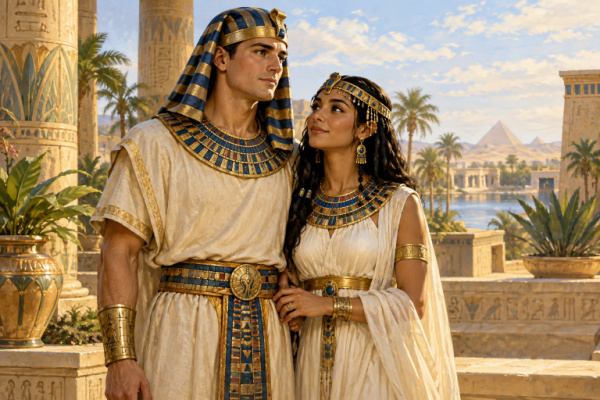
It is tempting to look at paintings and movies of ancient Egypt and decide that we know exactly what people like Asenath looked like. But those artistic depictions are interpretations. The scriptures themselves don’t give us enough information to reconstruct her appearance.
There is another interesting point here. The Bible does not actually say that Joseph had multiple wives. Asenath is the only wife of Joseph specifically identified in Genesis. So the plural “wives of Joseph” isn’t really supported by the biblical account. Joseph and Asenath had two sons, Manasseh and Ephraim, who became important ancestors in Israel.
Could Asenath have had dark skin? Yes. Could she have had a complexion that a modern person would describe as Black? It is possible. Could we establish that from LDS scripture or official Church doctrine? No. And that’s probably the most responsible answer to the question.
The Church has not received a revelation identifying Asenath’s race, and the scriptures don’t provide a physical description of her. What we do know is that she was an Egyptian woman, the daughter of Poti-pherah, and the wife of Joseph. She became the mother of Ephraim and Manasseh, whose descendants became part of the house of Israel.
In other words, we shouldn’t try to fill in a detail that God hasn’t revealed.
The more important part of Asenath’s story isn’t the color of her skin. It’s what happened through her family. Her sons became part of Israel’s covenant story, and Joseph’s family became one of the great branches of the house of Israel.
Gramps