

Question
Gramps,
I know that apostles are called as special witnesses, and that people can have heavenly visions and visitations. I’ve been trying to find any mention of the doctrine of the responsibility of such an event.
John
Answer
John,
One of the clearest examples comes from the Apostle Paul. In 2 Corinthians 12, Paul describes being “caught up to the third heaven” and hearing things that he says were “not lawful for a man to utter.” Notice what happens here: Paul had an extraordinary heavenly experience, but he was not commanded to tell everyone everything he had seen or heard. In fact, he deliberately kept some of the details private.
That is significant because Paul was an Apostle. If simply being an Apostle meant that every heavenly experience had to be publicly reported, Paul’s example would be difficult to explain. Instead, it suggests that even an Apostle may receive revelation that is sacred and personal and that is not intended for public disclosure.
The Book of Mormon gives another interesting example. Nephi records some of the tremendous things he saw in vision, including the history of his descendants, the Savior’s ministry, and events concerning the last days. But he also says that he was forbidden to write some things because the Lord had commanded him not to make them known.
In 1 Nephi 14:25, Nephi says that the things he saw were “sealed up, to come forth in their purity, according to the truth which is in the Lamb of God.” He had seen things he was not permitted to reveal.
That gives us an important principle: receiving revelation does not automatically mean receiving permission to disclose it. The Lord can reveal something to a person while simultaneously telling that person to keep it sacred.
We see something similar with John the Revelator. In Revelation 10, John heard “seven thunders” utter their voices. He was apparently about to write what he had heard, but the voice from heaven told him, “Seal up those things which the seven thunders uttered, and write them not.” John was commanded to keep a heavenly revelation to himself.
That is probably one of the strongest biblical examples against the idea that every genuine heavenly revelation has to be publicly announced. At the same time, scripture contains many examples in which a person was specifically commanded to testify.
After the First Vision, Joseph Smith eventually wrote and taught about what had happened to him. The experience was directly connected to the Restoration and to his prophetic calling. Likewise, when the resurrected Christ appeared to the Nephites, those people were commanded to bear witness of what they had seen.
In 3 Nephi 11, Christ invited the people to come forward and feel the prints of the nails in His hands and feet. They personally experienced the reality of His resurrected body. Their experience then became part of their testimony to others.
There is, therefore, a difference between having a witness and being commissioned to proclaim a particular message. That distinction is especially important when we talk about the Apostles.
The New Testament itself describes the Apostles as witnesses of the resurrected Christ. Peter said, “We are his witnesses of these things” in Acts 5:32. The Twelve had personally encountered the risen Savior, and their responsibility was to testify of Him.
The modern Church uses similar language. Doctrine and Covenants 107:23 states:
“The twelve traveling councilors are called to be the Twelve Apostles, or special witnesses of the name of Christ in all the world.”
The wording is important. They are special witnesses of the name of Christ. Their responsibility is to testify of Him and His gospel. It does not say that each Apostle is responsible for publicly describing every vision, revelation, or supernatural experience he receives. In fact, the Church has generally avoided treating the private spiritual experiences of its leaders as something members need to know to have faith.
This is consistent with another important LDS teaching: testimony is not supposed to rest on somebody else’s supernatural experience.
For example, if an Apostle says, “I know Jesus Christ lives,” a member does not need to know whether that Apostle has literally seen Jesus Christ with his physical eyes in order to accept his testimony. The member is encouraged to seek his or her own spiritual witness through the Holy Ghost.
This is one reason LDS leaders generally emphasize testimony of Christ rather than descriptions of mystical experiences. There is also a practical reason for this.
Suppose someone said, “I had a vision, and God told me that the Church needs to do this.” That claim would not automatically establish authority. The Church would still have to consider whether that revelation was actually from God, whether the person had authority to receive revelation on that subject, and whether the claimed revelation was consistent with established doctrine.
Doctrine and Covenants 43:3 makes the principle particularly clear. The Lord explained that commandments and revelations for the Church would come through the person appointed to receive them, rather than through someone simply claiming private revelation.
That does not mean that God cannot reveal something to someone outside the First Presidency or Quorum of the Twelve. He certainly can. But personal revelation and revelation for the entire Church are not the same thing.
This is also why the LDS concept of stewardship matters so much. A bishop can receive revelation for his ward in connection with his calling. A parent can receive revelation concerning his or her children. A missionary can receive inspiration concerning his or her missionary responsibilities. An individual can receive revelation concerning his or her own life. But none of those experiences automatically gives the person authority to receive revelation for everyone else.
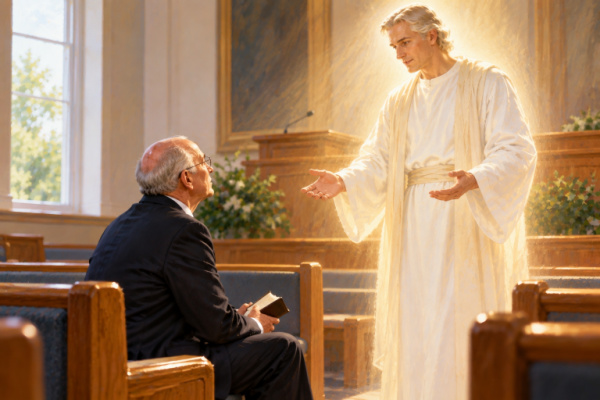
The same principle applies to heavenly visitations. Imagine that an ordinary Church member has a genuine visitation from an angel. The angel gives that person comfort concerning a deceased family member. The person may have received something profoundly sacred and meaningful. But that does not mean the person has suddenly become responsible for teaching the Church about the afterlife.
On the other hand, suppose the angel gives the person a specific command to deliver a message to a particular individual. In that case, the responsibility could be different. The person would need to prayerfully determine whether and how to follow that instruction. The scriptures show that heavenly messengers sometimes give very specific assignments.
Moroni’s appearances to Joseph Smith are an obvious example. Moroni did not simply appear and give Joseph a fascinating spiritual experience. He gave him information and instructions concerning the plates and the coming forth of the Book of Mormon. Those instructions were directly connected to Joseph’s future prophetic work.
So the responsibility came from the message and assignment, not merely from the fact that an angel appeared. This also helps explain why Latter-day Saints should be cautious about putting too much emphasis on supernatural claims. A person might honestly believe that he or she saw an angel or received a vision. That experience could be completely sincere. But sincerity and authority are not necessarily the same thing. LDS scripture repeatedly encourages spiritual discernment.
Doctrine and Covenants 46:23 teaches that one spiritual gift is the ability to know whether manifestations are from God. Moroni 7 teaches that good things invite people to do good and to believe in Christ, while Satan can deceive people by disguising falsehood as spiritual. That means the appropriate response to an extraordinary spiritual experience is not necessarily, “Everyone must believe me because I had a vision.”
Instead, the person should seek confirmation from God, remain within his or her stewardship, compare the experience with revealed doctrine, and carefully consider what responsibility—if any—the Lord has actually given.
There is a beautiful balance here in LDS theology. God really does reveal Himself to His children. He really does give visions, dreams, angelic visitations, prophetic revelation, spiritual gifts, and personal revelation. But God is also a God of order.
Not every revelation is for everybody. Not every spiritual experience is meant to be public. And not every person who receives an extraordinary revelation is thereby given authority over other people. Sometimes the responsibility is simply to believe, repent, change, endure, or find comfort. Sometimes the responsibility is to testify. Sometimes the responsibility is to act. And sometimes the responsibility is actually to keep the experience sacred and not disclose it.
That last possibility is easy to overlook, but scripture makes it unmistakable. Paul was not permitted to tell everything he had heard. John was commanded not to write what the seven thunders had spoken. Nephi was shown things that he was not permitted to reveal. These examples demonstrate that heavenly revelation and public proclamation are two separate things.
For Latter-day Saints, then, the important question after a heavenly experience is not simply, “What did I see?” It is also, “What does the Lord want me to do with what I was shown?” If the answer is to testify, then testimony may be part of the responsibility. If the answer is to act privately, then that may be the responsibility. And if the answer is to keep something sacred, then silence may actually be an act of obedience. That principle applies even to Apostles.
An Apostle’s calling gives him a special responsibility to bear witness of Jesus Christ to the world. But it does not mean that every private revelation or heavenly experience must be described publicly. Their responsibility is to fulfill the stewardship and witness they have been given. Ultimately, LDS doctrine places the emphasis not on spectacular spiritual experiences but on Jesus Christ.
A person does not need to see an angel to have a testimony. A person does not need to experience a vision to receive revelation. An Apostle does not need to describe a personal visitation in order to be a special witness of Christ. The real question is what God has asked the individual to do with the revelation He has given.
In that sense, the responsibility attached to a heavenly experience is not determined solely by how extraordinary it was. It is determined by the purpose for which God gave it and the stewardship of the person who received it.
Gramps