
Question
Gramps,
How can I have faith like a mustard seed?
Bri
Answer
Bri,
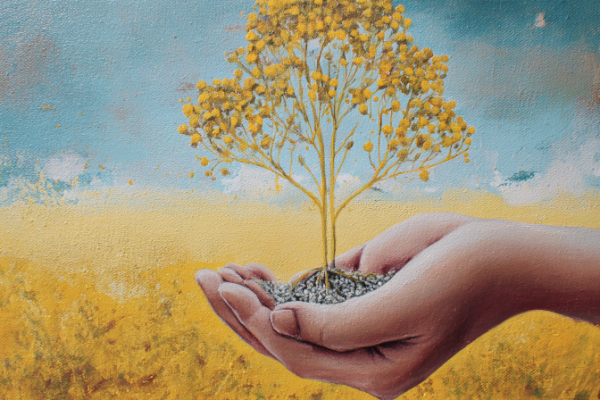
One of the most profound and distinctive teachings from the Book of Mormon appears in Alma 32, where the prophet Alma compares faith to planting a seed. He encourages individuals to “awake and arouse [their] faculties, even to an experiment upon [his] words, and exercise a particle of faith”—to give space in one’s heart for a portion of God’s word to be tested by living it. In this metaphor, faith is not a one-time declaration but an ongoing process of nurturing a fragile seed through action.
Crucially, Alma distinguishes faith from knowledge. He teaches that if you plant the seed and witness it sprouting, you gain an assurance—or knowledge—of its goodness, but that knowledge only covers that one particular thing. The overall journey of faith does not suddenly end once you see initial results; rather, it moves to a new level: your faith will now be tested at a higher level. Are you willing to continue nurturing the vulnerable sapling, or will you abandon it to wither away?
Modern members of the Church sometimes feel a cultural pressure to proclaim “I know,” especially in public testimonies. Spiritual power does not come from knowledge but from simple, often undervalued belief. Faith thrives in the gap between partial understanding and perfect certainty. As Jesus Himself told Thomas, “blessed are they that have not seen, and yet have believed.”
Faith is not the absence of evidence, nor is it blind. Instead, it is a chosen response to incomplete evidence—a willingness to act without full view, to hope even in uncertainty. The Book of Mormon teaches:
Faith is not to have a perfect knowledge of things; therefore if ye have faith ye hope for things which are not seen, which are true” (Alma 32:21)
The process of growing faith is messy, repetitive, and vulnerable. According to the teachings of the Church, the journey begins not with certainty, but with small, gentle actions—a desire to believe even if no more than a desire to believe. Acting on that spark is critical.
Once the seed is in the ground—once a person has begun to act in faith—responsibility follows. Faith does not flourish on autopilot. As Alma says,
“If ye nourish [the tree] with much care it will get root, and grow up, and bring forth fruit… but if ye neglect the tree…it withers away.” (Alma 32:37-40)
The main threat to growth is rarely external; it is most often the gardener’s neglect or abandonment.
Faith can be understood in stages:
Planting the Seed: Trying the “experiment”—beginning to act as if gospel principles are true.
Nourishing the Seed: Caring for the budding faith by praying, reading scripture, serving, seeking spiritual experiences, and persisting through adversity.
Protecting Against Neglect: Recognizing personal responsibility to keep faith alive and resistant to the heat of the sun (challenges, doubts, distractions).
Bearing Fruit: Experiencing the blessings, character growth, and spiritual power that flow from a mature, well-nourished faith. At this point, the fruit can offer new seeds for others, continuing the cycle.
Importantly, this process is never free from opposition. The Church’s teachings acknowledge doubt and fear as natural, even necessary aspects of the human experience. Overcoming them is not a matter of erasing uncertainty, but of learning to move forward in spite of it. Courage is not the absence of fear, but acting faithfully despite it. Faith is what Christ asks of us, and ‘without faith it is impossible to please him: for he that cometh to God must believe that he is, and that he is a rewarder of them that diligently seek him’” (Hebrews 11:6).
Practical steps for nurturing faith amid doubt include:
Letting the desire to believe work within us to give place in our hearts for a portion of God’s word.
Resisting the urge to cast out belief because of uncertainty.
Repeating cycles of obedience and seeking knowledge, line upon line.
Acting (doing the thing you fear), knowing that growth, courage, and certainty expand through action, not passive contemplation.
Much of the cultural narrative around faith focuses on arriving at certainty, but the teachings of the Church acknowledge that most disciples spend their lives somewhere between hope and knowledge. Challenges, setbacks, and even crises of faith are not evidence of failure but of growth. As one member shared from personal experience: “My faith crisis was as real to me as other faith crises are… what is most important [is] how we address them, or more precisely, the time we take to address them. Learning faith takes time. And during that time, we have to sit with our doubts.”
Faith, then, is a repeated choice—chosen each day in the face of uncertainty. There are several key principles suggested for choosing faith:
Pray for Faith: While faith is a gift from God, it is appropriate to ask for an increase in it. Faith grows through practice—by acting, trusting, and persisting even without full answers.
Distinguish Belief and Action: Belief is intellectual; faith is action-directed. Faith, going beyond belief, is a principle of action, where the belief is so strong that it impels commitment… Faith is sticking at it until the job’s done.
Embrace Doubt as Opportunity: Doubt is not an enemy to defeat at all costs, but a tension to be lived with, a context in which faith can flourish.
Practice Patience and Humility: Let go of the need to dictate outcomes. Trust that spiritual growth can happen even through setbacks and pain.
A seed in the ground faces many dangers—it is vulnerable to drought, neglect, and storms. Yet, only by being planted and nurtured does it unlock its potential. Similarly, faith is not meant to be kept safe and unused. Seeds are safe in your cupboard, but that’s not what seeds are for. Faith must be lived, challenged, and cared for if it is to bear fruit—not only for ourselves but for future generations.
Crisis points are common on the journey of faith. These moments, though deeply painful, provide unique opportunities for growth and intimacy with God. One woman described a crisis brought on by unanswered prayers for more children, which led to anger, self-doubt, and spiritual exhaustion. Her path to healing was not instantaneous—recovery required humility, patience, learning to let go of her own expectations, and trusting God’s timing.
She summarized her healing in three lessons:
Finding Humility and Patience: Releasing assumptions about the “correct” outcome, becoming teachable, and being open to God’s will.
Active Engagement: Continuing in habits of faith—like attending church, studying scripture, and serving others, even when her heart felt heavy.
Gaining Perspective: Recognizing that ultimate answers and blessings may lie in the future, and that present struggles can produce wisdom and resilience.
Such accounts illustrate a key truth: faith is less a destination than a journey, marked by cycles of doubt and renewal, setbacks and perseverance. Elder Richard G. Scott, quoted in her story, observed, “Humility is essential to the acquiring of spiritual knowledge. To be humble is to be teachable. Humility permits you to be tutored by the Spirit and to be taught from sources inspired by the Lord…”
Gramps