

Question
Gramps,
What is the difference in the workings of the Holy Ghost between members of the Church and non-members? Aside from being confirmed, what is the distinction in how the Holy Ghost operates for each group?
Jericho
Answer
Jericho,
If you’ve ever wondered how the Holy Ghost works in the lives of different people—especially between members of The Church of Jesus Christ of Latter-day Saints and those who aren’t members—you’re not alone. It’s a thoughtful question, and the answer is both simple and surprisingly meaningful.
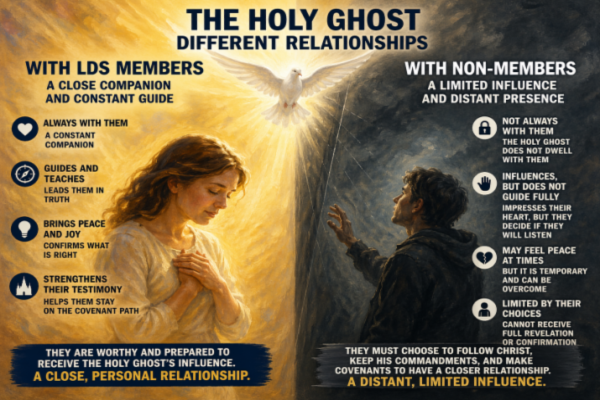
In Latter-day Saint belief, the Holy Ghost influences everyone, but there’s a difference between occasionally feeling His influence and having His ongoing companionship as a gift.
Let’s talk about what that means.
First, the Holy Ghost is understood to be a member of the Godhead, whose role is to testify of truth, comfort us, guide us, and help us grow. That role isn’t limited to Church members. In fact, LDS scripture makes it clear that God is constantly reaching out to all His children.
One of the clearest verses on this comes from the Book of Mormon:
“For behold, the Spirit of Christ is given to every man, that he may know good from evil…” (Moroni 7:16)
That’s a pretty sweeping statement—every man, meaning everyone, has access to divine influence that helps them recognize truth and goodness.
The Bible also echoes this idea. In the book of John, Jesus teaches:
“And when he is come, he will reprove the world of sin, and of righteousness, and of judgment” (John 16:8).
Notice the phrase “the world.” The Holy Ghost isn’t limited to a specific group—He works broadly, inviting all people toward truth.
So yes, according to LDS theology, non-members can absolutely feel the Holy Ghost. They can feel peace when they pray, clarity when they read scripture, or a quiet assurance that something is right. Many Latter-day Saints would say those very experiences are what led them to faith in the first place.
But then comes an important distinction.
After someone is baptized in the Church, they receive what’s called the gift of the Holy Ghost through the laying on of hands by priesthood authority. This isn’t just about feeling the Spirit occasionally—it’s about being given the right to His constant companionship.
The Doctrine and Covenants describes this gift as something that can teach and guide deeply:
“Yea, behold, I will tell you in your mind and in your heart, by the Holy Ghost…” (Doctrine and Covenants 8:2)
That kind of ongoing, personal guidance is what Latter-day Saints believe becomes more fully available after receiving the gift of the Holy Ghost.
Joseph Smith taught this distinction very directly. He explained:
“A man may receive the Holy Ghost, and it may descend upon him and not tarry with him.”
(Teachings of the Prophet Joseph Smith, p. 199)
In other words, anyone can feel the Holy Ghost—but having Him remain with you consistently is something different.
That idea is also emphasized by later Church leaders. President David A. Bednar explained:
“The gift of the Holy Ghost… is the right to have the constant companionship of that member of the Godhead.”
(“Receive the Holy Ghost,” General Conference, Oct. 2010)
That word “right” is important. It doesn’t mean the Spirit is forced to stay—it means the door is open in a more permanent way, as long as a person is striving to live in harmony with that gift.
Because that’s the other side of this: even members don’t feel the Spirit constantly. Agency still matters. Choices matter. The companionship of the Holy Ghost is something that can be invited—or, unfortunately, pushed away.
President Russell M. Nelson has taught:
“In coming days, it will not be possible to survive spiritually without the guiding, directing, comforting, and constant influence of the Holy Ghost.”
(“Revelation for the Church, Revelation for our Lives” General Conference, April 2018)
That statement highlights just how central this companionship is meant to be in a member’s life—not occasional, but steady and essential.
Another important difference in LDS belief is that the Holy Ghost doesn’t just testify of truth—He also sanctifies, meaning He helps people change and become more like Christ. The Apostle Paul taught:
“But ye are washed, but ye are sanctified… by the Spirit of our God” (1 Corinthians 6:11)
Latter-day Saints connect that sanctifying power especially with covenant relationships, including baptism and receiving the gift of the Holy Ghost.
So when you step back and look at the full picture, it might help to think of it this way:
- Non-members can feel the Holy Ghost in real and meaningful ways—especially when seeking truth, doing good, or turning toward God.
- Members who have received the gift of the Holy Ghost are given the opportunity for that influence to become more constant, guiding, and refining in their everyday lives.
But this isn’t about God favoring one group over another. It’s about invitation and response. God is already reaching out to everyone—the gift of the Holy Ghost is a way of choosing to more fully receive and live with that influence.
And honestly, many members would tell you that some of their most powerful spiritual experiences happened before they were baptized. Those moments weren’t lesser—they were invitations.
So if you’ve ever felt a quiet prompting to do something good, a sense of peace during prayer, or a clear impression about what’s right—that’s exactly the kind of experience Latter-day Saints would recognize as the Holy Ghost working in your life.
The difference, in the end, isn’t whether the Holy Ghost is present—it’s how consistently we’re able to receive, recognize, and live with that presence.
Gramps