

Question
Gramps,
I had a question posed to me by a family member about money changers in the temple and Christ’s response, tipping tables, and such, but we still exchange money in the temple for clothes that the church could easily provide without exchanging money there. This does not affect my beliefs, but I don’t know how to answer this.
Jared
Answer
Jared,
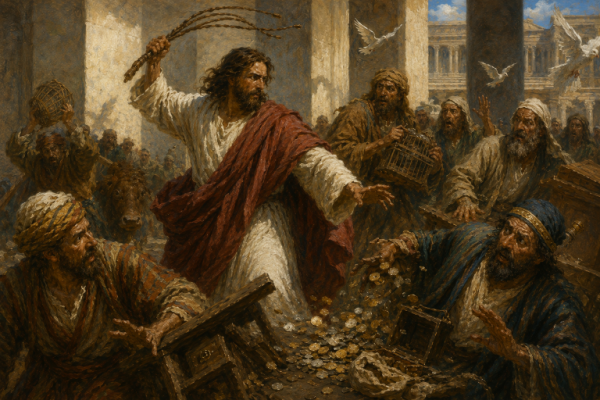
On the surface, it can feel like a contradiction: in the New Testament, Jesus Christ forcefully drives out money changers from the temple, overturning tables and declaring, “Make not my Father’s house an house of merchandise” (John 2:16). Yet today, in temples of The Church of Jesus Christ of Latter-day Saints, there are places where patrons can rent temple clothing, involving a small fee. So what’s going on here? Is this the same thing—or something meaningfully different?
To understand this, it helps to examine why Christ reacted so strongly in His day. The money changers and merchants in the ancient temple weren’t just providing a convenience. They had turned a sacred place into a marketplace, often exploiting worshippers in the process. Pilgrims traveling to Jerusalem needed animals for sacrifice and had to exchange their local currency into temple-approved coinage. This created an opportunity for price inflation, dishonesty, and distraction from the purpose of worship. What should have been a place of reverence and connection with God became noisy, commercialized, and, in some cases, corrupt.
Christ’s response wasn’t just about the presence of money—it was about misuse. The temple had been repurposed in a way that undermined its sacred function. His actions were a defense of holiness, not a blanket condemnation of all transactions connected to religious practice.
Fast forward to modern temples operated by The Church of Jesus Christ of Latter-day Saints, and the situation is quite different in both purpose and spirit. The small exchanges that happen—for example, renting or purchasing temple clothing—aren’t about profit or commerce in the traditional sense. They’re logistical and practical, designed to support worship rather than distract from it.
For one thing, temples are not set up as marketplaces. You won’t find bargaining, advertising, or profit-driven sales floors. The distribution of clothing is quiet, minimal, and handled with reverence. In many cases, the fees involved are meant to cover basic costs like laundering, maintenance, or manufacturing—not to generate income. In fact, the Church heavily subsidizes temple operations overall. Temples are expensive to build and maintain, and they operate without charging admission or fees for ordinances, which are considered sacred and freely given.
There’s also an important principle at play in Latter-day Saint theology: the idea of consecration and participation. Members are often invited to contribute, whether through time, service, or resources, as a way of being spiritually invested in the work. Even small acts—like caring for temple clothing or contributing to its upkeep—can be seen as part of that broader pattern of shared responsibility. It’s not about “buying” access to sacred experiences, but about supporting the environment where those experiences happen.
That said, your question still touches on something real: why not just provide everything freely, with no exchange at all? It’s a fair point. And in many ways, the Church does strive to remove barriers. Individuals who cannot afford clothing or rent are not turned away; accommodations are made. The goal isn’t to exclude, but to ensure that the temple remains accessible while also being sustainably maintained.
Another key difference is intent and atmosphere. In Christ’s time, the temple courts had become crowded, noisy, and transactional to the point that their spiritual purpose was overpowered. In modern temples, every effort is made to preserve peace, order, and a sense of sacredness. The presence of a small logistical exchange doesn’t dominate the experience or redefine the space’s purpose. If anything, it’s intentionally kept in the background so worship remains central.
It might help to think of it this way: not all uses of money in a religious setting are equal. There’s a meaningful distinction between profiting from worship and facilitating worship. Christ condemned the former. Modern temple practices aim for the latter.
Still, questions like yours are valuable because they invite reflection. They push us to examine whether our practices align with our principles. And in a faith that places high importance on both scripture and continuing guidance, that kind of thoughtful engagement matters.
In the end, the heart of the issue comes back to what the temple is meant to be: a place set apart, focused on God, free from exploitation and distraction. Christ’s cleansing of the temple was a call to protect that sacred purpose. Modern practices, when done carefully and reverently, are intended to support—not undermine—that same goal.
If anything, your question echoes the same concern Christ had: keeping holy things truly holy. And that’s a question worth asking at any time and in any setting.
Gramps