
Question
Gramps,
If God can’t create from nothing, how did he multiply the bread and fish to feed the 5000?
Unknown
Answer
Unknown,
(This question was asked in response to the article: Do I believe scientists or doctrine? Can matter be created?)
To understand this, it helps to begin with what Latter-day Saints believe about the Creation. One of the distinctive teachings of The Church of Jesus Christ of Latter-day Saints is that God did not create the universe out of absolutely nothing. Rather, Latter-day Saints believe that matter is eternal and that God organized existing matter to bring order, purpose, and life to His creations. This understanding is reflected in Doctrine and Covenants 93:33, which teaches, “For man is spirit. The elements are eternal, and spirit and element, inseparably connected, receive a fulness of joy.”
We also see this idea reflected in the account of the Creation in the Book of Abraham. Abraham 4:26 describes the Gods taking counsel and forming man in their image, using the dust of the earth. The language is interesting because it describes the organization of existing material rather than the creation of matter from nothing. This is different from the traditional Christian understanding of creation ex nihilo, a Latin expression meaning creation out of nothing.
So, how does this understanding fit with Jesus multiplying the bread and fish?
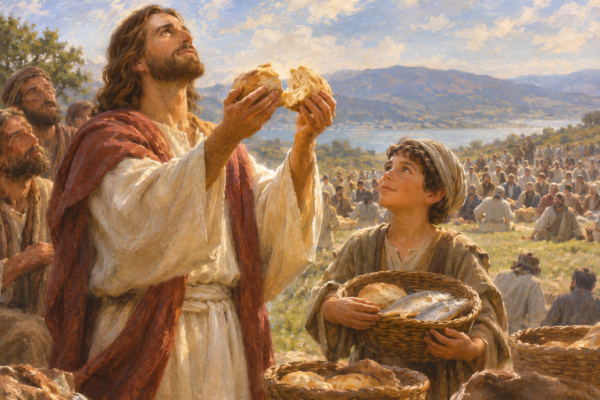
All four Gospels record the miracle of feeding the 5,000, although John’s account gives us some additional details. In John 6:5-13, Jesus sees a large crowd approaching and asks Philip where they could buy bread to feed everyone. Philip points out that even 200 pieces of silver wouldn’t be enough to feed everyone a little. Andrew then mentions a young boy who has five barley loaves and two small fishes, but he understandably wonders what such a small amount could possibly accomplish among so many people.
Jesus takes the food, gives thanks, and distributes it to the people. The account says everyone ate as much as they wanted. When they had finished, Jesus instructed His disciples to gather the remaining fragments so that nothing would be lost. They collected twelve baskets of leftovers from the original five barley loaves. Think about that for a moment. Five loaves and two fish had fed thousands of people, and there was still food left over!
John’s account doesn’t describe the physical process by which this happened. It simply records that Jesus performed the miracle. We aren’t told whether the food multiplied as Jesus blessed it, as the disciples distributed it, or through some other process. What we do know is that the Savior took what was available and, through His divine power, made it sufficient to feed an enormous crowd.
One possible explanation, consistent with Latter-day Saint teachings about eternal matter, is that Jesus caused the existing food to multiply through His power over the elements. In other words, He could have caused additional bread and fish to come into existence by organizing and directing matter that already existed. However, we should be careful not to present this as the exact explanation, because the scriptures don’t tell us how the miracle occurred physically. They leave that part to our imagination.
We actually find another example of the Savior exercising power over existing elements in John 2:1–11, when He turns water into wine at the wedding feast in Cana. Jesus doesn’t simply announce that wine exists. He takes water that is already present and transforms it into something entirely different. Once again, the scriptures don’t explain the scientific process behind the transformation. They simply tell us that Jesus performed the miracle. Both accounts demonstrate that the Savior has power over the physical world in ways we cannot fully comprehend.
We see a related principle in the Book of Mormon when the Lord commands Nephi to build a ship. In 1 Nephi 17:8–10, Nephi is given a task that is far beyond his experience and abilities. Yet the Lord promises to show him how to construct it. Nephi eventually builds the ship using materials available to him, following the Lord’s instructions and relying on divine help. Although this isn’t the same kind of miracle as multiplying food, it illustrates how God can direct the use of existing materials to accomplish things that would otherwise seem impossible.
This brings us back to the original question. If matter is eternal, does that somehow make God less powerful? According to Latter-day Saint theology, it doesn’t. Believing that God works with eternal matter doesn’t mean He is limited by what limits us. He understands the elements, knows how they work, and possesses power over them in ways we cannot begin to understand. The fact that we don’t know exactly how He performs a miracle doesn’t mean the miracle is any less real.
Consider some of the other things Jesus accomplished during His mortal ministry. He healed the blind, made the lame walk, calmed raging seas, and even raised the dead. We can describe what happened in each instance, but we cannot explain the divine power behind those miracles in scientific terms. We simply recognize that Jesus Christ possessed power far beyond anything available to ordinary mortals.
Ultimately, the miracle of feeding the 5,000 doesn’t contradict the Latter-day Saint understanding of eternal matter. The most reasonable explanation, consistent with that belief, is that Jesus used His divine power to multiply the food that was already available. We don’t know precisely how He accomplished it, and the scriptures don’t require us to know.
Perhaps the greater lesson from this miracle isn’t figuring out the mechanics of how five loaves became enough to feed thousands. It’s recognizing what the Savior can do with what little we have to offer. The young boy had only five loaves and two fish, but when placed in the hands of Jesus Christ, that small offering became more than enough.
And perhaps that’s a lesson worth remembering in our own lives. We may sometimes feel that what we have to offer isn’t enough, whether it’s our abilities, our knowledge, our faith, or our efforts to serve others. But the Savior has a way of making more out of what we bring than we could ever accomplish on our own.
Gramps