

Question
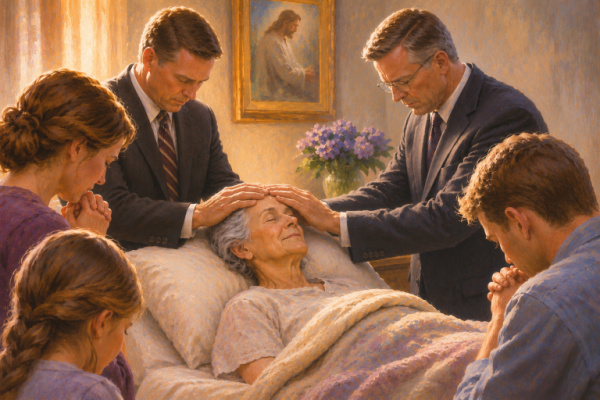
When my father was suffering from Parkinsons and Lewy Body Dementia, he was given a blessing of release by our Stake President and other priesthood holders, and passed away within 2 weeks. Years later, my mother– although not diagnosed with anything that could be considered “end of life”, has so many illnesses and frailties (deafness, blindness, unable to walk, unable to keep food down, etc) that she has basically no quality of life left. Is it appropriate to ask for this blessing?
Crista
Answer
Crista,
When someone we love reaches a point in life where illness, physical limitations, and declining health have taken away much of their ability to enjoy life, we naturally begin asking difficult questions. We want them to be comfortable; we want them to have peace, and sometimes we wonder whether it might be time for the Lord to release them from their mortal suffering.
Consider a family who watched their father suffer from Parkinson’s disease and Lewy body dementia. As his condition continued to decline, the stake president and other Melchizedek Priesthood holders gave him what the family understood to be a blessing of release. Within two weeks, he passed away. Years later, their mother is experiencing a different situation. Although she has not received a diagnosis indicating that she is nearing the end of her mortal life, she has numerous serious health problems. She is deaf, blind, unable to walk, unable to keep food down, and has very little quality of life remaining. Naturally, the family wonders whether it would be appropriate to ask for a similar blessing for her.
The short answer is yes. It is appropriate to seek priesthood counsel and a blessing for someone experiencing severe illness and suffering, even when there is no formal terminal diagnosis. However, there are some important principles of Latter-day Saint doctrine to understand.
First, the Church does not have a separate, standardized priesthood ordinance officially called a “blessing of release” with specific requirements that must be met before receiving it. Members sometimes use this expression to describe a blessing in which priesthood holders seek the Lord’s will concerning a person’s remaining mortal life, comfort, peace, and possible release from suffering. The Church does, however, provide clear instructions concerning blessings for the sick and afflicted.
In General Handbook section 18.13, the Church explains that administering to the sick is normally done at the request of the person receiving the blessing or at the request of others who are concerned. The ordinance involves anointing with consecrated oil and sealing that anointing with a priesthood blessing. Worthy Melchizedek Priesthood holders may perform this ordinance without needing approval from a priesthood leader.
Elder Dallin H. Oaks addressed the availability of priesthood blessings in his April 1987 General Conference address, Priesthood Blessings. He explained that there are many kinds of priesthood blessings and reminded Church members:
“Priesthood blessings are available for all who need them, but they are given only on request.”
This is an important principle because it reminds us that blessings are not reserved for those with a particular medical diagnosis. Serious illness, physical affliction, and suffering are all appropriate reasons to seek the Lord’s help through priesthood blessings.
One of the most important scriptures concerning priesthood blessings is found in Doctrine and Covenants 42:43-48. These verses teach that the sick should be nourished with tenderness and that healing can come through faith and the power of the priesthood. However, they also help us understand that healing is ultimately subject to the Lord’s will. A priesthood blessing is not a guarantee that someone will recover, nor is it a way for us to determine exactly when another person’s mortal life should end.
Sometimes the Lord grants physical healing, while other times He provides the strength to endure difficult circumstances. Elder Oaks addressed this beautifully in his October 2006 General Conference address, He Heals the Heavy Laden. He explained:
“Healing blessings come in many ways, each suited to our individual needs, as known to Him who loves us best. Sometimes a ‘healing’ cures our illness or lifts our burden. But sometimes we are ‘healed’ by being given strength or understanding or patience to bear the burdens placed upon us.”
I think this teaching is especially meaningful when considering someone who has reached a point where physical recovery may no longer be realistic. Healing does not always mean that a person will regain their health or physical abilities. Sometimes the Lord’s blessings come through comfort, peace, understanding, and the strength to endure. It also reminds us that we can approach Heavenly Father with our concerns without assuming we already know His answer.
The Church addresses another important aspect of this subject in General Handbook section 38.7.11, titled “Prolonging Life (Including Life Support).” The handbook teaches that when members face severe illness, they should exercise faith in the Lord and seek competent medical assistance. However, when dying becomes inevitable, it should be seen as a blessing and a purposeful part of eternal existence. It also explains that members should not feel obligated to extend mortal life through extreme means. Decisions concerning life support and other medical measures should be made by the individual, when possible, or by family members, with competent medical advice and divine guidance through prayer.
This is an important distinction. LDS doctrine does not teach that every possible effort must always be made to prolong mortal life, regardless of the suffering involved or the circumstances. There is also no published Church policy stating that someone must have a terminal diagnosis before family members can request a priesthood blessing for comfort, healing, or guidance. A person may have several serious health conditions that individually are not considered terminal but collectively leave them extremely frail and dependent on others. In such circumstances, it is entirely reasonable for family members to speak with their bishop or stake president about their concerns.
Of course, a blessing should not be viewed as a request for priesthood holders to decide that someone’s life should end. Rather, it is an opportunity to seek the Lord’s will and ask for His guidance, comfort, and mercy. If the person is mentally capable of expressing their wishes, those feelings should be central to the decision. If they want a blessing, they can request one themselves. If they cannot communicate or make decisions, family members who are deeply concerned about their welfare can seek appropriate priesthood counsel and support.
I also think it is important to recognize the difference between wanting someone to die because caring for them has become difficult and wanting someone to be released from a life filled with seemingly endless suffering. The latter can come from a place of genuine love and compassion. We believe that death is not the end of existence. Through the Atonement and Resurrection of Jesus Christ, mortality is temporary, and physical suffering will not continue forever. In 2 Nephi 9:6, Jacob teaches about the necessity of the Resurrection and the Lord’s plan to overcome death. That understanding can bring considerable comfort when someone we love is nearing the end of mortality.
It is perfectly appropriate to pray that the Lord will ease someone’s suffering, provide comfort, and, if their mortal journey is complete, allow them to return to His presence in His own time. At the same time, we should never assume that a blessing will necessarily result in death or that the timing of someone’s passing is something priesthood holders can control.
Elder Oaks explained this principle particularly well in his April 2010 General Conference address, Healing the Sick. He taught:
“Faith and the healing power of the priesthood cannot produce a result contrary to the will of Him whose priesthood it is.”
He went on to explain that even when there is sufficient faith for healing, a priesthood blessing cannot cause someone to be healed if that healing is not the Lord’s will. Near the conclusion of that same address, Elder Oaks offered another thought that is especially meaningful for families facing these difficult circumstances:
“We do all that we can for the healing of a loved one, and then we trust in the Lord for the outcome.”
That is an important principle to remember. We can pray, exercise faith, seek priesthood blessings, obtain medical care, and do everything reasonably possible for someone we love. But ultimately, we must trust Heavenly Father with the outcome. I would also encourage the family to make sure the mother’s medical needs are being evaluated. Being unable to keep food down, for example, warrants prompt medical attention, even when the greater concern is a declining quality of life.
So, is it appropriate to approach the bishop or stake president and ask about a blessing for the mother? Absolutely. The family can explain what she is experiencing, describe her declining quality of life, and share the experience they had with their father. They can then ask whether the priesthood holders would be willing to come and offer a blessing, seeking the Lord’s will concerning her health, comfort, and remaining mortal journey. There is no need to insist that the blessing contain particular words or that it result in a particular outcome.
Ultimately, the Lord knows when someone’s mortal journey is complete. Our responsibility is to exercise faith, show compassion, seek appropriate medical care, and trust Him. Sometimes the greatest expression of faith is asking for healing. Other times it is asking for strength to endure. And sometimes, when someone has endured tremendous suffering, it is simply asking Heavenly Father to grant them peace.
We should never feel guilty for wanting someone we love to be free from suffering. That desire, when rooted in love and respect for their wishes, is a very human expression of compassion. We can trust that Heavenly Father understands both the suffering of the person who is ill and the hearts of the family members who love them.
Gramps
Related Posts
 What was the Church’s stance on the Saints living under Hitler in Nazi Germany?
 Is it better to say receive endowment or take out endowment?
 When blessing a baby, do we ask the Lord for blessings or pronounce blessings on the baby?
 Is it an act of faith or a lack to faith to repeatedly importune our Father in Heaven on behalf of a loved one who is ill?