

Question
Gramps,
What is the difference between Communism and the Law of Consecration? Thank you.
Ryan
Answer
Ryan,
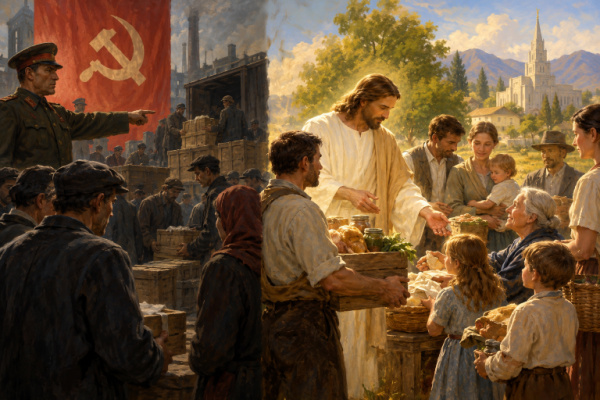
The law of consecration and communism may appear similar because both involve sharing resources and helping the poor, but according to LDS doctrine, they are fundamentally different. The law of consecration is a covenant with God in which individuals willingly dedicate their time, talents, and resources to the Lord and use them to care for others. Communism, as a political and economic system, generally seeks collective ownership of property and economic resources, often through government control. The biggest difference is that the law of consecration is based on faith, voluntary commitment, personal stewardship, and charity rather than political authority or forced economic equality.
The law of consecration is a principle that comes directly from the teachings of Jesus Christ. In Doctrine and Covenants 42:30, the Lord instructed members of the Church to remember the poor and consecrate their properties for their support. The purpose was not simply to redistribute wealth, but to establish a society in which people loved one another, cared for those in need, and willingly dedicated their resources to the Lord.
This principle is closely connected to the idea that everything ultimately belongs to God and that we are stewards of the blessings He has given us. Doctrine and Covenants 104:14 teaches that the Lord created the earth and that everything in it belongs to Him. From an LDS perspective, our possessions are not simply things we own for our own benefit. They are blessings entrusted to us, and the Lord expects us to use them responsibly. Consecration means recognizing that responsibility and being willing to dedicate our resources, talents, time, and abilities to His purposes.
When the law of consecration was introduced to the early Saints, members were expected to consecrate their property to the Lord through the Church. The bishop would then help determine what each family needed for its support. Families received stewardships and were responsible for managing those resources. Any remaining resources could be used to help the poor, support the Church, and accomplish the Lord’s work. The goal was to provide for everyone’s needs while encouraging people to work, become self-reliant, and use their talents wisely.
This is where the law of consecration begins to differ from communism. Communism, as generally understood, seeks collective ownership of the means of production and, in many historical examples, has involved government control over property, industries, and economic decisions. The law of consecration, however, is not based on government ownership or political force. It is based on a covenant between individuals and God. Members willingly dedicate their resources because they believe those resources ultimately belong to the Lord and should be used according to His will.
Another important difference is that the law of consecration does not teach that everyone must have exactly the same amount of property, income, or possessions. Instead, the objective is to make sure that people have what they need while encouraging those who have more to help those who have less. Doctrine and Covenants 51:3 explains that individuals were to receive portions according to their circumstances, needs, and wants. This recognizes that families have different circumstances and that their stewardships need not be identical.
The law of consecration also emphasizes personal responsibility. Members are expected to work, manage their resources wisely, care for their families, and help others whenever possible. Those who receive assistance are encouraged to become self-reliant as their circumstances allow. The purpose of helping someone is not simply to provide temporary relief, but also to strengthen them and help them become more capable of meeting their own needs. This principle continues today through the Church’s welfare program, which emphasizes both compassion and self-reliance.
President Spencer W. Kimball explained during General Conference in 1977 that consecration involves giving our time, talents, and means to care for those in need and build the Lord’s kingdom. His teachings make it clear that consecration involves much more than transferring money or property. It includes how we serve others, how we use our abilities, and whether we are willing to put the Lord’s purposes ahead of our own selfish interests.
There is also a difference in the ultimate purpose of the two systems. Communism is generally concerned with organizing economic resources and establishing a particular political and economic structure. The law of consecration is concerned with preparing people to become a Zion society, where individuals are united through faith in Jesus Christ and genuine love for one another. Doctrine and Covenants 97:21 describes Zion as “the pure in heart,” while Doctrine and Covenants 82:19 teaches that the Lord’s people should seek the interests of their neighbors and do all things with an eye single to His glory.
The early Saints attempted to live these principles through the United Order, but their efforts were not always successful. The historical experience of the United Order does not mean that the principles of consecration have been abandoned. Rather, the Church continues to teach that members should dedicate their lives and resources to the Lord according to their circumstances and responsibilities. Today, members are encouraged to live consecration through paying tithing, serving in Church callings, helping those in need, supporting their families, and using their blessings to accomplish good.
So, is the law of consecration the same as communism? According to LDS doctrine, no. Although both may involve concern for the poor and the use of resources to benefit others, their foundations are different. The law of consecration is a religious covenant based on voluntary devotion to God, stewardship, work, charity, and personal responsibility. Its purpose is not simply to create economic equality, but to establish Zion, a society in which people love God and one another enough to willingly share their blessings and make sure that those in need are cared for.
The central difference is that the law of consecration is not merely about who owns property or how wealth is distributed. It is about recognizing that everything ultimately belongs to the Lord and choosing to use our blessings according to His will.
Gramps