
Question
Gramps,
I really like the verse in 1 Nephi 21:16, which is also in Isaiah: 16 Behold, I have graven thee upon the palms of my hands; thy walls are continually before me. What does it mean when it says thy walls are continually before me? Is it referring to a specific wall?
Melissa
Answer
Melissa,
Melissa,
There are so many interpretations of this verse that we cannot go over all of them. And, frankly, I have difficulty accepting some of them that I hear. But as we consider the various interpretations, we must take a closer look at context (both historical and textual).
First, this is Isaiah, whose words and prophecies are unequalled among mortal men. And chief among all the subjects of his prophecies were those of the Savior.
One major trait of Isaiah’s writings is that he switches positions as he narrates events in his own day, then goes on to prophesy of coming events, then to far future events (both the Savior’s mortal ministry and the latter days).
Another trait was that he was so skilled that he accomplished something unparalleled. He wrote many verses which simultaneously spoke of his own day, the Savior’s day, and the latter days, using a single phrase.
And he shall set up an ensign for the nations, and shall assemble the outcasts of Israel, and gather together the dispersed of Judah from the four corners of the earth. (Isaiah 11:12)
This referred to both the initial diaspora (The Babylonian Scattering and Persian Gathering) as well as the global diaspora after the destruction of the Second Temple. And it included the latter-day gathering of which we are in the middle stages.
So, keeping this writing style in mind, I’d point to the verses that are the subject at hand:
Can a woman forget her sucking child, that she should not have compassion on the son of her womb? yea, they may forget, yet will I not forget thee.
Behold, I have graven thee upon the palms of my hands; thy walls are continually before me. (Isaiah 49:15-16)
Meaning of “graven thee on the palms of my hands”:
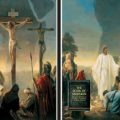
Of course, this refers to the Crucifixion and Atonement. But let me peel away a layer of the depth of what that did to our relationship with the Savior.
The two preceding verses speak of how He will never forsake us. Then in verse 16, He evokes the hands as a symbol of familiarity & identity.
- We often have a saying today: “I know it like the back of my hand.” It could just as easily be said of the palms of the hands.
- Both the Babylonians and Chinese used fingerprints and palm prints to sign contracts (forget what Pudd’nhead Wilson made a generation believe). It was a distinguishing mark in an era when most people were illiterate.
So, He knows each and every one of us as a mother knows her suckling child. And the invoking of the Crucifixion reminds us of His relationship to us. His identity is that of the Savior. Our identity is that of the saved. He knows us each intimately. He knows our joys and our sorrows. And He feels them just as we do.
We are His. And He will keep those tokens until the final resurrection.
Meaning of walls:
In this context, walls represent two things:
Jerusalem was the Zion of that era. The walls represented protection for all inhabitants of Zion. So, protection was one aspect.
Walls also defined the city limits. What was most important about the city limits? It was a matter of culture, customs, and people. It was their way of life that was known, copied, and repeated. Most importantly, it was the home of the temple. And the works of our hands are particularly important within the temple walls.
So, to summarize the meanings:
- He sorrows over the fall of Jerusalem as a city, and the scattering of the House of Israel as a people.
- Hope and promise of the redemption & gathering of Israel.
- The dead who have been and are waiting to be redeemed by temple ordinances and praise for those who do the redeeming.
- Graven on His palms as a sign of the crucifixion, and He can do (hands) nothing without remembering His people. We are the works of His hands.
Gramps