

Question
Gramps,
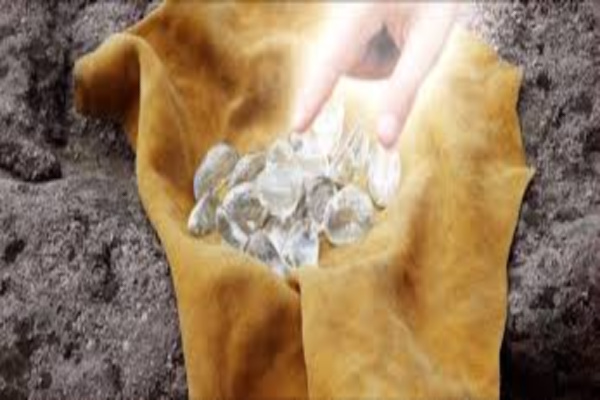
I have always wondered what happened to the sixteen clear stones touched by the finger of the Lord for the Brother of Jared? I can find nothing in the scriptures. Has any prophet ever weighed in on this matter?
Ken
Answer
Ken,
This is another one of those questions that we really don’t have an answer for.
When the Lord commanded the Jaredites to construct barges to cross the “raging deep,” He made clear that conventional sources of light would not suffice. They could not have windows, which would be “dashed in pieces,” nor could they “go by the light of fire” (Ether 2:23–25). Confronted with this dilemma, the brother of Jared demonstrated both resourcefulness and humility. He “molten out of a rock sixteen small stones; and they were white and clear, even as transparent glass,” and petitioned, “Touch these stones, O Lord, with thy finger, and prepare them that they may shine forth in darkness… that we may have light while we shall cross the sea” (Ether 3:1, 4).
In response, the Lord touched the stones, imbuing them with a divine light. This miraculous event not only provided the needed illumination but also served as a catalyst for a profound spiritual experience. When the brother of Jared saw the Lord’s finger, the “veil was taken from off [his] eyes,” and he was permitted an extraordinary vision of the Lord and of all things that had been and would be upon the earth. This encounter famously typifies the principle that human efforts and divine intervention work hand in hand, with God magnifying faithful initiative.
One of the deepest themes in this episode is the balance between human agency and God’s grace. The Lord did not specify how the problem of light should be solved, but rather asked, “What will ye that I should prepare for you?” This posed a challenge: act in faith, use your intellect and effort, and then come to me. The brother of Jared’s solution—melting stones and pleading for divine power—became the means for a miracle.
Hugh Nibley, a prominent Latter-day Saint scholar, notes, “man cannot save himself after all, and yet God requires him to perform acts of obedience demanding both brain and brawn before He will help him.” The pattern is instructive: when we do all we can, the Lord steps in to do what we cannot.
Skeptics have sometimes dismissed the Jaredite shining stones as fanciful or nonsensical. However, a closer look at ancient sources reveals a surprising prevalence of similar legends—luminous stones and pearls that provide light in times and places of deep darkness.
Jewish and Near Eastern traditions bear a striking resemblance to the Jaredite account. Several sources report that God provided Noah with a glowing stone or pearl to bring light into the Ark during the flood. In some Jewish texts, it is described that when “the Lord told Noah to construct… the ark,” he was instructed to set a precious gem or crystal inside, which would “glow during the night and grow dim during the day” so that Noah could mark the passage of time. This is related to the mysterious “sôhar” of Genesis 6:16, a word variously translated as “window” or as “light” in ancient versions.
Other traditions mention similar wonders. The tale of Jonah describes, in some rabbinic sources, how “a pearl being suspended inside the fish” illuminated Jonah’s sojourn in the depths. Mandaean, Arab, and even some Christian sources speak of pearls and crystals that radiate divine light, often serving as guidance, revelation, or preservation through dark and dangerous circumstances.
The motif of luminous stones does not end with the Jaredite narrative. In biblical Israel, the mysterious Urim and Thummim—objects used by priests to receive revelation—are believed by some traditions to have been shining stones. Early Christian writings, like those of Ephraem of Syria, likewise associate pearls and gems with light, knowledge, and the divine presence.
The Lord’s instructions to the brother of Jared merged this motif of glowing stones with later traditions of sacred “interpreter” stones. As part of the Jaredite account, the Lord gives to the brother of Jared “two stones… to seal them up also with the things which ye shall write,” promising that, “these stones shall magnify to the eyes of men these things which ye shall write,” connecting the concept of “shining stones” both to literal light and to the light of revelation. This linkage finds echoes in later scripture, such as in the promise that those who overcome will receive a “white stone” as a Urim and Thummim (Revelation 2:17; Doctrine and Covenants 130:10–11).
Beyond questions of plausibility, the shining stones serve as a radiant thread weaving together themes of revelation, temple symbolism, and the process by which humans approach the divine.
Mount Shelem, where the brother of Jared fashioned and presented the stones, is significant in itself. Latter-day Saint and biblical theology alike point to mountains as sacred settings for revelation—places where prophets commune face-to-face with God. This pattern is seen in the experiences of Moses, Nephi, and even Christ Himself. Thus, the actions of the brother of Jared become, in a sense, a “temple” pattern: ascent to holy ground, confrontation with the limits of mortality, and the receiving of God’s light and presence.
Latter-day Saint commentators have drawn connections between the white stones of Ether 3 and the “white stone” promised to the faithful in Revelation 2:17—a symbol tied explicitly in Latter-day Saint doctrine to the Urim and Thummim, instruments for gaining knowledge of higher spiritual things (Doctrine and Covenants 130:10–11). The stones thus become not merely sources of physical light, but tokens of the knowledge and revelation available to those who approach God in faith.
The Lord’s subsequent command that the brother of Jared should “seal up” the account of his vision and the stones resonates with temple themes of hidden knowledge, revelation kept in reserve for a future time, and the promise that the full measure of the Lord’s teachings will one day be revealed (Ether 3:22–24). As with the stones, the true and full illuminating power will be revealed in God’s “due time.”
The story of light-giving stones in the barges has, at times, been ridiculed for its supernaturalism. But as John Tvedtnes notes, the “idea of stones that glow in the dark may seem strange to the modern mind, such beliefs were widespread in earlier times.” Traditions abound from the ancient Near East, medieval Jewish lore, Christian texts, and even Arabian legends of stones, crystals, and gems that provided light, knowledge, or protection by God’s power.
It is especially notable that many of these ancient traditions only came to light in modern scholarship well after the coming forth of the Book of Mormon. The convergence between the Jaredite shining stones and these ancient motifs lends weight to the Book of Mormon’s self-portrayal as a record deeply grounded in the patterns and beliefs of the ancient world, not a mere invention of the nineteenth century.
Gramps
Related Posts
 Why are the biblical passages cited in the Book of Mormon essentially identical with those in the Bible?
 What evidence is there that steel was used on the American continent during Book of Mormon times?
 How do I best prepare myself for the return of my missionary boyfriend?
 According to the Book of Mormon, when did the Lamanites skin turn a dark color?